

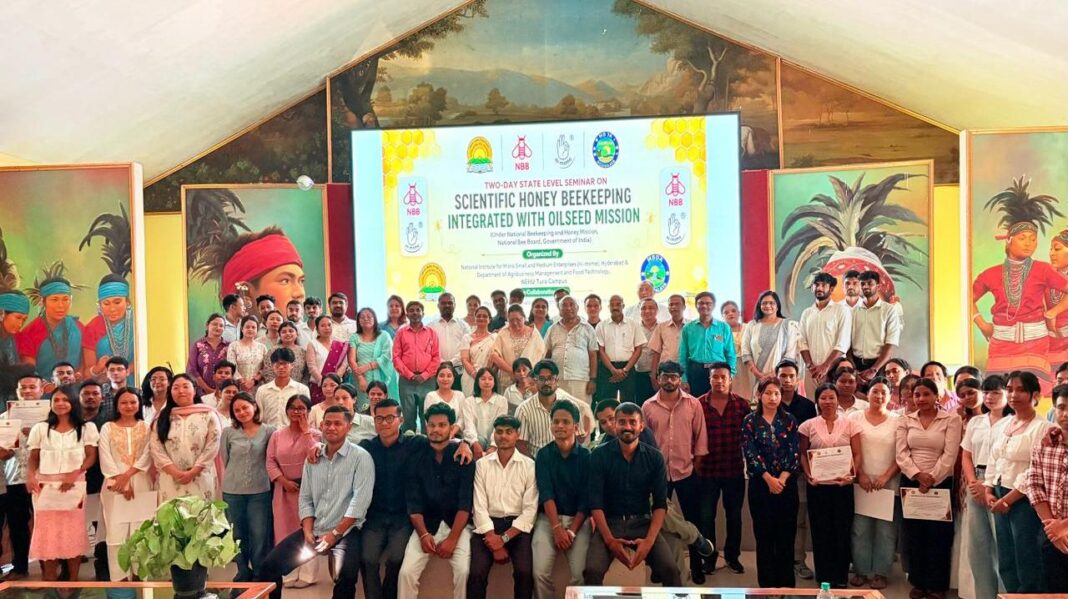

Tura, June 6: Could the humble honeybee help power Meghalaya’s rural economy?
That was the central message emerging from a two-day State-Level Seminar on Scientific Honey Beekeeping Integrated with Oilseed Mission that concluded at NEHU’s Tura Campus, where experts, policymakers, entrepreneurs and farmers came together to explore how scientific apiculture can boost farm incomes, strengthen food security and create sustainable livelihood opportunities across the state.
Organised by the National Institute for Micro, Small and Medium Enterprises (ni-msme), Hyderabad, in collaboration with NEHU Tura Campus and the Meghalaya Basin Development Authority (MBDA), the seminar drew around 250 participants and featured 26 technical deliberations covering horticulture-oilseed synergies, scientific honey processing, quality control, value addition, agribusiness marketing and advanced beekeeping technologies.
Participants highlighted that beekeeping should no longer be viewed merely as a traditional activity but as a modern rural enterprise capable of generating income while simultaneously improving agricultural productivity through pollination.
Experts noted that integrating bee colonies with oilseed cultivation can significantly enhance crop yields through cross-pollination while creating additional revenue streams through honey, beeswax and other bee-based products.
The seminar concluded with a series of recommendations aimed at building a robust apiculture ecosystem in Meghalaya. These included establishing regional honey-testing laboratories, scientific processing hubs, institutional support for farmer entrepreneurs, stronger market linkages, wider adoption of modern beekeeping practices and greater participation on the Madhukranti portal.
Delegates also advocated promoting cross-pollination by placing bee boxes in oilseed farms and creating community-led migratory bee corridors to address seasonal foraging challenges and support ecological sustainability.
The valedictory session was attended by Prof. Deepak Bhagat, Deputy Project Director Augustus S. Suting of MBMA, Prof. Jyoti V. Vastrad, Dean of the College of Community Science, CAU Tura, and Prof. F.K. Marak, Pro Vice-Chancellor of NEHU Tura Campus. Special recognition awards were presented to Joseph Basumatary and V. Valentine Hembrom for their contributions to promoting scientific beekeeping in Meghalaya.
At a time when states across the country are exploring sustainable, nature-based economic opportunities, the seminar positioned scientific beekeeping as a promising avenue for Meghalaya. If the recommendations are translated into policy and practice, experts believe the tiny honeybee could become a powerful ally in strengthening rural livelihoods, supporting agriculture and building a more resilient local economy.