

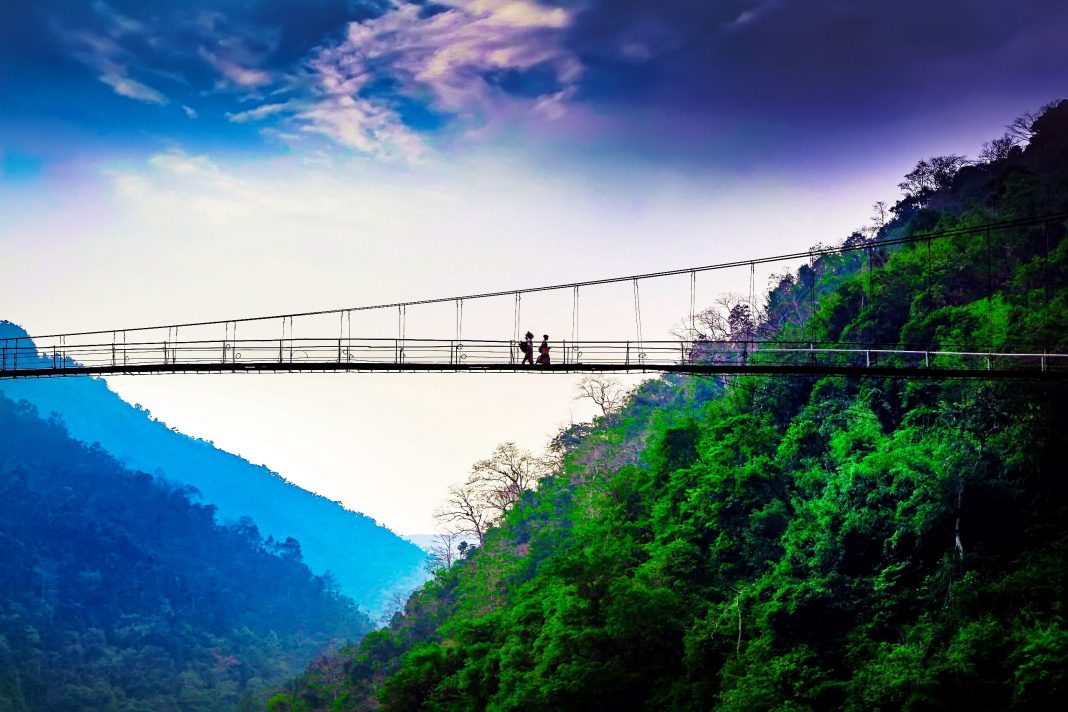

Record tourist footfall, luxury stays and Instagram-driven travel culture are transforming Meghalaya from a backpacker haven into one of India’s fastest-rising premium destinations.
Urmi Bhattacharjee
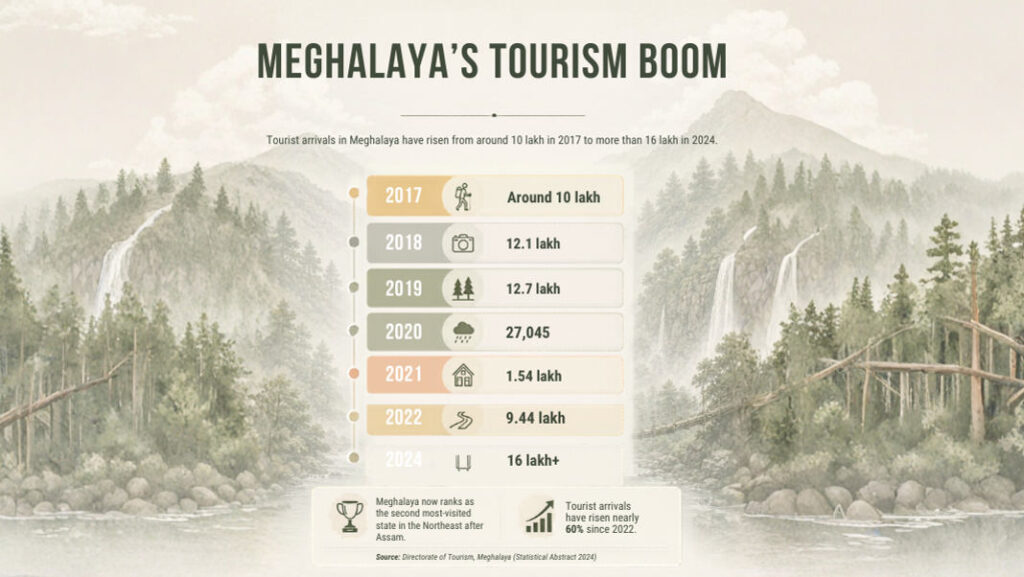
Shillong, May 10: Tourist arrivals in Meghalaya have risen from around 10 lakh in 2017 to more than 16 lakh in 2024, reflecting how rapidly the hill state has moved from being an offbeat backpacker destination to one of India’s most talked-about travel hotspots.
The numbers tell only one part of the story though.
Meghalaya today occupies far more space in India’s digital travel imagination than its actual tourism volume suggests. Despite being a relatively small hill state with limited urban infrastructure compared to larger tourism economies, Meghalaya has become one of the country’s most visually recognisable travel destinations online.
The state is now ranked as the second most-visited destination in the Northeast after Assam, according to DoNER-linked tourism references and regional tourism data. Tourism operators say the pace of growth over the last few years has been unlike anything Meghalaya witnessed earlier.
There was a time when Meghalaya felt like a place travellers discovered slowly. Somebody would return from Shillong speaking about music cafés hidden inside narrow lanes. A biker would describe the drive to Sohra through clouds and rain. Friends passed around photographs of Dawki’s clear waters and the living root bridges, usually blurry pictures taken on old phones, yet magical enough to make others curious.
The state carried an almost quiet charm then. Tourism existed, certainly, though it still felt personal, unhurried and slightly removed from the mainstream travel circuit.
That atmosphere has changed dramatically over the last few years.
Today, Meghalaya appears everywhere on social media feeds. Reels of waterfalls pouring down dark cliffs, drone shots floating over green valleys, videos of couples walking through mist-covered hills, café aesthetics from Shillong and cinematic drives through Sohra have pushed the state into the centre of India’s online travel imagination.
The transformation is visible beyond the internet as well. Hotels are expanding, boutique stays are appearing across hill towns and the state government itself is now openly speaking about luxury tourism and premium travel experiences as part of Meghalaya’s next phase of growth.
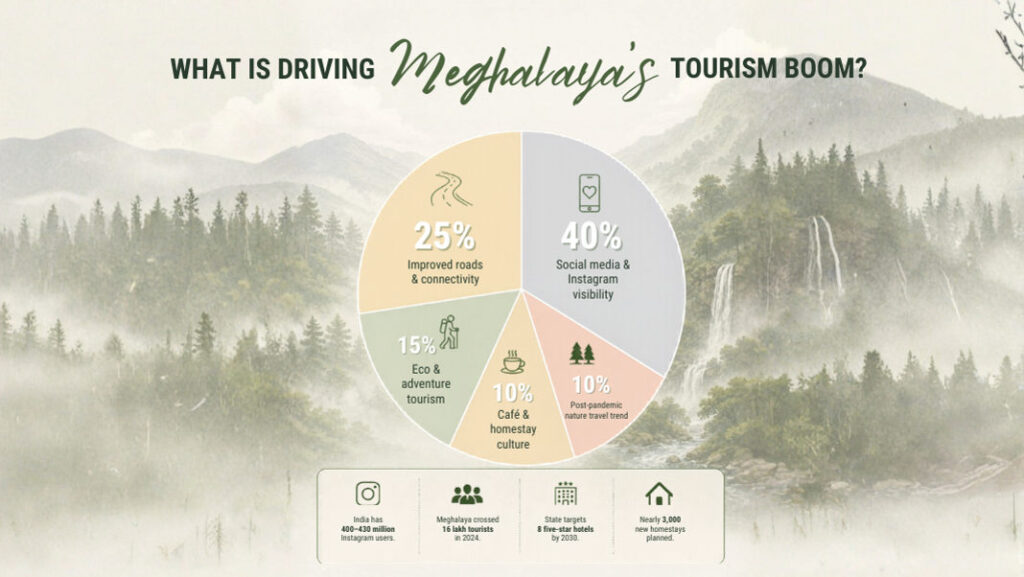
Chief Minister Conrad Sangma has already outlined plans to position Meghalaya as a high-value tourism destination through luxury infrastructure, eco-tourism projects and premium hospitality initiatives. The state is targeting eight five-star hotels by 2030 while also planning nearly 3,000 additional homestays to accommodate increasing visitor demand.
Industry estimates and travel listings also show a visible rise in boutique hospitality properties across Shillong, Sohra and Dawki over the last five years. Premium cottages, designer homestays, luxury camps and experience-focused stays have rapidly expanded, particularly in areas popular among younger travellers and social media influencers.
The Instagram effect
 Travel itself has changed in India over the past few years, and Meghalaya seems to have arrived at exactly the right moment.
India currently has between 400 million and 430 million Instagram users, making it the platform’s largest market in the world. Much of this user base belongs to younger travellers between 18 and 34 years of age, a generation that increasingly discovers destinations through reels and short videos rather than travel brochures or guidebooks.
Tour operators in Shillong say many visitors now arrive with entire itineraries already saved on their phones. Some want photographs at the same viewpoints they saw online. Others search for hidden cafés, glamping sites or private stays that recently became popular through travel influencers.
Meghalaya fits naturally into this kind of visual travel culture. The state’s landscape changes quickly within short distances. Waterfalls, forests, caves, rivers and hill viewpoints often appear within a single road trip, making the region ideal for short-format travel content and fast-moving itineraries.
Places like Dawki, Laitlum, Umiam and the living root bridges have become instantly recognisable online, especially among young urban travellers looking for nature-focused holidays. Meghalaya photographs unusually well during monsoons and winter alike, and tourism operators say cinematic drone footage and travel reels have significantly amplified the state’s visibility across India.
Earlier, tourists often discovered Meghalaya through word of mouth or travel magazines. Today, many first encounter the state through a reel that appears while scrolling on a phone screen late at night.
The online visibility has also created a powerful perception around Meghalaya. Social media narratives frequently describe the state as untouched, magical and among India’s must-visit destinations. Influencers, vloggers and travel pages continue to push Meghalaya as an escape from crowded urban life, especially for younger Indians searching for aesthetic, nature-focused travel experiences.
From budget travel to premium tourism
The tourism economy evolving around Meghalaya is also beginning to look very different from the backpacker culture that shaped the state’s image for years.
Earlier, most conversations around Meghalaya tourism revolved around budget travel, bikers, hostels and low-cost adventure trips. Shillong’s café culture, cheap homestays and backpacker-friendly atmosphere attracted younger travellers searching for an offbeat experience away from crowded hill stations.
What is emerging now is a far more premium market centred around boutique hospitality, curated experiences and luxury nature travel.
The state government has already begun discussing glamping projects and high-end eco-tourism infrastructure. Private investors and hospitality entrepreneurs are also increasingly exploring boutique resorts, experiential stays and luxury camps across Sohra, Shillong and nearby hill destinations.
Property owners who once rented out simple rooms are redesigning spaces for online visibility and experience-driven tourism. Interiors, cafés, balconies and viewpoints are now often planned with photography and social media aesthetics in mind because travellers increasingly choose places that “look” memorable online.
Officials and tourism businesses believe premium travellers can generate greater local revenue through longer stays, curated experiences and higher spending on food, transport and accommodation compared to large volumes of low-budget tourism.
The shift is also linked to a larger post-pandemic trend visible across India, where urban travellers increasingly prefer shorter luxury holidays, wellness retreats and nature-focused experiences over conventional crowded tourist circuits.
Meghalaya fits neatly into that demand. Its climate, dramatic landscapes, café culture and relatively untouched image have helped position the state as a premium escape for urban professionals from cities like Kolkata, Bangalore, Delhi and Mumbai.

Is Meghalaya becoming a victim of viral expectations?
Alongside the praise and growing tourism numbers, another conversation is rapidly expanding online.
Across Reddit threads, Instagram comments, travel vlogs and discussions on X, some tourists are increasingly debating whether Meghalaya’s real experience matches the near-perfect image created online. Complaints around traffic congestion, overcrowded hotspots, expensive stays during peak seasons, waste management concerns and gaps in tourism infrastructure are appearing more frequently in online discussions.
Some visitors say certain destinations now feel overcrowded because of viral travel trends, especially during holiday periods. Others point to long travel hours, limited last-mile connectivity and pressure on Shillong’s roads during tourist rush seasons.
Tourism operators acknowledge that Meghalaya’s popularity has grown faster than infrastructure in some areas. Shillong witnesses heavy congestion during peak tourism seasons, while concerns around waste management and overcrowding are becoming more common in popular tourist destinations.
Some communities have already started trying to balance tourism growth with local life. Mawlynnong village, which became globally known for its cleanliness and community tourism model, recently decided to limit tourism activity on Sundays to preserve local routines and reduce continuous visitor pressure.
Questions around sustainability are slowly becoming part of the tourism conversation in Meghalaya. The same hills, rivers and forests attracting millions of visitors are ecologically fragile, and rapid tourism expansion often brings concerns about construction pressure, water use, waste disposal and rising land prices.
States like Himachal Pradesh, Uttarakhand and Goa have already experienced similar transitions where destinations once associated with slow travel gradually became heavily commercialised tourism economies. Many planners and residents in Meghalaya now want to avoid repeating those mistakes while still benefiting from tourism growth.
Tourism operators say Meghalaya is now entering a delicate phase where the challenge lies in expanding infrastructure without losing the simplicity and ecological charm that made travellers fall in love with the state in the first place.
People travel to Meghalaya today for far more than sightseeing alone. Some arrive searching for quiet retreats and slow living. Others come for café culture, boutique stays, destination photography or curated nature experiences. Luxury tourism, wellness travel and aesthetic travel culture are slowly becoming part of Meghalaya’s identity.
A place that once depended mostly on word-of-mouth recommendations now sits at the centre of India’s digital travel culture, where a single viral reel can turn an unknown hillside café or hidden waterfall into the next tourism hotspot within days.
Also Read: Assam: Himanta Biswa Sarma elected NDA legislature party leader for second term
Also Watch
Find latest news from every corner of Northeast India at hubnetwork.in, your online source for breaking news, video coverage.
Also, Follow us on
Twitter-twitter.com/nemediahub
Youtube channel- www.youtube.com/@NortheastMediaHub2020
Instagram- www.instagram.com/ne_media_hub
Download our app from playstore – Northeast Media Hub