

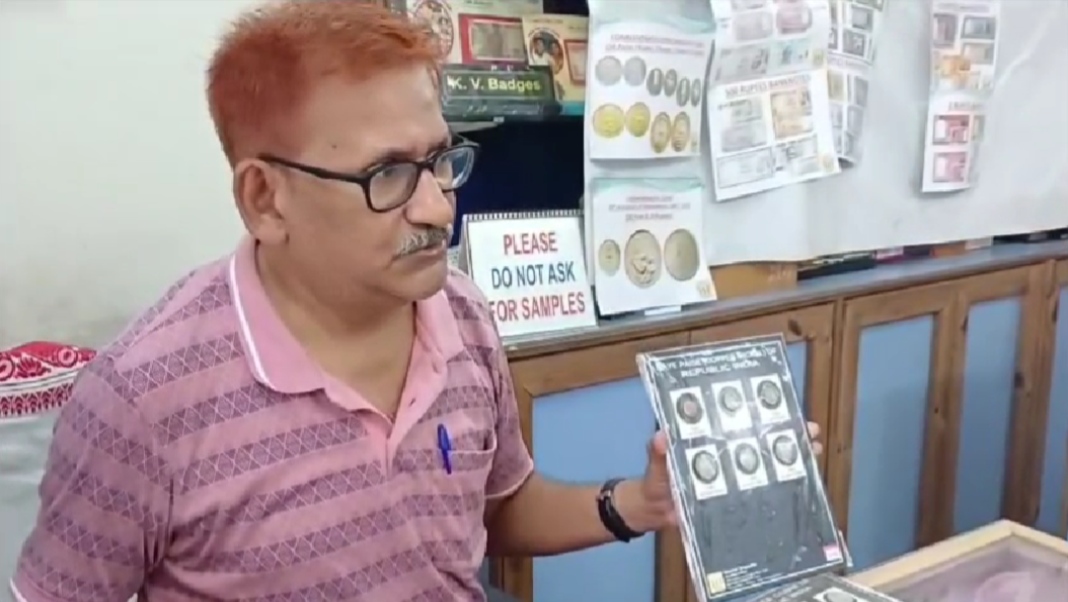

Guwahati, June 1: Inside a modest exhibition space in Guwahati, visitors gather around neatly arranged albums filled with old coins and currency notes — some dating back to British India, others from countries many students have never even heard of.
At the centre of it all is 62-year-old Bharat Bagadia, a Guwahati-based numismatist who has spent decades preserving coins, banknotes and pieces of monetary history that many people now rarely notice in everyday life.
At a time when digital payments and mobile phones dominate modern life, Bagadia believes coin and currency collecting can help younger generations reconnect with history, culture and learning.
Through his weekly “Hobby Hub” exhibitions held every Sunday in Guwahati, Bagadia showcases commemorative and definitive coins sourced from Indian mints, British-era currency, polymer notes, fancy serial number notes, error notes and several other rare collectibles.
But for Bagadia, numismatics is not only about collecting rare objects. He sees it as a way of understanding history through something people once used in their daily lives.
Speaking exclusively to Hub News, Bagadia recalled how his interest in coin collecting began during childhood.
“In 1980, my father had some British India coins, including annas. I used to repeatedly ask him to give me a few of them. Initially, he refused, but one day he handed me a palmful of British-era coins and told me not to show them to anyone. Those coins became my biggest motivation and inspired me to start collecting,” he said.
What started as curiosity gradually became a lifelong passion.

Due to financial constraints, Bagadia could not buy many rare coins during his early years. Instead, relatives and acquaintances often helped him grow his collection.
“Whenever I visited relatives, they would often give me old coins. I carefully preserved them in albums. By 2004, my hobby had become very active, and I started devoting both my time and money to it,” he said.
Today, his collection reflects different phases of Indian and world history — from colonial-era currency and Republic India coinage to modern polymer notes and special commemorative issues.
Bagadia explained how India’s own currency evolved after Independence.
“Although India became independent in 1947, the country did not immediately issue its own coins. After India became a Republic in 1950, the government introduced its first coin series featuring the Ashoka Pillar instead of the British monarch’s effigy. Later, the anna system was replaced by the decimal currency system, introducing the Naya Paisa, where one rupee became equal to 100 paise,” he said.
Apart from preserving coins, Bagadia has also worked to promote numismatics and philately among students across Assam. Having served as secretary of several numismatic and philatelic societies, he regularly conducts awareness and outreach programmes.
He believes hobbies like coin collecting can help children develop patience, curiosity and historical understanding.
“Today, children are mostly occupied with their mobile phones. Parents often don’t know what content they are viewing. Through coin collecting, many students associated with me have organised exhibitions in their schools and won awards. This hobby helps develop knowledge, discipline and an appreciation for history,” he said.
His long-term aim is to conduct workshops in schools across Assam and encourage more students to take an interest in preserving historical currency.
“My aim is to reach students who are genuinely interested in learning. They will become the future custodians of these historical treasures. Parents also play an important role because preserving these coins today can help educate future generations,” he said.
Bagadia also stressed the importance of public awareness in identifying counterfeit currency.
“Many people cannot identify fake notes because they are unfamiliar with the features of genuine currency. Public awareness and education are essential to help people distinguish between authentic and counterfeit notes,” he said.
Sharing his perspective on his father’s work, Kushal Bagadia said the exhibitions continue to be a learning experience even for family members.
“Every time we look at the collection, we learn something new. Today, we had an exhibition on polymer notes. We knew about polymer currency, but even now we come across notes from countries whose names we are hearing for the first time. Every exhibition becomes a learning opportunity,” he said.
According to Kushal, Bharat Bagadia’s contribution goes beyond maintaining a personal collection.
“My father is not just a collector. He has played an important role in promoting numismatics across Northeast India for many years. We have witnessed the growth of this hobby and the community around it. His contribution to society through education and awareness is what matters most,” he said.
Even after decades of collecting, Bagadia continues to spend his Sundays speaking to students, visitors and hobbyists about the stories hidden inside coins and currency notes.
For him, old coins are not simply collectibles stored inside albums — they are reminders of how societies, governments and everyday life changed over time.
And through his exhibitions and educational efforts, he hopes more young people will learn to see history not just in books, but also in the coins that once passed through countless hands.
Also Read: Union Sports Minister joins ‘Sundays on Cycle’ event in Shillong to promote Fit India movement
Also Watch
Find latest news from every corner of Northeast India at hubnetwork.in, your online source for breaking news, video coverage.
Also, Follow us on
Twitter-twitter.com/nemediahub
Youtube channel- www.youtube.com/@NortheastMediaHub2020
Instagram- www.instagram.com/ne_media_hub
Download our app from playstore – Northeast Media Hub