


Urmi Bhattacharjee
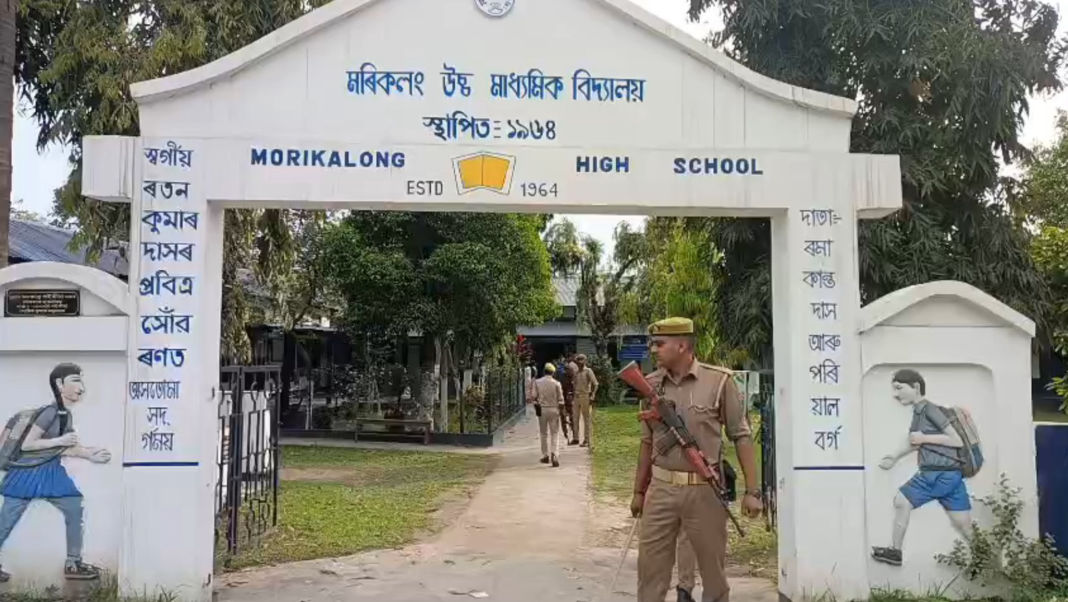
Guwahati, April 9: Elections in Assam today appear calm, structured, and tightly secured. Polling stations are closely monitored, security deployment is extensive, and voting is largely proceeding without major disruptions.
But the state’s electoral history tells a far more complex story, where voting has not always been a smooth democratic exercise.
Assam’s most defining and tragic election-linked episode dates back to the 1983 Assembly elections, held in the middle of intense agitation over illegal immigration and voter identity.
The decision to go ahead with polls despite widespread opposition led to large-scale violence, most notably the Nellie massacre, where hundreds of people were killed in one of the deadliest election-related incidents in independent India.
That period also saw multiple instances where elections were described as nearly impossible to conduct in certain constituencies due to security threats, requiring heavy deployment of paramilitary forces and phased polling.
Over the years, while the scale of violence has reduced, disruptions have continued in different forms.
In more recent elections, incidents have ranged from pre-poll clashes between political workers to attacks on candidates. During the current election cycle, confrontations have been reported in districts like Sonitpur and Nagaon, where clashes between rival groups left several people injured and raised concerns over localised tensions.
There have also been instances where candidates have alleged lapses in security during campaigning, indicating that enforcement challenges have not completely disappeared.
Beyond physical disruptions, technical and logistical issues have also been part of Assam’s electoral story.
In the 2016 Assembly elections, hundreds of electronic voting machines had to be replaced due to technical faults during polling, highlighting vulnerabilities even in an otherwise high-turnout election.
Repolling has also been a recurring feature, with several polling stations requiring fresh voting in different elections due to irregularities or disruptions at the booth level.
Assam’s geography adds another layer of complexity. Remote riverine islands, forested regions, and hill districts often require extraordinary logistical planning, and delays or access-related challenges have historically impacted polling in certain areas.
And yet, what stands out today is the contrast.
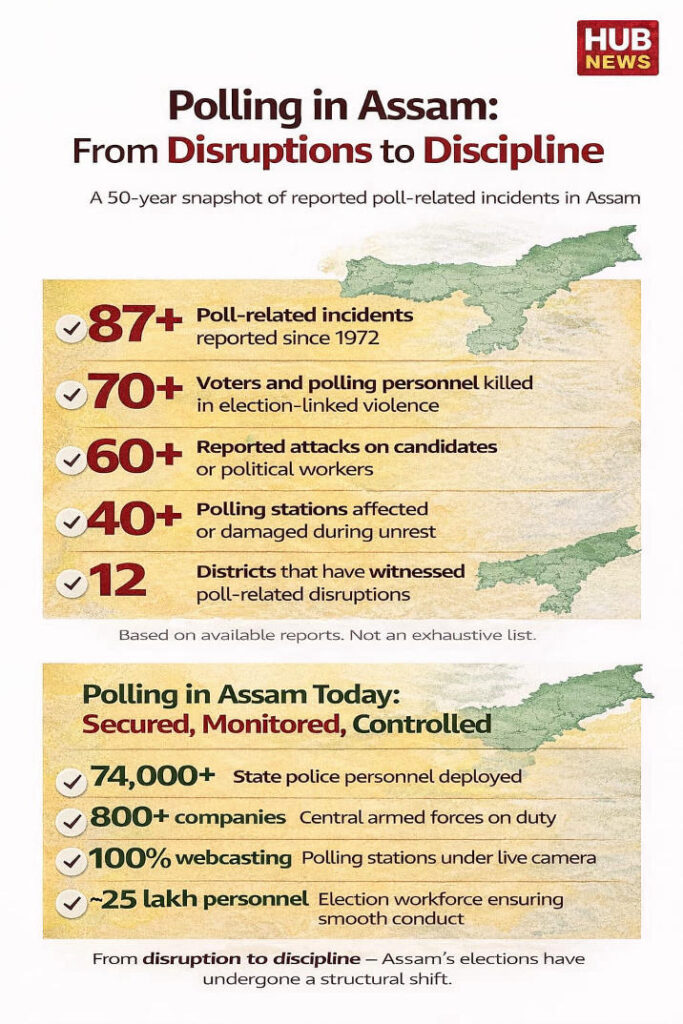
Recent elections have seen a visible shift towards tighter security, better coordination, and increased use of technology such as webcasting and real-time monitoring.
Polling is now conducted under one of the most extensive security frameworks in the country, designed to prevent the very disruptions that once defined the process.
The presence of central forces, layered surveillance, and improved logistics has contributed to a more controlled and predictable polling environment.
The evolution is significant.
From a period where elections could trigger unrest, to a present where they are largely managed with discipline and oversight, Assam’s electoral journey reflects both its past vulnerabilities and its institutional strengthening.
And yet, the past continues to inform the present.
Because in Assam, elections have never been just about voting. They have often intersected with questions of identity, conflict, and control, making every peaceful polling day not just a routine exercise, but a reflection of how far the system has come.
Also Read: Newborn baby boy abandoned at Ganesh Das hospital
Also Watch
Find latest news from every corner of Northeast India at hubnetwork.in, your online source for breaking news, video coverage.
Also, Follow us on
Twitter-twitter.com/nemediahub
Youtube channel- www.youtube.com/@NortheastMediaHub2020
Instagram- www.instagram.com/ne_media_hub
Download our app from playstore – Northeast Media Hub