


Shillong, June 21: Five years after Meghalaya unveiled its Electric Vehicle Policy, the state’s transition to cleaner mobility is beginning to gather momentum, even if the shift remains gradual.
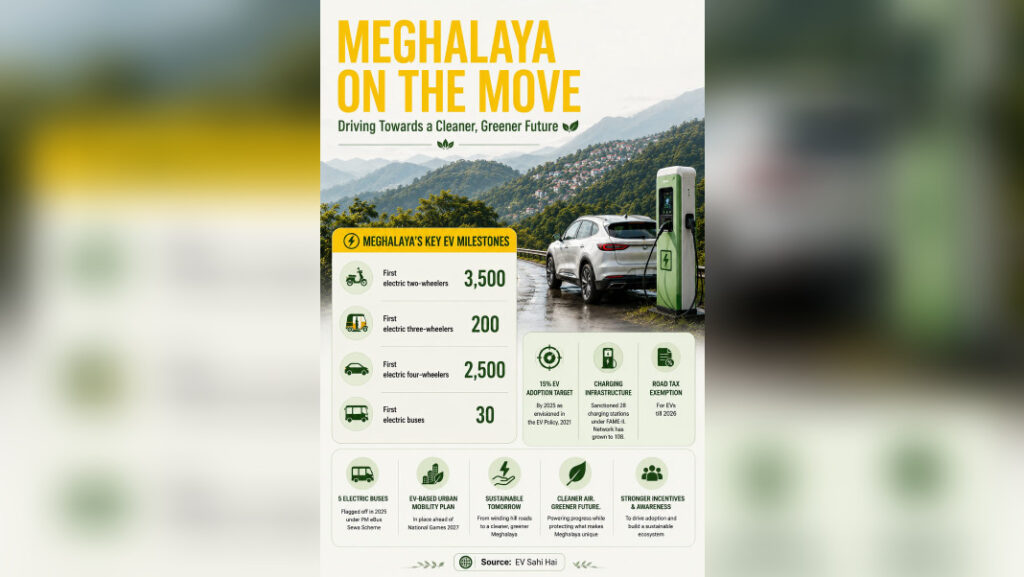
The policy, launched in 2021, set an ambitious target of achieving 15 per cent EV adoption while encouraging the development of charging infrastructure and incentives for consumers. The government also exempted electric vehicles from road tax and registration fees to make adoption more attractive.
What often goes unnoticed is how ambitious Meghalaya’s EV roadmap was on paper. Apart from tax exemptions, the state announced purchase incentives for thousands of electric two-wheelers, three-wheelers and four-wheelers, while also supporting the deployment of electric buses and charging infrastructure. The policy further envisioned EV adoption across tourism circuits, hotels, transport hubs and commercial centres, reflecting an effort to align clean mobility with Meghalaya’s image as one of India’s leading eco-tourism destinations.
The push comes at a time when cities across India are grappling with worsening air pollution and rising fuel costs. While Meghalaya’s air quality remains significantly better than many urban centres in the country, policymakers see electric mobility as part of a broader effort to build a cleaner and more sustainable future.
In recent years, the state has steadily expanded its EV ecosystem. Meghalaya has been sanctioned dozens of charging stations and has announced plans to strengthen public transport through electric buses and other green mobility initiatives. The government has also indicated that sustainable transport will play a key role in preparations for the 2027 National Games.
The conversation around electric mobility received fresh attention after a recent social media video showed Chief Minister Conrad K. Sangma explaining how he charges his own electric vehicle and speaking about his experience using an EV over the years. Sangma had publicly announced his decision to commute using an electric vehicle as early as 2022, making him one of the first chief ministers in the Northeast to visibly champion EV adoption through personal use.
Yet experts say infrastructure remains the key challenge.
Studies on EV adoption worldwide consistently point to “range anxiety” and inadequate charging networks as among the biggest barriers preventing consumers from making the switch. Expanding charging stations and improving accessibility will therefore be critical if the Northeast hopes to accelerate adoption in the coming years.
Across the Northeast, states are moving at different speeds. Assam currently leads the region in charging infrastructure and EV registrations, while Meghalaya is increasingly positioning itself as a testing ground for sustainable mobility through policy support, charging infrastructure and public transport initiatives. Nagaland, Manipur and Sikkim are also gradually expanding their EV ecosystems, though adoption remains at an early stage across much of the region.
The larger question is no longer whether electric vehicles will arrive in the Northeast.
They already have.
The question now is how quickly the region can build the ecosystem needed to make clean mobility the norm rather than the exception.
For a region celebrated for its forests, rivers, mountains and biodiversity, the EV transition is about more than replacing petrol with batteries. It is about whether the Northeast can build a development model that grows without compromising the natural wealth that makes the region unique in the first place.
Also Read: Kuki CSOs enforce emergency highway shutdown, allege selective security operations in Manipur
Also awatch
Find latest news from every corner of Northeast India at hubnetwork.in, your online source for breaking news, video coverage.
Also, Follow us on
Twitter-twitter.com/nemediahub
Youtube channel- www.youtube.com/@NortheastMediaHub2020
Instagram- www.instagram.com/ne_media_hub
Download our app from playstore – Northeast Media Hub