

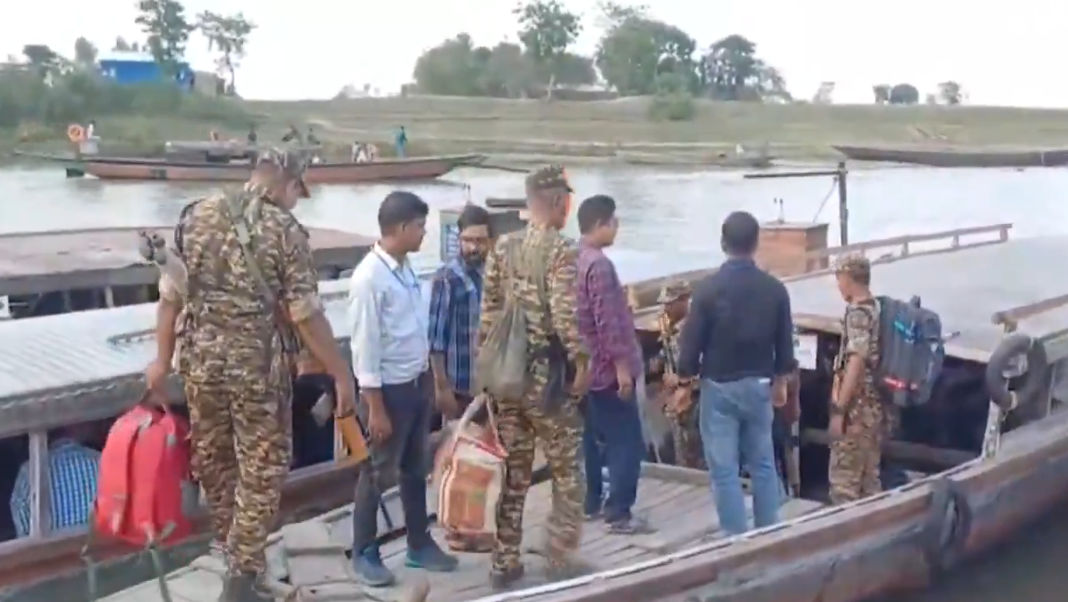

Boko, April 8: In the shifting landscape of Chamaria, where the land breaks into sandbars and roads often disappear without warning, elections do not simply arrive. They have to be taken there.
A day before polling, teams begin their journey from Boko, carrying sealed EVMs, documents, and essential supplies. The first stretch is by bus, up to Alikash Parghat. It looks routine at first.
Then the road ends.
Beyond that point lies the Brahmaputra River, wide and unpredictable. Polling officials board mechanised boats, travelling across under a harsh sun, sitting beside the machines they are responsible for. The crossing takes time, and there is little room for error.
On the other side, the journey shifts again.
The char areas have no fixed roads, only stretches of loose sand shaped by the river’s flow. Tractors manage part of the route. After that, officials step down and walk. Carrying equipment on their shoulders, some balancing it on their heads, they move carefully across the uneven ground, making their way to polling stations in Batashidia, Kalatoli, Duramari, Shalmara, and Balagaon.
In this cluster alone, 21 polling stations have been set up, serving nearly 10,000 voters. What takes a voter a few minutes on polling day takes an entire day of travel for those bringing the process to them.
This is not an isolated story. It is part of a much larger exercise.
Assam will vote in a single phase across all 126 Assembly constituencies on April 9. Across the state, polling is being conducted through tens of thousands of booths, with the number continuing to rise as the Election Commission caps voters per booth to ensure accessibility and reduce crowding.
Even in earlier phases of elections, more than 11,500 polling stations were operational in just one phase covering part of Assam, indicating the scale at which the system functions.
But numbers alone do not explain what it takes to make each booth functional.
In districts with riverine terrain, entire routes depend on boats and temporary access points. In places like Dibrugarh, officials also travel by river to reach remote booths, underlining how common these challenges are across Assam’s geography.
The char chapori belt, spread across vast stretches of the Brahmaputra basin, remains one of the most difficult terrains for any administrative exercise. Land shifts, access changes, and distances are often uncertain. Yet, polling stations are still set up within reach of voters.
What stands out in Chamaria is not just the difficulty of the terrain, but the quiet routine with which it is handled. There is no pause in the process, no special framing. Just a sequence of movement that repeats every election.
By the time polling begins, everything is in place. The booth is ready, the machine is set, and the process appears smooth to those who arrive to vote.
What remains unseen is the distance covered to make that moment possible.
Here, democracy doesn’t arrive easily. It travels—across currents, across sand, and against the odds.