

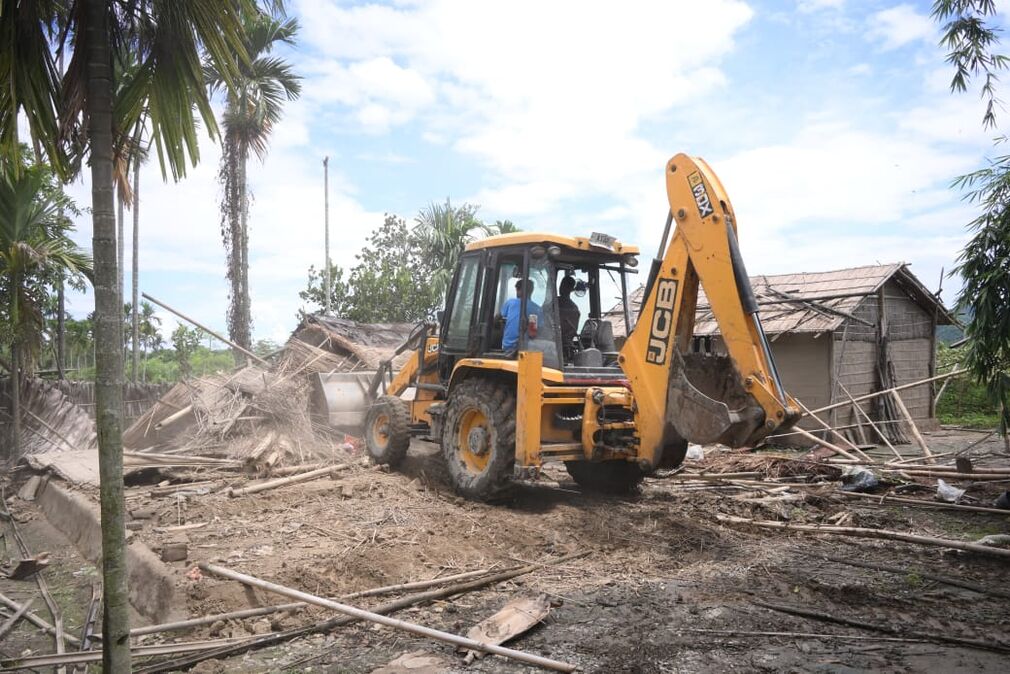

Guwahati, May 12: Even before beginning his second consecutive term, Himanta Biswa Sarma has signalled that land politics will remain one of the defining themes of his government.
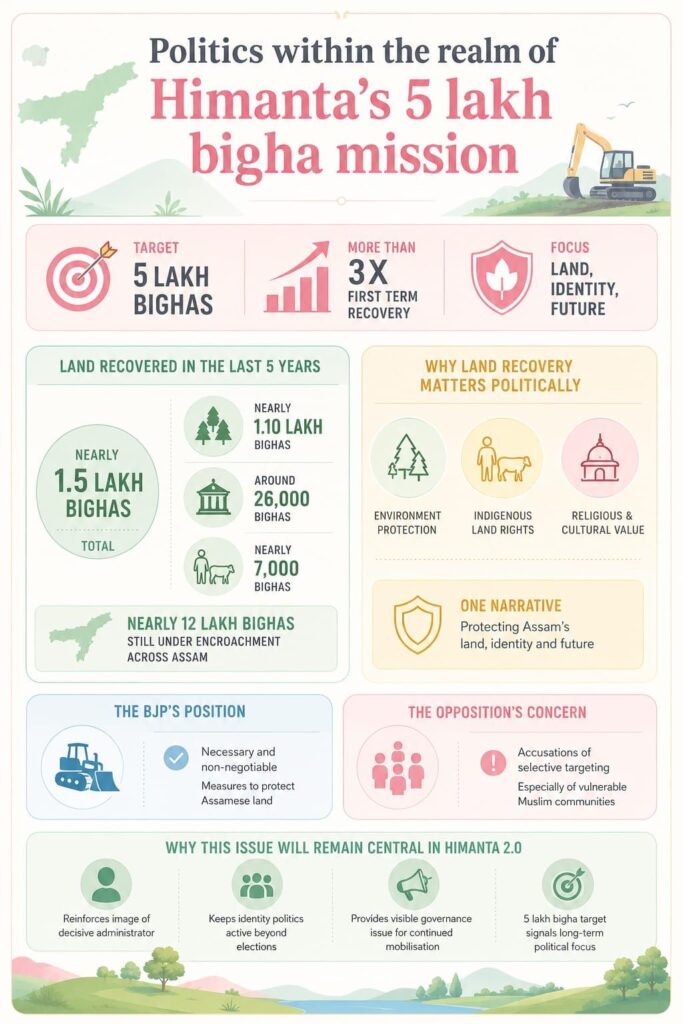
On the eve of taking oath again as Assam chief minister, Sarma announced that his government would intensify eviction drives and seek to reclaim nearly five lakh bighas of allegedly encroached land across the state — a target more than three times the scale of recovery operations carried out during his first term.
Over the past few years, eviction drives and land recovery operations have evolved from administrative exercises into one of the BJP’s most potent political narratives in Assam. During the recent election campaign, bulldozer imagery featured prominently in BJP mobilisation efforts and social media messaging, with supporters portraying the drives as evidence of the government reclaiming “Assamese land” after decades of political inaction.
Government figures presented during official reviews and public statements indicate that nearly 1.5 lakh bighas of land have been cleared over the last five years, including forest land, government land, Village Grazing Reserve (VGR) land and Professional Grazing Reserve (PGR) land. The government has also maintained that close to 12 lakh bighas across Assam remain under encroachment.
Different categories of land carry different political and social sensitivities. Recovery of forest land allows the government to project the drives as measures for environmental protection and conservation, while eviction from VGR and PGR land is closely tied to indigenous land rights and resource access. Recovery of satra land also carries cultural and religious significance, particularly in Upper Assam.
Over time, the BJP has linked these issues to a broader political narrative centred on protecting Assam’s “land, identity and future” — a phrase repeatedly invoked by Sarma in speeches and campaign messaging.
The issue resonates strongly in Assam because land is no longer viewed purely through an administrative lens. It is increasingly intertwined with concerns over migration, demographic change, indigenous identity and political representation.
At the same time, the eviction drives have remained politically contentious. Several of the largest operations in recent years were carried out in areas inhabited largely by Bengali-speaking Muslims, including erosion-affected families who had settled over generations on forest and government land after repeated displacement from riverine areas.
While the BJP has defended the drives as necessary steps to protect public and indigenous land, opposition parties, civil society groups and minority organisations have accused the government of disproportionately targeting vulnerable Muslim communities under the broader framework of anti-encroachment measures.
The proposed target of reclaiming five lakh bighas suggests that land politics is likely to remain central to Himanta 2.0 — both as a governance agenda and as a continuing political strategy. For the BJP, the issue reinforces Sarma’s image as a decisive administrator while also sustaining identity-driven political mobilisation beyond the election cycle.
In contemporary Assam politics, land has increasingly become more than a resource issue — it has emerged as one of the state’s most powerful political fault lines.