

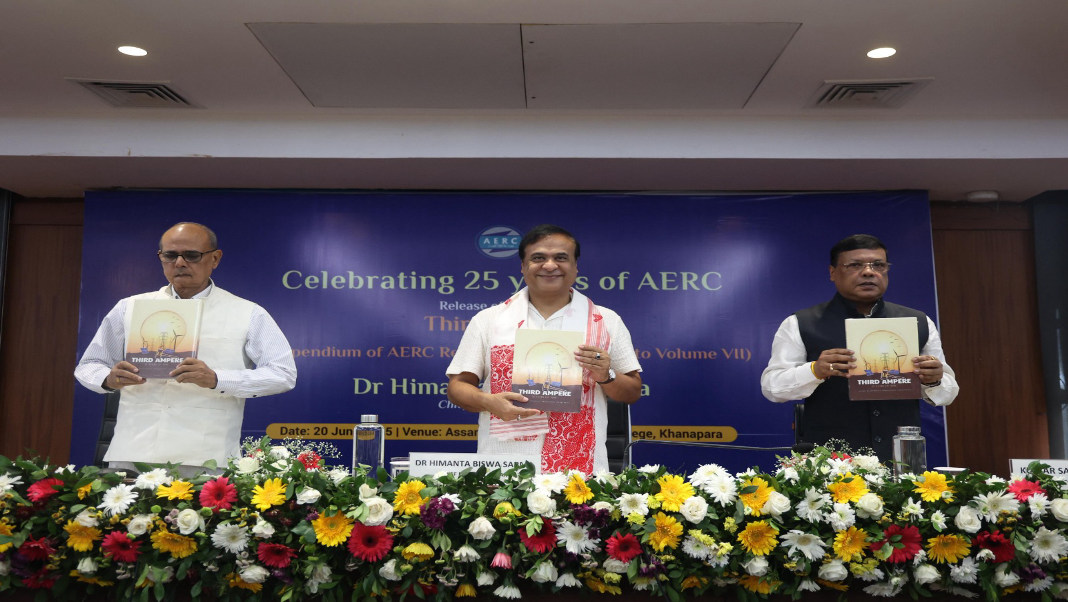

Guwahati, June 20: With electricity demand in Assam growing at an average of 11 per cent annually over the past four years, Chief Minister Dr. Himanta Biswa Sarma on Thursday outlined a long-term strategy to make the state self-reliant in power generation by 2035.
Speaking at the silver jubilee celebration of the Assam Electricity Regulatory Commission (AERC) and the release of THIRD AMPERE — a chronicle of Assam’s power sector evolution — the Chief Minister stressed the need for forward-looking energy policies in the face of rising industrialisation and climate change.
The event saw the release of five new and revised regulatory frameworks developed by AERC to modernise the sector.
“Electricity is a core driver of development. Assam’s rising energy demand is a sign of its fast-paced growth,” said Dr. Sarma. He noted that while the state currently produces only around 500 MW on its own, it draws an additional 1,800 MW from the central grid. In recent weeks, peak summer demand surged to 2,700 MW and could climb to 2,900 MW by September.

Citing investment inflows from the recent Advantage Assam 2.0 summit, Dr. Sarma said industrial and infrastructure projects were worth Rs. 60,000 crore is already in progress, with several slated for completion by year-end — further accelerating energy consumption.
To meet the projected 5,500 MW daily demand by 2035, the government is rolling out a multi-pronged energy strategy that includes generating 5,000 MW of solar power, with suitable sites already identified. The plan also includes developing 8,000 MW of pumped storage systems to store solar power for nighttime use.
The Centre has approved setting up a 3,000 MW thermal power project in Assam.
The Chief Minister also highlighted reforms undertaken over the past four-and-a-half years, including substantial investments and infrastructure upgrades that have halved transmission and distribution losses—from 29-30 per cent to 15.5 per cent. The deployment of smart meters has improved efficiency, and for the first time in years, all three power companies in the state have turned profitable. As a result, electricity tariffs have been reduced by Rs. 1 per unit.
Dr. Sarma credited the AERC for playing a pivotal role in these achievements. “The Commission has not only regulated but also guided the sector’s sustainable transformation,” he said.
The book THIRD AMPERE, released at the event, traces the region’s electricity history — from Shillong’s electrification in 1923 (making it the first city in undivided Assam and the Northeast to be electrified), to the lighting of Jorhat in 1924, and the electrification of Guwahati and Tezpur in 1927 and 1933, respectively.
Also Watch
Find latest news from every corner of Northeast India at hubnetwork.in, your online source for breaking news, video coverage.
Also, Follow us on-
Twitter-twitter.com/nemediahub
Youtube channel- www.youtube.com/@NortheastMediaHub2020
Instagram- www.instagram.com/ne_media_hub
Download our app from playstore – Northeast Media Hub