

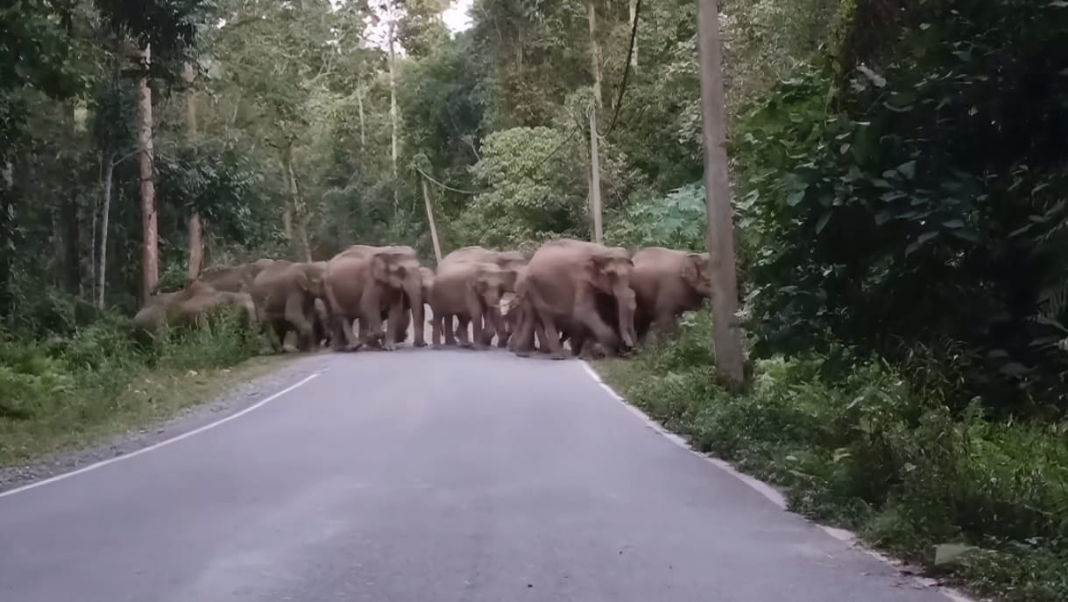

Dibrugarh, Dec 18: Once celebrated as Asia’s largest elephant corridor, the Bogapani Elephant Corridor in Tinsukia district of eastern Assam has witnessed a dramatic halt in elephant movement in recent years as widespread encroachment has blocked their age-old migratory route.
The 3-km-long stretch, ranging between 0.5 and 1 km in width, forms a crucial link between the forested landscapes of Dehing Patkai in Assam and adjoining habitats in Arunachal Pradesh. But today, the corridor stands fragmented and obstructed by expanding human settlements, alongside pressures from NH-38 and railway tracks cutting across the landscape.
For generations, herds numbering up to 200 elephants made routine crossings through Bogapani, a spectacle locals fondly called ‘Hati Mela’ — the “elephant fair.” But that movement has vanished.
“Elephants no longer cross through Bogapani. Earlier, it felt like a moving elephant market — now that sight is gone,” said local resident Ramesh Tanti. “With their natural routes blocked, herds are entering villages, and attacks have increased. Many people have died in recent months.”
Communities who once coexisted with elephants fear the relationship has turned adversarial — not by choice, but by the force of land pressure. Several settlements have sprung up inside forest areas, narrowing and in some stretches completely sealing the corridor.

Urgent Concerns and Calls for Action
At a meeting held in Digboi on November 9, 2025, forest officials, conservationists and community representatives discussed the escalating crisis across the elephant corridors of Tinsukia.
“The Golai corridor is almost fully encroached, and Bogapani is blocked. Elephant movement from Dehing Patkai is now diverted into villages, triggering conflict,” said wildlife conservationist Devajit Moran.
Moran, who has tracked elephant movement in the region for several years, said local participation is essential. “Villagers are becoming aware of the ecological importance of the corridor. Some are already cooperating. But a larger strategy is needed.”
Legal Intervention
The issue has also reached the National Green Tribunal (NGT) through a petition filed by wildlife biologist Dr. Kashmira Kakati. The petition accuses the state government of allowing Indian Oil Corporation Ltd (IOCL) to build an oil dispatch terminal within the Golai elephant corridor, allegedly violating environmental regulations. It warns that the project would further disrupt elephant movement and increase vehicular load and pollution in the area.

Forest Department Response
Divisional Forest Officer (Digboi) B.V. Sandeep acknowledged that the corridor’s ecological integrity has suffered.
“Bogapani is a lifeline for elephant movement. Encroachment has severely affected the route. The NGT has directed us to clear certain patches, but new houses continue to come up,” he said.
He added that the department is monitoring elephant movement and engaging with communities:
“The problem can only be solved through shared responsibility. When elephants lose their path, people lose their safety.”
Looking Ahead
Conservationists and environmental experts argue that securing alternative land for landless settlers and relocating encroached households may be the only sustainable path forward.
“If people are provided land elsewhere, the corridor can be restored,” said one environmentalist.
As elephants continue to navigate shrinking spaces, the region confronts a critical choice: restore Bogapani’s ecological corridor — or brace for rising conflict between people and the animals that once passed through their villages with ease and familiarity.
Also Read: Will there be a winter chill in Northeast India? No, says the weatherman
Also Watch
Find latest news from every corner of Northeast India at hubnetwork.in, your online source for breaking news, video coverage.
Also, Follow us on-
Twitter-twitter.com/nemediahub
Youtube channel- www.youtube.com/@NortheastMediaHub2020
Instagram- www.instagram.com/ne_media_hub
Download our app from playstore – Northeast Media Hub