

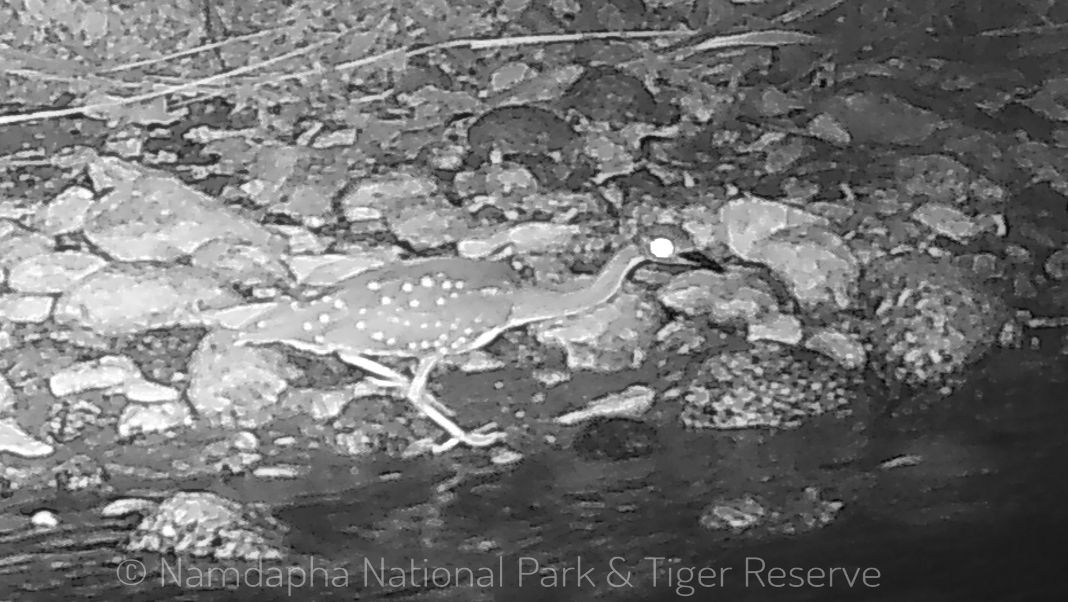

Guwahati, July 2: In a major conservation breakthrough, the Endangered White-eared Night Heron (Oroanassa magnifica) has been photo-captured in Namdapha National Park and Tiger Reserve in Arunachal Pradesh, marking only the second confirmed record of the elusive species in India.
The bird, which is primarily found in southern China and northern Vietnam and has an estimated global population of fewer than 1,000 individuals, was recorded through a camera trap installed by staff of the Namdapha Wildlife Range and the park’s research wing. The only prior confirmed sighting in India dates back to 2016 in Valmiki Tiger Reserve, Bihar.
Known for being extremely secretive and nocturnal, the White-eared Night Heron is rarely observed in the wild. Its detection in Namdapha, a remote, richly biodiverse rainforest, underscores the ecological significance of this Eastern Himalayan wilderness, especially as a refuge for globally threatened and lesser-known species.
Located in Changlang district, along the India–Myanmar border, Namdapha spans 1,985.23 square kilometres of largely untouched forest. Nestled a few kilometres from the town of Miao, and stretched along the banks of the turbulent Noa-Dihing River, this national park and tiger reserve is a treasure trove of ecological wealth and enchanting natural beauty. It was declared a Tiger Reserve in 1983.
Namdapha is the only park in the world to host all four big cat species—Tiger (Panthera tigris), Leopard (Panthera pardus), Snow Leopard (Panthera uncia), and Clouded Leopard (Neofelis nebulosa)—along with several species of lesser cats. Its impenetrable forests also provide habitat for a variety of primates, including the endangered Hoolock Gibbon, India’s only ape species, as well as elephants, Indian bison, black bear, stump-tailed macaques, and numerous species of deer, reptiles, and arboreal mammals.
The park’s tropical and temperate ecosystems, combined with its elevation range, have given rise to exceptional botanical and faunal diversity, much of which remains scientifically unexplored. Botanists consider Namdapha a “dream site,” with over 150 species of timber trees, including rare finds like Pinus merkusii and Abies delavayi, not found elsewhere in India. The Blue Vanda orchid, among the rarest in the world, and the famed medicinal herb Mishimi Teeta (Coptis teeta)—used traditionally for treating various ailments—are found here, though the export of the latter has been banned to protect its population.
“Namdapha’s forests are still largely virgin and unexplored. This recent record of the White-eared Night Heron is not just a tick on a species list—it’s a sign of the park’s immense, untapped biodiversity,” said a senior forest official.
Due to the species’ sensitive conservation status, authorities are withholding exact details about the location and timing of the sighting. However, the observation reinforces Namdapha’s status as one of India’s most vital biodiversity strongholds within the Indo-Myanmar biodiversity hotspot.
Conservationists say this discovery should trigger renewed research and long-term conservation strategies, not only for the White-eared Night Heron but also for the myriad species that silently thrive in Namdapha’s remote, mist-covered canopies.
“This park may hold secrets we haven’t even imagined yet. But for that, we need sustained scientific attention and strong protection,” the official added.
Also Read: Six detained after water bottle hurled at CM Himanta Biswa Sarma’s convoy
Also Watch
Find latest news from every corner of Northeast India at hubnetwork.in, your online source for breaking news, video coverage.
Also, Follow us on-
Twitter-twitter.com/nemediahub
Youtube channel- www.youtube.com/@NortheastMediaHub2020
Instagram- www.instagram.com/ne_media_hub
Download our app from playstore – Northeast Media Hub