

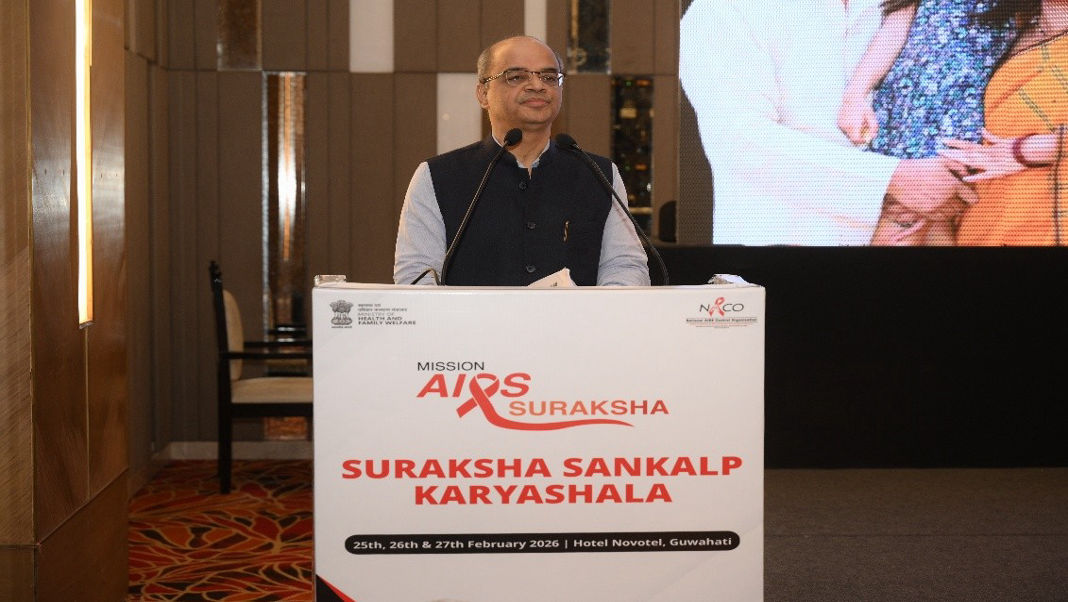

Guwahati, Feb 26: National AIDS Control Organisation (NACO) Additional Secretary and Director General Dr Rakesh Gupta on Thursday underscored the need for granular district-level planning, data-driven monitoring and strong local ownership to bend the curve of new HIV infections in high-prevalence states such as Manipur and Mizoram.
Addressing participants on the second day of the ongoing three-day review workshop under Mission AIDS Suraksha, Gupta said targeted, evidence-based interventions at the district level are critical to accelerating progress in states bearing a disproportionate HIV burden.
The workshop is undertaking an intensive review of the HIV response in Manipur and Mizoram, examining state-specific epidemiological trends, district-level gaps and tailored programme strategies to fast-track India’s journey towards the 95-95-99 targets and achieving HIV control by December 1, 2027 — coinciding with World AIDS Day.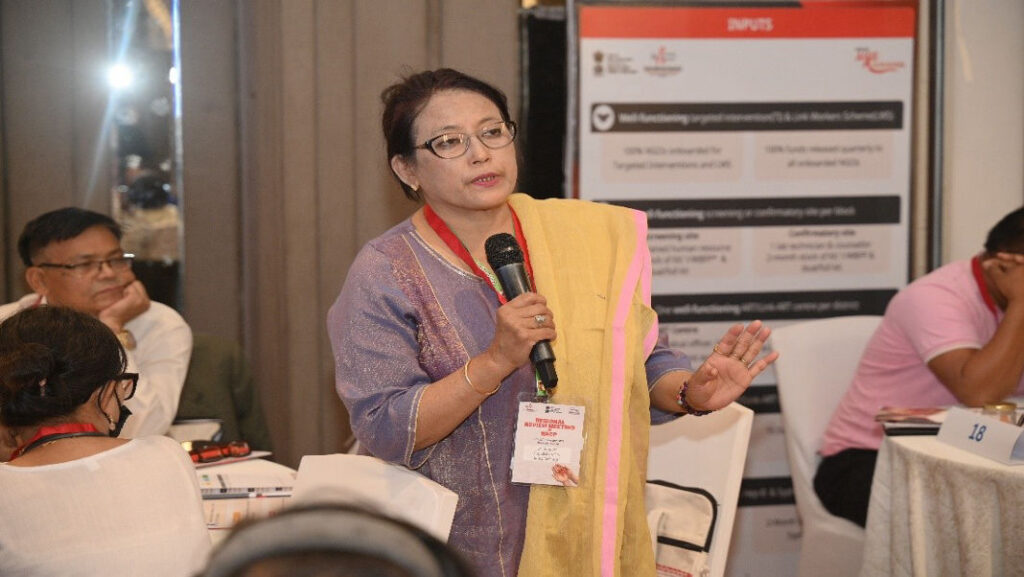
During Day 2 of the Suraksha Sankalp Karyashala, detailed reviews were conducted for 12 identified high-priority districts in Manipur and 11 in Mizoram. Discussions focused on epidemiological trends, programme coverage, treatment outcomes, viral load suppression rates and outreach among high-risk populations.
Manipur, with an adult HIV prevalence of 0.81 per cent and an estimated 23,000 people living with HIV, remains a priority state in the national response. Districts including Bishnupur, Chandel, Churachandpur, Imphal East, Imphal West, Thoubal and Ukhrul were examined closely to assess micro-level indicators and identify gaps in testing, linkage to treatment, retention in care and viral suppression.
Mizoram — which has the highest HIV prevalence in the country at 2.75 per cent and an estimated 26,000 people living with HIV — also underwent an extensive review. Districts such as Aizawl, Champhai, Kolasib, Lunglei, Serchhip, Mamit and Siaha were assessed for district-specific strategies, with emphasis on intensified and index testing, improved linkage to treatment, scaling up opioid substitution therapy (OST) services, and focused interventions targeting youth and high-risk groups. Special attention was given to strengthening early detection and follow-up mechanisms to ensure treatment adherence and sustained viral suppression.
The primary objective of the workshop is to sharpen strategies and accelerate progress towards the global 95-95-99 targets — ensuring that 95 per cent of all people living with HIV know their status, 95 per cent of those diagnosed receive sustained antiretroviral therapy (ART), and 99 per cent of those on treatment achieve viral suppression.
Also Read: Assam: Boko’s Rajapara villagers unite against proposed liquor shop
Also Watch
Find latest news from every corner of Northeast India at hubnetwork.in, your online source for breaking news, video coverage.
Also, Follow us on
Twitter-twitter.com/nemediahub
Youtube channel- www.youtube.com/@NortheastMediaHub2020
Instagram- www.instagram.com/ne_media_hub
Download our app from playstore – Northeast Media Hub

 Additional Secretary and Director General Dr Rakesh Gupta on Thursday underscored the need for granular district-level planning, data-driven monitoring and strong local ownership to bend the curve of new HIV infections in high-prevalence states such as Manipur and Mizoram.)