


Urmi Bhattacharjee
Guwahati, April 9: As polling concluded across Assam, voter turnout reached a record 85.38%, the highest ever in a state Assembly election, surpassing the previous high of 84.67% recorded in 2016, according to the Election Commission of India.
The scale of participation once again underscores Assam’s strong electoral culture. Yet, beyond the headline number, the mandate remains far from clear. Rather than pointing to a decisive political shift, the record turnout suggests a more complex and finely balanced contest, where multiple narratives are at play.
No Wave, Only Intent
There is no visible wave in this election—no sharp anti-incumbency surge, no overwhelming pro-government momentum. Yet turnout has surged to record levels.
This indicates a contest driven less by emotion and more by mobilisation and intent. Voters are turning up not in reaction, but with decisions already made, making this a competitive and evenly poised election rather than a wave-driven one.
One Interpretation, Not the Only One
Assam Chief Minister Himanta Biswa Sarma has framed the turnout as a “movement” rather than a routine democratic exercise.
This reading, however, represents one interpretation—one that may not fully capture the more nuanced and locally driven dynamics shaping voter behaviour across the state.
Where the Election Is Being Decided
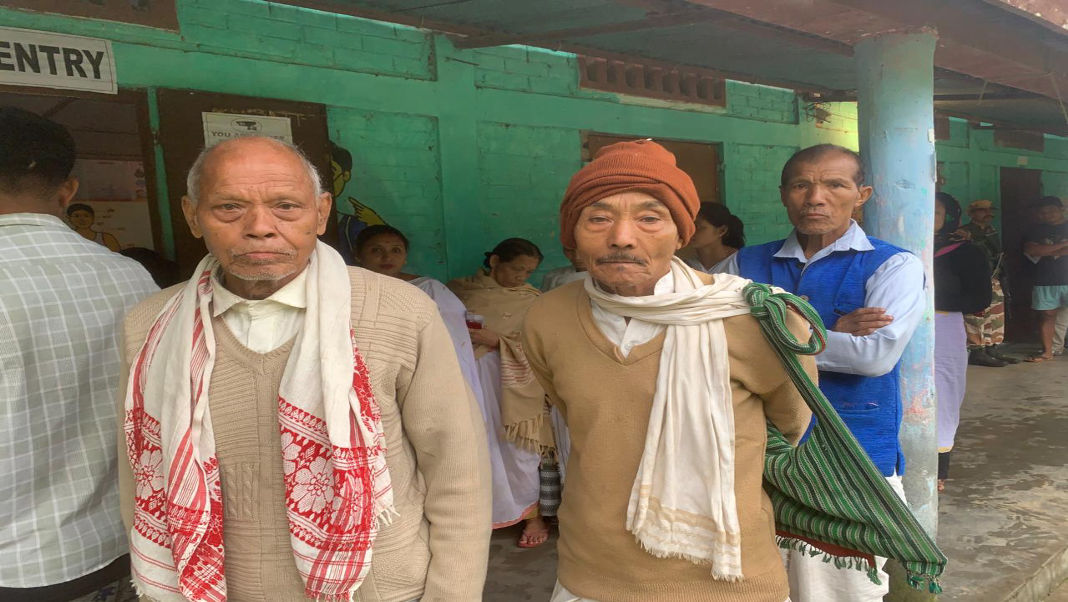
Turnout patterns underline this balance. Rural Assam has set the pace, with early queues and steady participation shaping the day’s momentum.
In contrast, urban centres such as Guwahati have shown a slower, more staggered response. This suggests the election may ultimately be decided not where it is discussed the most, but where participation is more disciplined and consistent.
High Participation, Without Visible Anger
High turnout is often read as a sign of voter dissatisfaction. In Assam, that assumption does not always hold.
The absence of visible anger suggests voters are not reacting impulsively. Instead, they appear to be making measured choices. This is shaping up to be less a protest election and more a decision election—one where outcomes are determined quietly rather than dramatically.
A Free Vote, Not a Pressured One
A strong security presence ensured largely peaceful polling across constituencies, allowing voters to participate without hesitation.
This creates a freer voting environment, where turnout reflects genuine choice rather than pressure or constraint. That, in turn, makes the outcome harder to interpret in real time, as participation alone offers limited clues about voter preference.
One Phase, One Continuous Surge
The single-phase nature of the election has also shaped turnout. With the entire state voting on the same day, participation built steadily through the hours, culminating in a record final figure.
This compressed timeline turned polling day into a continuous surge rather than a fragmented process, intensifying both engagement and unpredictability.
The Quiet Voter Effect
Taken together, these patterns point to the presence of a quiet voter—one who has made a choice but is not expressing it publicly.
The absence of strong outward signals, despite record turnout, makes it difficult to read the direction of the mandate. In such a scenario, turnout itself becomes the only visible indicator.
Ground Game Over Optics
These trends also underline the importance of booth-level organisation. High turnout across regions suggests effective ground mobilisation.
Elections like this are shaped less by large rallies and more by the ability to bring voters to polling stations. The mechanics of participation, often invisible, are playing a decisive role.
Calm Surface, Competitive Core
Despite the orderly visuals of polling day—long queues, minimal disruptions—the underlying contest appears tightly balanced.
Record turnout without a clear wave typically signals a close fight, where margins may be narrow and outcomes finely contested.
The Bottom Line
This is not an election that is announcing its outcome. It is unfolding quietly, with each layer of turnout adding complexity rather than clarity.
In Assam, when voters speak through numbers instead of noise, it often means the decision has already been made—just not yet revealed.
For now, the numbers speak, but not the result. That will emerge on May 4.