

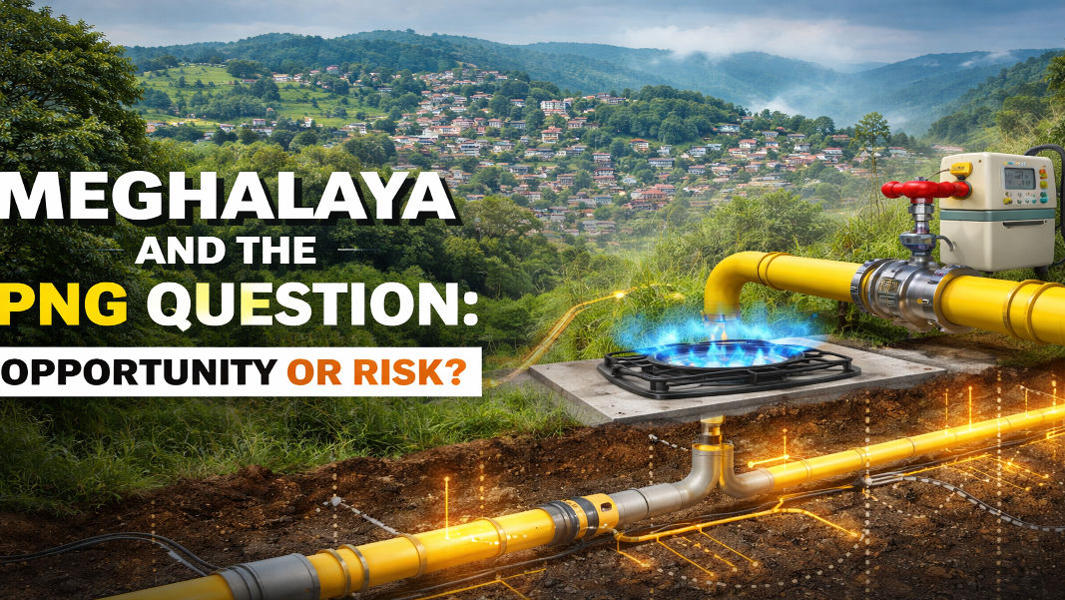

A quiet energy transition is underway across India, and at its core is Piped Natural Gas (PNG) — a fuel that promises convenience, safety, and a cleaner future. From the bustling kitchens of Delhi to the high-rise apartments of Mumbai, PNG has already reshaped how urban India cooks and consumes energy. Now, the question turns to the hills: is Meghalaya ready to embrace this shift, or are the risks too significant to overlook?
PNG, composed largely of methane, is supplied directly to homes through underground pipelines. It eliminates the need for LPG cylinder bookings, ensures uninterrupted supply, and operates on a pay-as-you-use model — features that align well with the needs of modern consumers. In an ecologically sensitive state like Meghalaya, its cleaner-burning profile makes it especially attractive.
Yet, the promise of PNG becomes more complex when viewed through the lens of Meghalaya’s terrain and realities.
Unlike the dense, relatively flat urban landscapes where PNG networks have thrived, Meghalaya’s geography is marked by steep hills, dispersed settlements, and limited urban infrastructure. Building a City Gas Distribution network here would demand substantial investment, careful route planning, and long-term institutional commitment.
Safety adds another critical layer to the debate. The Northeast falls within Seismic Zone V, one of the most earthquake-prone regions in India. While underground gas pipelines can be engineered to withstand seismic activity through flexible materials, automatic shut-off systems, and continuous monitoring, the margin for error remains slim. Any compromise in design, installation, or maintenance could carry serious consequences.
Affordability and practicality also come into play. While PNG can be cost-effective over time, the upfront cost of connection and infrastructure may deter many households. LPG cylinders, by contrast, remain portable, familiar, and widely accessible. Moreover, PNG’s relatively lower calorific value may translate into higher consumption, raising questions about real savings for consumers.
Across India, companies such as Indraprastha Gas Limited, Mahanagar Gas Limited, Adani Total Gas Limited, Gujarat Gas Limited, and GAIL Gas Limited have built extensive PNG networks in urban centres. However, replicating this model in Meghalaya is not a straightforward expansion — it requires adaptation to a region defined by environmental sensitivity and logistical complexity.
There are lessons closer to home. In neighbouring Assam, authorities have pushed for wider PNG adoption through agencies like Assam Gas Company, Purba Bharati Gas, North East Gas Distribution Company, and Adani City Gas. The initiative aims to expand coverage in urban and semi-urban areas, reduce logistics costs, and accelerate the shift toward cleaner fuels.
So, is PNG the future for Meghalaya?
The answer lies between ambition and caution. PNG holds the potential to modernise energy use, lower emissions, and introduce urban convenience to the state. But without detailed feasibility studies, pilot projects, and stringent safety protocols, a rushed rollout could prove counterproductive.
For Meghalaya, the way forward is not to resist change, but to approach it with clarity and care. PNG may well become part of the state’s energy future — but only if that future is built on robust infrastructure, scientific planning, and, above all, uncompromising safety.
Also Read: Opp wants all-party meet before KHADC rule 128 change
Also Watch
Find latest news from every corner of Northeast India at hubnetwork.in, your online source for breaking news, video coverage.
Also, Follow us on
Twitter-twitter.com/nemediahub
Youtube channel- www.youtube.com/@NortheastMediaHub2020
Instagram- www.instagram.com/ne_media_hub
Download our app from playstore – Northeast Media Hub

 — a fuel that promises convenience, safety, and a cleaner future. From the bustling kitchens of Delhi to the high-rise apartments of Mumbai, PNG has already reshaped how urban India cooks and consumes energy. Now, the question turns to the hills: is Meghalaya ready to embrace this shift, or are the risks too significant to overlook?)