

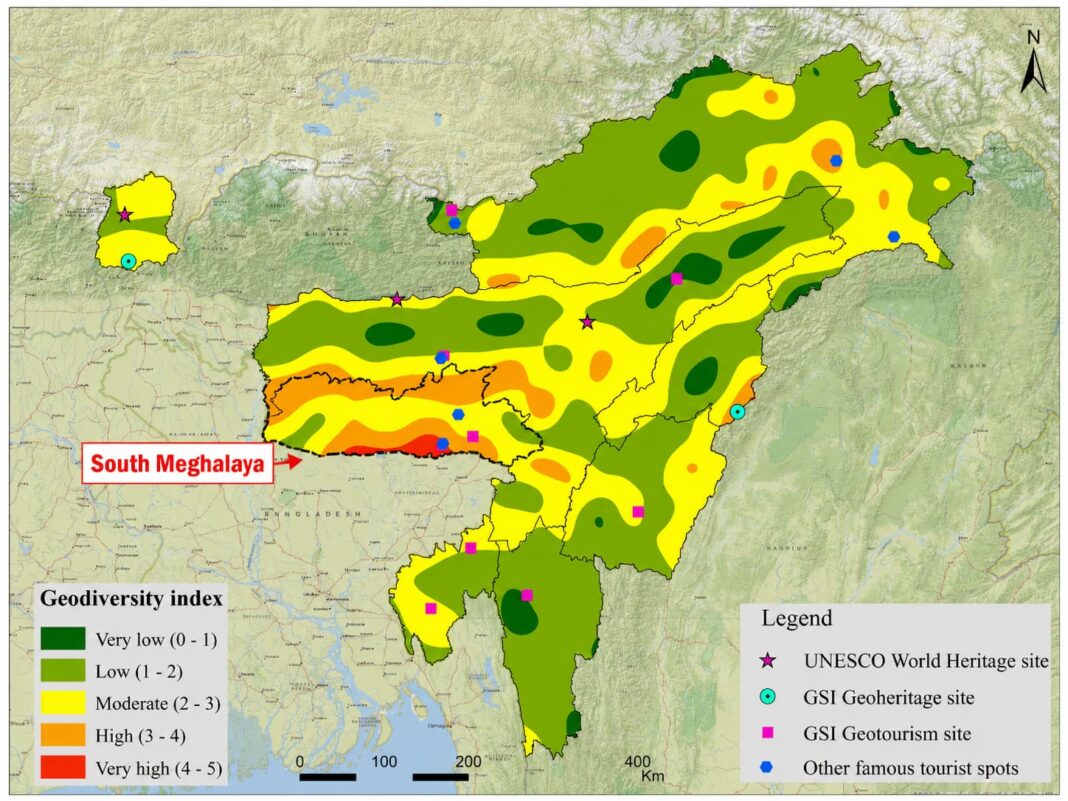

Southern Meghalaya identified as the region’s richest geodiversity zone, opening new possibilities for geotourism, conservation and sustainable planning
ROOPAK GOSWAMI
Guwahati, May 26: Meghalaya’s dramatic hills, caves, plateaus and mineral-rich landscapes have now earned scientific recognition as the geological heart of Northeast India.
A landmark study published in the international journal Geoheritage has identified southern Meghalaya as the region’s most geodiverse landscape — a distinction that researchers say could strengthen the state’s position as a major geotourism and conservation destination.
The study, conducted by researchers from Gauhati University and the Centre for Brahmaputra Studies Durlov Lahon, Jatan Debnath, Nityaranjan Nath, and Professor Dhrubajyoti Sahariah mapped the geodiversity of all eight northeastern states by analysing geological formations, landforms, rocks, soils, minerals, and fossil occurrences.
Among all regions studied, southern Meghalaya stood out as the only area categorised under “very high geodiversity”, though it covers just 0.53% of the Northeast’s total area.
Researchers found that Meghalaya’s unique geological character comes from its extraordinary mix of dissected plateaus, ancient rock systems, limestone formations, mineral deposits and varied soil structures. The state showed particularly high scores in geomorphology, lithology, pedology and mineral occurrence.
The paper notes that Meghalaya’s landscape is shaped by Precambrian granite-gneiss complexes, sedimentary formations and diverse plateau systems that create a remarkably varied terrain.

Scientists say this geological richness has enormous implications beyond academic research.
“Areas with significant geodiversity can be developed as tourist destinations, which may attract visitors and contribute to regional economic development,” the study states, while calling for stronger geotourism and geoconservation policies in the Northeast.
The findings are particularly significant for Meghalaya, which is already globally known for attractions such as living root bridges, limestone caves, waterfalls and the rain-soaked Cherrapunji-Mawsynram plateau system.
The researchers also observed that many recognised heritage and tourism sites across the Northeast are located in moderate-to-high geodiversity zones, underlining the close relationship between striking landscapes and tourism appeal.
However, the study also sounds a warning. It notes that many abiotic resources across the region face increasing pressure from mining, deforestation, urbanisation and unsustainable land use.
The authors argue that geodiversity mapping should become an important tool for environmental protection, land-use planning and sustainable development policies.
Interestingly, despite Meghalaya’s geological richness, the study found only a weak correlation between geodiversity and biodiversity, suggesting that climate, habitat and soil conditions often play a bigger role in shaping ecosystems.
For Meghalaya, the research offers something larger than scientific recognition — it positions the state as one of India’s most remarkable geological landscapes at a time when sustainable tourism and conservation are becoming increasingly important.
Also Read: Lost for 110 years, rare dragonfly resurfaces in Arunachal’s Namdapha
Also Watch
Find latest news from every corner of Northeast India at hubnetwork.in, your online source for breaking news, video coverage.
Also, Follow us on
Twitter-twitter.com/nemediahub
Youtube channel- www.youtube.com/@NortheastMediaHub2020
Instagram- www.instagram.com/ne_media_hub
Download our app from playstore – Northeast Media Hub