

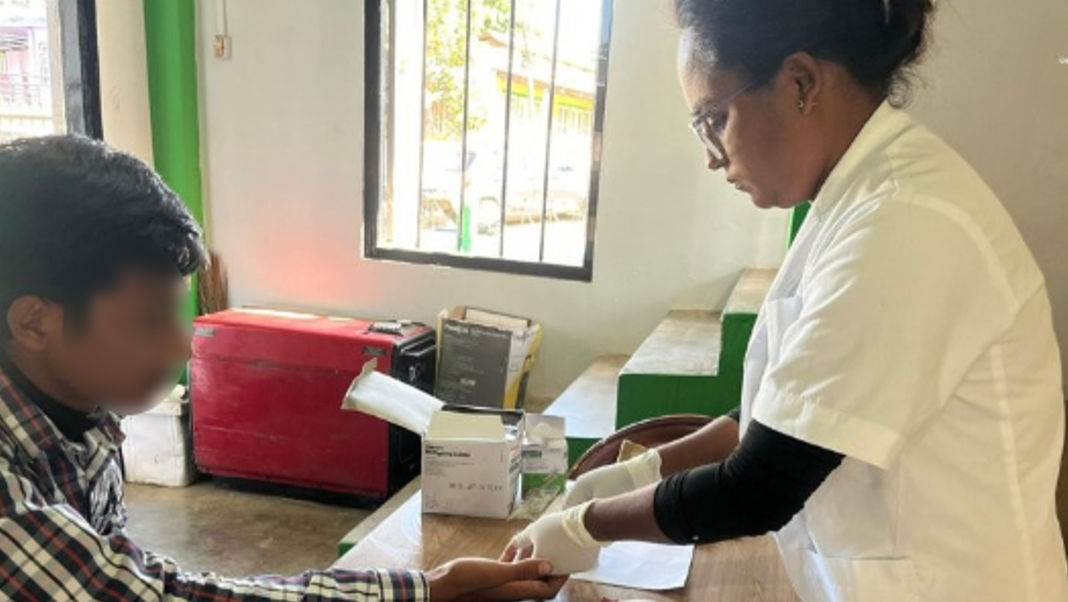

Shillong, Jan 22: Meghalaya is home to an estimated 9,244 people living with HIV, according to the India HIV Estimation 2025 Technical Report, which presents a mixed public health picture for the state—showing a rise in new HIV infections even as AIDS-related deaths have fallen sharply over the past decade.
The report, released by the National AIDS Control Organisation (NACO), provides a comprehensive assessment of the scale, distribution, trends, and impact of HIV at national, State/UT, and district levels. The annual HIV burden estimation is conducted under the National AIDS and STD Control Programme (NACP) in collaboration with the Indian Council of Medical Research – National Institute for Research in Digital Health and Data Science (ICMR-NIRDHDS) and other national and regional institutions.
Across the Northeast, Mizoram, Nagaland and Manipur continue to record the highest estimated adult HIV prevalence in the country. Mizoram leads with an adult HIV prevalence of 2.75 per cent in 2024, followed by Nagaland (1.37 per cent) and Manipur (0.81 per cent).
While Meghalaya’s prevalence remains lower than these states, the report flags a worrying upward trend. It notes that adult HIV prevalence has been rising sharply in Arunachal Pradesh, Meghalaya, Mizoram and Tripura, alongside Punjab. The trend appears stable in Nagaland, while Assam and Sikkim are seeing a slower rise.
At the state level, the number of people living with HIV (PLHIV) is a key indicator used to assess disease burden and guide the prioritisation of resources for testing, treatment, and prevention programmes. In Meghalaya, the report estimates that 8,892 adults aged 15 years and above are living with HIV, along with 351 children under 15 years and 1,231 young people aged 15–24 years.
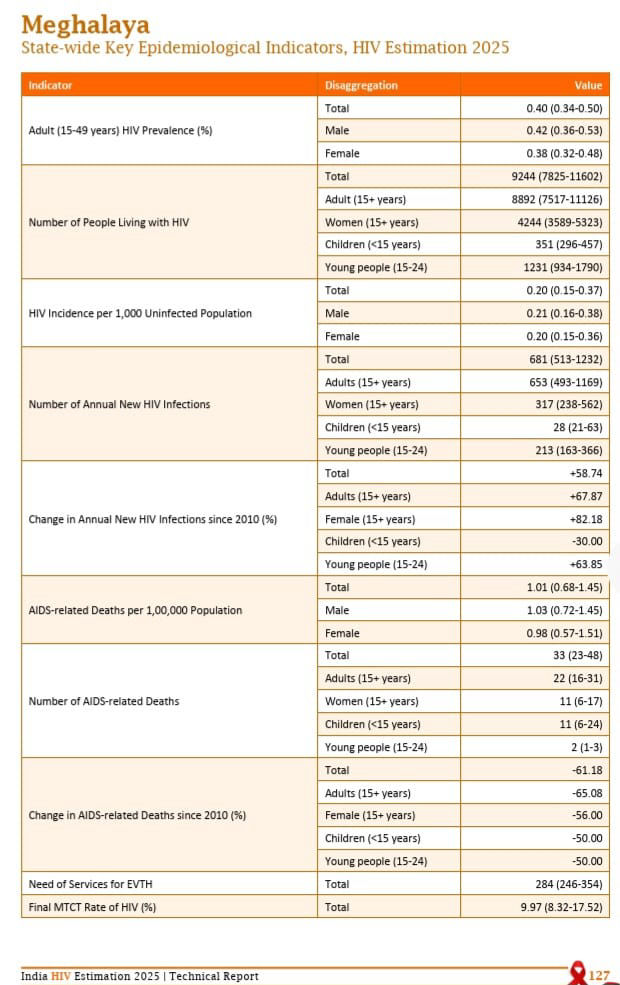
The estimated adult HIV prevalence (15–49 years) in Meghalaya stands at 0.40 per cent, with prevalence marginally higher among men (0.42 per cent) than women (0.38 per cent).
Of particular concern is the rise in new infections. Meghalaya records an estimated 681 new HIV infections annually, translating to an incidence rate of 0.20 per 1,000 uninfected population. Annual new infections have increased by nearly 59 per cent since 2010, with the sharpest rise seen among women—an increase of over 82 per cent—followed by young people aged 15–24 years, where infections have risen by nearly 64 per cent.
Public health experts say the data underlines the need for stronger prevention outreach, especially among women and youth, even as treatment outcomes show improvement.
In a positive development, AIDS-related deaths in Meghalaya have declined by more than 61 per cent since 2010. The state now records an estimated 33 AIDS-related deaths annually, with a death rate of 1.01 per 100,000 population. This decline is attributed to expanded access to antiretroviral therapy (ART), improved testing coverage, and better linkage to care services.
The report also highlights continued challenges in preventing mother-to-child transmission of HIV. Meghalaya’s final MTCT rate stands at 9.97 per cent, pointing to the need for stronger early testing, treatment adherence, and maternal health interventions. An estimated 284 pregnant women in the state require services each year to eliminate vertical transmission of HIV.
Experts stress that sustaining gains in treatment while intensifying prevention efforts will be critical to preventing a further rise in HIV infections in Meghalaya.
Also Watch
Find latest news from every corner of Northeast India at hubnetwork.in, your online source for breaking news, video coverage.
Also, Follow us on
Twitter-twitter.com/nemediahub
Youtube channel- www.youtube.com/@NortheastMediaHub2020
Instagram- www.instagram.com/ne_media_hub
Download our app from playstore – Northeast Media Hub