



Shillong, June 28: This is certainly good news for Meghalaya, as its protected areas have been rated “good” according to the Management Effectiveness Evaluation (MEE) 2020-25 report brought out by the Wildlife Institute of India.
MEE is an indispensable tool in improving the management of National Parks and Wildlife Sanctuaries, helping identify gaps and adopt effective conservation measures. The report was released recently.
The repeat cycle of MEE assessed 438 protected areas across different states and union territories, with an overall mean MEE score of 64.41%, indicating management effectiveness as “Good.” Among these, 84 protected areas were rated as “Very Good,” highlighting their strong management practices, adherence to conservation goals, and effective implementation of MEE recommendations.
Meghalaya got a mean MEE score of 65.87% and with a maximum MEE score of 79.17%. Six protected areas of Meghalaya were evaluated in the repeat cycle.
Nongkhyllem wildlife sanctuary has been rated as “very good” with a MEE score of 79.17% while Balpakram national park was rated as “good”. Narpuh wildlife sanctuary is “good”, Nokrek Ridge national park is “fair”, Siju wildlife sanctuary is “good”, and Baghmara Pitcher Plant wildlife sanctuary is “good”.
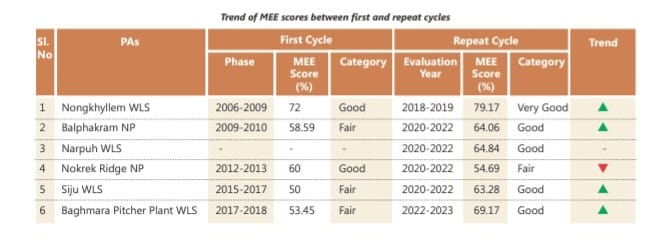
On Nongkhyllem wildlife sanctuary, the report says it has an approved management plan with proper zonation, and the ESZ has been notified. It has low biotic interference and includes several livelihood improvement programs to garner support from local communities, with systematic evaluation and routine reporting of management-related trends in place. The park was evaluated in 2018-19.
“However, some management weaknesses include the absence of a coordinated system for conducting wildlife censuses, limited staff trained in wildlife management, and a lack of coordinated research”, the report said.
The report has recommendations for training staff in wildlife management, standardising methodologies and periodicity for key wildlife species assessments, and improving coordination with research institutions.
On Balphakram National Park, which was evaluated in 2020-22, the report says the remoteness of the area poses challenges for protected area protection, management, and the implementation of various programs. Additional issues include insufficient staff numbers, inadequate capacity and protection infrastructure, heavy northeast monsoon rains, and low-intensity insurgency, all of which adversely affect management efforts. “It is recognised as a migratory route for elephants, and its relative inaccessibility has helped preserve local biodiversity and catchment values”, the report says.
The report recommends that it is crucial to improve the connectivity of the protected area with the outside world and involve local NGOs in creating participatory livelihood improvement and nature education programs.
Narpuh wildlife sanctuary, which was evaluated in 2020-22, is recognised as the only multi-storeyed, tall eastern tropical forest in the East Jaintia Hills. It was notified in 2014 to protect indigenous flora and fauna. However, the management plan expired in 2022, and there are no villages within the protected area. Local unemployed youth have formed voluntary protection squads to aid in its conservation.
The protected area faces several challenges, including inadequate staff numbers, poor skills and knowledge of wildlife management (particularly regarding participatory approaches), insufficient protection infrastructure, and a lack of effective eco-tourism, eco-development programs, nature education, and research-monitoring initiatives.
The report has recommended preparing a new management plan immediately and enhancing the planning and implementation of participatory programs with local communities for both protected area protection and livelihood improvement.
The Nokrek Ridge National Park was established in 1986 in the Nokrek ranges to protect the birthplace of Citrus indica and its germplasm. Known for its rich biodiversity, the area contains no villages and enjoys support from the surrounding local communities. However, the protected area faces significant challenges, including inadequate protection infrastructure, staff shortages, an inability to manage human wildlife conflicts effectively, and insufficient participatory programs, nature education, and research monitoring.
The report has recommendations for preparing a management plan immediately, improving staff numbers, skills, and the protection network, instituting participatory programs with local communities—particularly in eco-tourism that utilizes local myths and stories—and enhancing publicity and interpretation efforts to promote the significance of the place that gave Citrus indica to the world.
Siju wildlife sanctuary is the oldest and first protected area in Meghalaya was notified in 1989 in the southern Garo Hills for the protection of its catchment and biodiversity values. As part of the Balpakram-Baghmara and Siju-Rewak elephant corridor, the protected area is a crucial component of a larger conservation landscape.
The area is well known for bird watching and is home to five species of arboreal primates. There are no human settlements inside the protected area, and it has potential for developing eco-tourism programs.
However, the protected area suffers from several challenges, including staff shortages and inadequate training, poor infrastructure, and a lack of participatory programs. The report has recommended improving the protection network by increasing the numbers, capacities, and deployment of frontline staff, preparing a comprehensive management plan,
Coordinating with local scientific institutions for the documentation and cataloguing of biodiversity, ensuring better funding flow.
The Baghmara Pitcher Plant wildlife sanctuary attracts students, researchers, and nature enthusiasts, and an ESZ proposal has been prepared.
However, the protected area is an isolated patch located on a steep slope, making it difficult for visitors to access. It is vulnerable to landslides, erosion, and fires, with marginal grazing also taking place. The ecological status of the pitcher plant population and its habitat hasn’t been thoroughly studied, and a reported 40% decline in the species has occurred over the last 30 years. Local awareness of the plant is minimal, and other areas with significant pitcher plant populations remain unidentified. Additionally, pollution from plastic and glass waste poses a threat to the protected area.
The report has recommended incorporating an identified 8-hectare area in Baghmara reserved forest into the protected area network to enhance protection for the pitcher plant, improve visitor amenities, and raise awareness about the PA and the plant to attract more visitors.
Also Read: North East Catholic youth converge in Kohima for 5th Regional Convention
Also Watch
Find latest news from every corner of Northeast India at hubnetwork.in, your online source for breaking news, video coverage.
Also, Follow us on-
Twitter-twitter.com/nemediahub
Youtube channel- www.youtube.com/@NortheastMediaHub2020
Instagram- www.instagram.com/ne_media_hub
Download our app from playstore – Northeast Media Hub

 2020-25 report was brought out by the Wildlife Institute of India.)