


Meghalaya is no longer asking to be included in the Northeast story. It is increasingly shaping it.
Urmi Bhattacharjee
Shillong, June 16: The North East Infrastructure Summit that concluded this week in Shillong was far more than just highways, investment commitments and jaw-dropping numbers. It was the palpable expression of a transformation that has been steadily unfolding in Meghalaya over the better part of a decade.
In many ways, the summit marked an important moment in the state’s evolution. Meghalaya, once viewed as a peripheral player in regional development conversations, is increasingly emerging as one of the key voices shaping the future of the Northeast. The presence of Union ministers, policymakers, investors and representatives from all eight northeastern states in Shillong was not merely ceremonial. It reflected the growing confidence that the state has built through a combination of infrastructure development, institutional credibility and an increasingly ambitious vision for the future.
For much of its history, Meghalaya played a relatively modest role in regional conversations on growth, investment and connectivity. Discussions on infrastructure often revolved around larger states with bigger populations, greater political influence and stronger economic leverage. Despite its natural wealth and strategic location, Meghalaya was rarely viewed as a state capable of shaping the regional development agenda.
That perception is changing — and changing rapidly.
The shift has not gone unnoticed nationally. Prime Minister Narendra Modi has described Meghalaya as a “blueprint for a resilient and self-reliant India” — a remark that reflects how the state is increasingly being viewed beyond conventional development metrics. Whether through infrastructure, sports, tourism or governance, Meghalaya is beginning to be seen not merely as a beneficiary of national policies, but as a model of how those policies can be translated into tangible outcomes on the ground.
The symbolism of Shillong hosting the North East Infrastructure Summit should not be underestimated. Policymakers, investors, business leaders and representatives from across the region converged on Meghalaya to discuss the future of the Northeast. Moments like these rarely happen by accident. They are usually the culmination of years of institution-building, administrative credibility and the steady accumulation of trust.
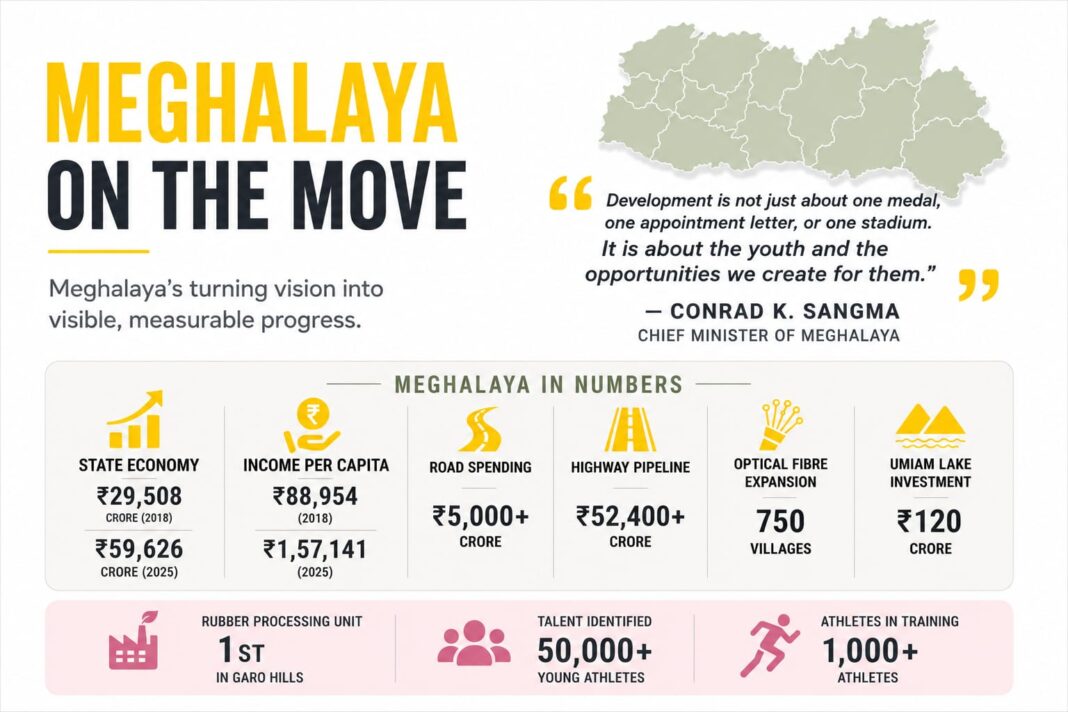
The scale of announcements made during the summit was undeniably impressive. Union Minister Nitin Gadkari unveiled a roadmap of highway projects that promises to transform Meghalaya’s connectivity landscape. More than ₹52,000 crore worth of highway projects are already under implementation in the state, while fresh commitments running into thousands of crores were announced during the summit. Strategic corridors linking Shillong with Dawki and Silchar, improving connectivity through the Garo Hills, and strengthening links to international border points have the potential to reduce travel times, boost trade and tourism, and unlock new economic opportunities.
Yet it is not merely the size of these investments that matters. What makes these announcements significant is Meghalaya’s growing reputation for converting promises into outcomes.
Across India, infrastructure announcements often become entangled in land disputes, environmental clearances and administrative delays. Meghalaya’s recent experience has been notably different. Several major projects have already been completed and opened to the public, while others are visibly progressing on the ground.
The Shillong-Dawki road upgrade, the Jowai Bypass and a series of strategic highway projects are no longer proposals in government presentations. They are concrete realities. This record of delivery has strengthened confidence among policymakers, investors and citizens alike.
There was a telling observation during the summit that “prosperity follows infrastructure.” Union Minister Nitin Gadkari has repeatedly argued that roads and connectivity are the foundation upon which investment, employment and economic growth are built. What was particularly striking in Shillong, however, was that the conversation was no longer about Meghalaya simply receiving infrastructure investments. For perhaps the first time, national infrastructure planning was being discussed with Meghalaya not merely as a beneficiary, but as a partner in shaping the Northeast’s growth story.
For decades, despite the rich possibilities of the region, the Northeast was viewed through the lens of remoteness and distance. Today, it is increasingly being viewed as a region of opportunity. Meghalaya, perhaps more than most, is helping turn that vision into reality.
The story does not end with roads.
Barely 24 hours after headlines focused on highways and connectivity, Shillong hosted the Meghalaya Sports Conclave 2026. At first glance, the two events appeared unrelated — one about concrete and connectivity, the other about athletes and ambition. Yet together, they offered a glimpse into the state’s larger development philosophy.
Addressing the conclave, Chief Minister Conrad K. Sangma remarked: “Development is not just about one medal, one appointment letter, or one stadium. It is about the youth and the opportunities we create for them.”
Though made in the context of sports, the statement captures a broader vision increasingly shaping Meghalaya’s development trajectory. Roads, sports infrastructure, digital connectivity, tourism investments and youth-focused programmes are not being viewed as isolated achievements. They are being treated as building blocks for future opportunity.
The sports conclave itself reflected that ambition. Olympic medallists, world champions, sports administrators and policymakers gathered in Shillong to discuss athlete development, sports governance and the future of Indian sport. A decade ago, the idea of Meghalaya hosting such a gathering would have seemed improbable. Today, it feels entirely natural.
Preparations for the 39th National Games have become symbolic of the state’s wider aspirations. Significant investments have been committed to sports infrastructure and athlete development, with hundreds of projects completed, underway or planned. Talent identification drives have reportedly reached more than 50,000 young athletes, while over 1,000 are currently undergoing structured training programmes.
While these numbers are impressive, the more profound transformation may be psychological.
Chief Minister Sangma has often spoken about mindset as Meghalaya’s greatest transformation. Political leaders frequently use such language, but in this case there is evidence to support the claim. A state that once questioned its ability to host major national events is now preparing to host one of India’s biggest sporting spectacles. It is building what is expected to be the country’s largest football stadium and inviting Olympic champions to Shillong not merely as guests, but as participants in a larger conversation about the future of sport.

Confidence, after all, is an economic asset.
It shapes government decisions, influences investor sentiment and determines how young people imagine their futures. Development is rarely driven by infrastructure alone. It also requires belief — belief that ambitious goals are achievable and belief that a state can compete with the best in the country.
Economic indicators reinforce this broader narrative. State revenues have expanded, infrastructure spending has increased, and sectors such as tourism, sports, digital services and agriculture have received sustained policy attention. Investments in rural connectivity, digital infrastructure and livelihood programmes suggest a deliberate attempt to broaden growth beyond flagship projects.
It would be misleading, however, to suggest that Meghalaya’s challenges have disappeared. Significant gaps remain in healthcare, education, urban infrastructure and employment generation. Traffic congestion continues to frustrate residents. Income growth has not always kept pace with broader economic expansion, and many communities are yet to experience the full benefits of development. These concerns are real and of course deserve attention.
But they do not diminish the larger story. States are not judged solely by the problems they face; they are judged by the direction in which they are moving. By that measure, Meghalaya’s trajectory is becoming increasingly difficult to ignore.
The growing national attention on Meghalaya stems from precisely this reason. Increasingly, the discussion is not only about roads built, funds allocated or projects announced. It is about execution, ambition and the ability of a relatively small state to punch above its weight. In that sense, the recognition Meghalaya is receiving today may be as significant as the investments themselves.
The state is attracting investment, improving infrastructure, nurturing sporting ambition and building institutional credibility at a pace few would have predicted a decade ago.
Beyond these tangible outcomes lies a deeper narrative – A state that once sought attention is now commanding it. A state that occupied the margins of the Northeast’s development story is steadily moving toward its centre.
History rarely announces turning points in real time. Most become visible only in hindsight. When that hindsight arrives, this period may well be remembered as the moment Meghalaya stopped waiting for its future and began defining it.
Also Read: Shillong summit charts infrastructure-led growth roadmap for Northeast
Also Watch
Find latest news from every corner of Northeast India at hubnetwork.in, your online source for breaking news, video coverage.
Also, Follow us on
Twitter-twitter.com/nemediahub
Youtube channel- www.youtube.com/@NortheastMediaHub2020
Instagram- www.instagram.com/ne_media_hub
Download our app from playstore – Northeast Media Hub