


ROOPAK GOSWAMI
Shillong, April 21: In a striking discovery from Meghalaya’s caves, researchers have recorded a microscopic land snail inside the state’s cave systems for the first time—shedding new light on hidden biodiversity and raising conservation concerns.
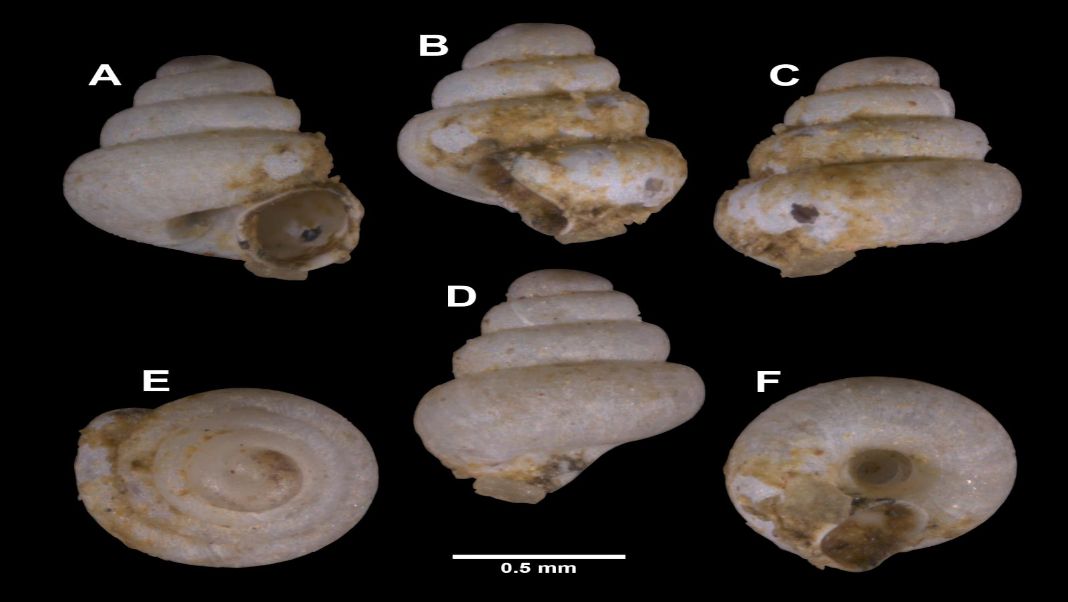
The study, authored by Nipu Kumar Das, N.A. Aravind, András Hunyadi, and Barna Páll-Gergely, identifies the species as Angustopila milium—a snail barely 1 millimetre in size. The findings are based on shell samples collected during field surveys in 2022 from Krem Puri and Mawjymbuin caves, the authors said.
The finding not only marks a first for Meghalaya’s caves but also reshapes scientific understanding of the species’ distribution.
While the species was previously known from the Shillong Plateau, this marks its first confirmed documentation from cave environments in Meghalaya, expanding understanding of its ecological range.
“This study began in 2022, when I received a grant from the Malacological Society of London, UK, to explore molluscan diversity in caves of Meghalaya,” said Nipu Kumar Das. “During fieldwork, we collected tiny land snail shells from Krem Puri and Mawjymbuin caves, which were initially thought to represent a local species. However, detailed examination showed they are actually the same as Angustopila elevata.”
Das added that additional records from Nepal helped confirm the finding, significantly altering the known distribution of the species.
“This discovery shows that Angustopila milium is far more widespread than previously known, highlighting how even the smallest organisms can reveal important insights into biodiversity,” he said. “It also underscores the importance of subterranean habitats, which remain poorly explored yet biologically significant.”
A Hidden World Inside Caves
The shells were found in distinct microhabitats within the caves—on dry walls a few metres from the entrance, in humid twilight zones, and along moss-covered rocky surfaces that support microfauna.
However, researchers caution that the species may not be a strict cave dweller. The shells could have been transported into the caves through water movement or other natural processes.
One of the study’s most significant revelations is taxonomic: Angustopila milium has been shown to be the same species as Angustopila elevata. This reclassification dramatically extends its known range across India, Nepal (a new record), Thailand, Laos, Vietnam, and southern China.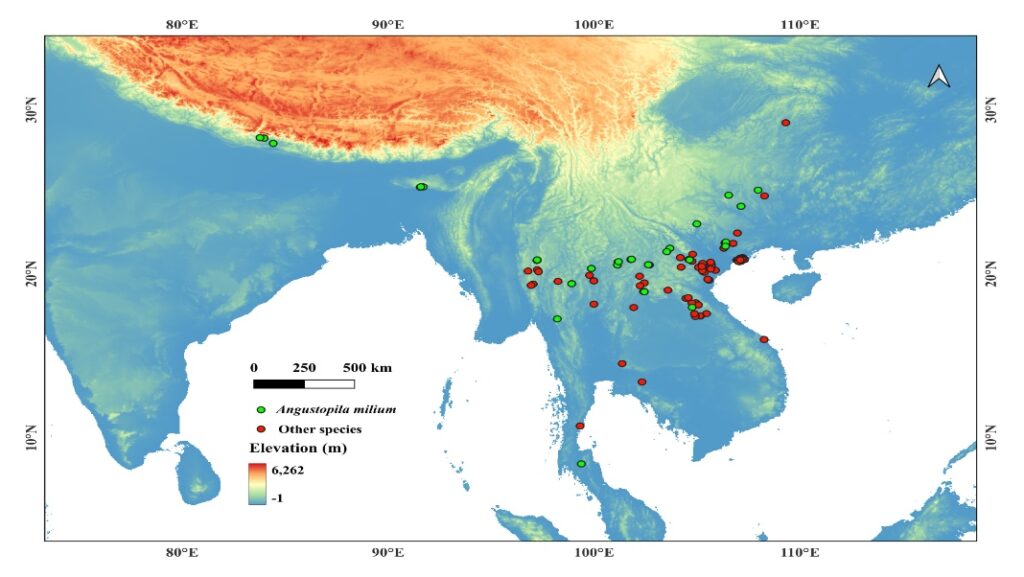
The finding makes it one of the most widely distributed land snails in South and Southeast Asia—though researchers note that such a broad distribution could point to a complex of visually similar but genetically distinct species.
“It is remarkable that such a tiny snail can span a vast range from Nepal to Thailand,” said co-author N.A. Aravind. “This raises compelling questions about its dispersal mechanisms and the evolutionary adaptations that enable it to thrive across diverse climatic conditions.”
Conservation Concerns Rise
The discovery also draws attention to ecological pressures facing Meghalaya’s caves. Both Krem Puri—recognised as the world’s longest sandstone cave—and Mawjymbuin are popular tourist destinations.
Researchers warn that high footfall could disturb fragile cave ecosystems, alter humidity and temperature, and threaten the survival of microscopic organisms.
For Meghalaya, the study is a reminder that its caves are not just geological marvels but reservoirs of largely unexplored life.
The authors emphasise that further anatomical and molecular research is needed to understand the species fully and determine whether it represents a single widespread species or a complex of cryptic lineages.
The findings underline how much of Meghalaya’s cave biodiversity remains unexplored.
Also Read: GTF ends 12-day hunger strike after Meghalaya Govt drops Lumpongdeng Island from Taj project
Also Watch
Find latest news from every corner of Northeast India at hubnetwork.in, your online source for breaking news, video coverage.
Also, Follow us on
Twitter-twitter.com/nemediahub
Youtube channel- www.youtube.com/@NortheastMediaHub2020
Instagram- www.instagram.com/ne_media_hub
Download our app from playstore – Northeast Media Hub