


AVIK CHAKRABORTY
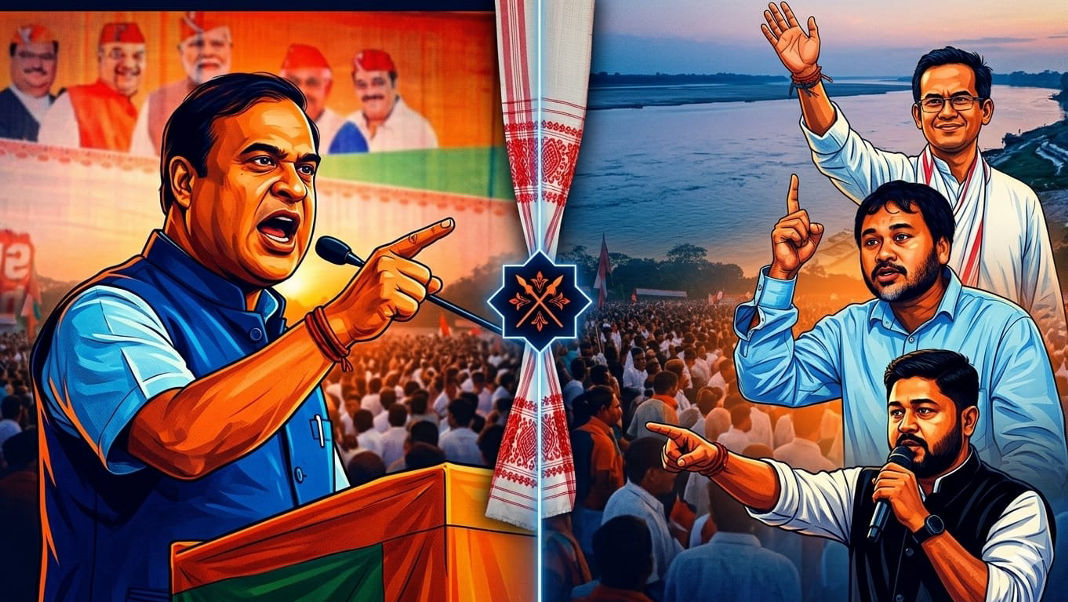
Guwahati, March 21: In Assam’s politically crucial Upper Assam region, the upcoming assembly elections are shaping up as a compelling contest—pitting a powerful incumbent against an unusual opposition trio bound not by party, but by a shared surname.
At the centre of the battle is Chief Minister Himanta Biswa Sarma, widely seen as one of the Bharatiya Janata Party’s (BJP) most formidable strategists in the Northeast. Challenging his dominance are what local observers are calling the “three Gogois”—Gaurav Gogoi, Akhil Gogoi, and Lurinjyoti Gogoi.
Upper Assam is not just another electoral zone—it is widely regarded as the political and cultural heartland of ethnic Assamese identity, dominated by the Ahom community, a historically influential group whose legacy continues to shape the region’s politics. Control over this belt often determines the broader electoral outcome in the state, and in 2021, the BJP swept most of these constituencies, consolidating its hold on Assam.

Who Are the Ahoms—and Why They Matter
The Ahoms trace their origins to Tai groups that migrated into the Brahmaputra Valley in the 13th century, establishing a powerful kingdom in 1228 that went on to rule much of present-day Assam for nearly six centuries, until the early 19th century. Over time, they assimilated with local communities, playing a central role in shaping Assamese identity, culture, and political consciousness, making them a decisive force in contemporary electoral politics.
BJP’s Strategy: Consolidating the Ahom Vote
To retain its dominance, the BJP has fielded a slate of candidates from the Ahom community across key constituencies such as Naharkatia, Mahmora, Nazira, and Sonari. Leaders like Taranga Gogoi, Chakradhar Gogoi, and Sushanta Borgohain have been strategically chosen to align with local identity politics. The approach is aimed at consolidating Ahom votes, countering the influence of the Gogoi leaders, and preventing fragmentation in what is expected to be a tightly contested region. As one political observer noted, the BJP “does not want to take any risks in Upper Assam, where identity and community equations remain decisive.”
The ‘Three Gogois’: Different Paths, One Goal
Despite sharing a surname, the three Gogoi leaders represent distinct strands of opposition politics. Gaurav Gogoi, son of former Chief Minister Tarun Gogoi, embodies the Congress party’s legacy and currently leads its state unit. Akhil Gogoi, a grassroots activist-turned-politician, rose to prominence during protests against the Citizenship Amendment Act (CAA) and made headlines by winning the 2021 election from jail. Lurinjyoti Gogoi, a former student leader and key face of Assamese nationalism, has steadily expanded his influence despite electoral setbacks. Together, they reflect a convergence of legacy politics, grassroots mobilisation, and regional assertion.
An Uneasy Opposition Alliance
For this election, the Congress has aligned with regional forces such as Raijor Dal, conceding seats in a bid to avoid splitting the opposition vote—a factor that hurt them in previous elections. However, the alliance has been far from seamless. Seat-sharing negotiations nearly collapsed, and internal disagreements, particularly between Gaurav and Akhil Gogoi, have exposed underlying tensions. At the same time, the Congress has chosen to keep the AIUDF out of the alliance, aiming to avoid religious polarisation that could consolidate ethnic Assamese Hindu votes in favour of the BJP and its ally, the Asom Gana Parishad.
The Social Math: Ahoms and Tea Tribes
The electoral dynamics of Upper Assam are shaped largely by two influential groups—the Ahoms and the tea tribes—both of whom play a decisive role in determining outcomes across constituencies. Their voting patterns often tilt the balance, making the region a critical battleground in every election cycle.
What’s at Stake in 2026
While the BJP enters the contest as the dominant force, the race this time is expected to be tighter. With a strong incumbent on one side and a rare, if uneasy, opposition convergence on the other, Upper Assam is poised to witness one of the most closely watched political contests in India this year. As one analyst observed, this election is not merely routine—it is a test of whether identity-driven politics will prevail, or whether opposition unity can reshape the state’s political landscape.
Also Read: Assam: Rebel BJP leader Jayanta Das alleges 10,000 fake social media accounts run from party office
Also Watch
Find latest news from every corner of Northeast India at hubnetwork.in, your online source for breaking news, video coverage.
Also, Follow us on
Twitter-twitter.com/nemediahub
Youtube channel- www.youtube.com/@NortheastMediaHub2020
Instagram- www.instagram.com/ne_media_hub
Download our app from playstore – Northeast Media Hub