

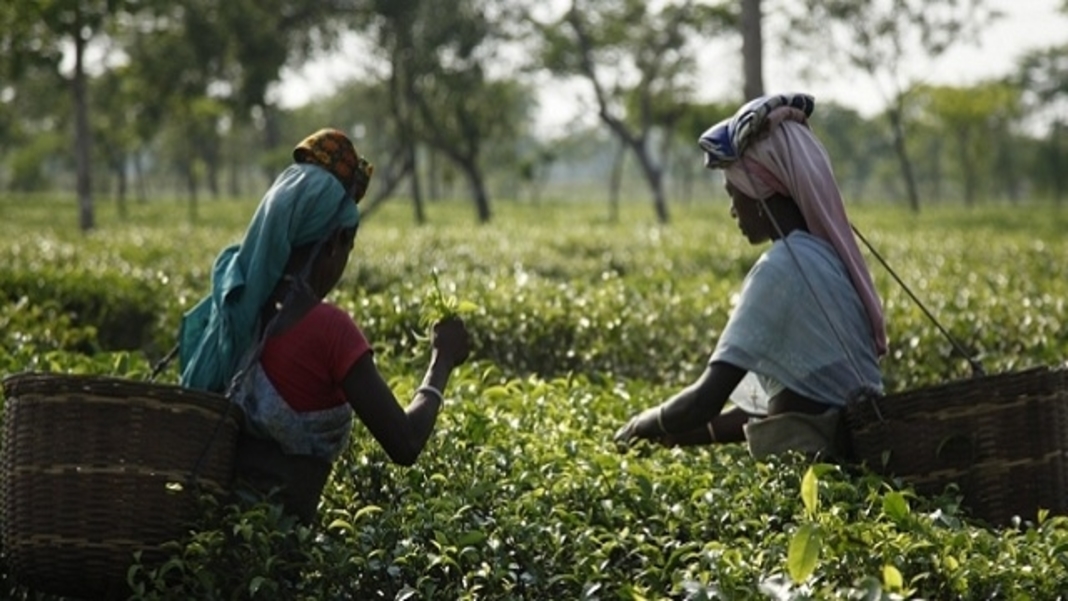

Guwahati, Dec 8: A sweeping land acquisition drive launched by the Assam government to grant land rights to over 3.33 lakh tea worker families has triggered serious concerns among tea planters, with the Consultative Committee of Planters Association (CCPA) urging the State to ensure fair compensation and clear accountability before proceeding.
Assam plans to acquire 2,18,553 bighas across 825 tea estates, making it one of the largest land redistribution exercises ever undertaken for tea communities.
The CCPA — the apex body representing tea planter associations — has written to the Chief Secretary seeking compensation under the Right to Fair Compensation and Transparency in Land Acquisition, Rehabilitation and Resettlement Act, 2013, arguing that estate owners must be adequately compensated for land being taken over for distribution of land pattas to workers.

District administrations have already started survey work across tea estates, beginning with Tinsukia — home to 122 registered gardens, the second-highest in Assam — following the passage of the landmark Assam Fixation of Ceiling on Land Holding (Amendment) Bill, 2025 on November 28.Officials led by Tinsukia Deputy Commissioner Swapneel Paul initiated the mapping and verification process after a high-level meeting with revenue and labour officials and tea management representatives.
But on the ground, unease is rising.
Planters fear it could fundamentally reshape the structure of the tea industry.
A senior planter, requesting anonymity, warned that once workers receive individual land titles, “it will be extremely difficult to ensure daily attendance in garden operations,” adding that the move may also “trigger unforeseen law-and-order challenges.”
Beyond operational worries, planters are also examining legal recourse, arguing that “takeover and redistribution of such land may not be legally tenable,” especially where ownership and leasehold structures are complex.

The CCPA has also highlighted another looming issue:
With the Centre implementing the Occupational Safety, Health & Working Conditions (OSH&WC) Code, 2020 from November 21, 2025, the “status of garden labour lines” may change after the land is acquired. Once those areas cease to be part of the estate, garden managements, the CCPA said, should no longer be responsible for welfare obligations in the acquired zones — a provision they insist must be formally recognised.
Supporters say the initiative is a historic step toward granting dignity and ownership to workers who have lived for generations on estate land.
Despite these debates, Assam’s move signals a profound shift: a transition from employer-controlled housing to worker-owned spaces, raising big questions for global supply chains, sustainability standards, labour rights, and plantation economics.
Whatever side one takes, the reform marks a turning point.
Also Read: Assam launches intensive one-year drive to end child marriage in 30 high-risk districts
Also Watch
Find latest news from every corner of Northeast India at hubnetwork.in, your online source for breaking news, video coverage.
Also, Follow us on
Twitter-twitter.com/nemediahub
Youtube channel- www.youtube.com/@NortheastMediaHub2020
Instagram- www.instagram.com/ne_media_hub
Download our app from playstore – Northeast Media Hub

 urging the State to ensure fair compensation and clear accountability before proceeding.)