

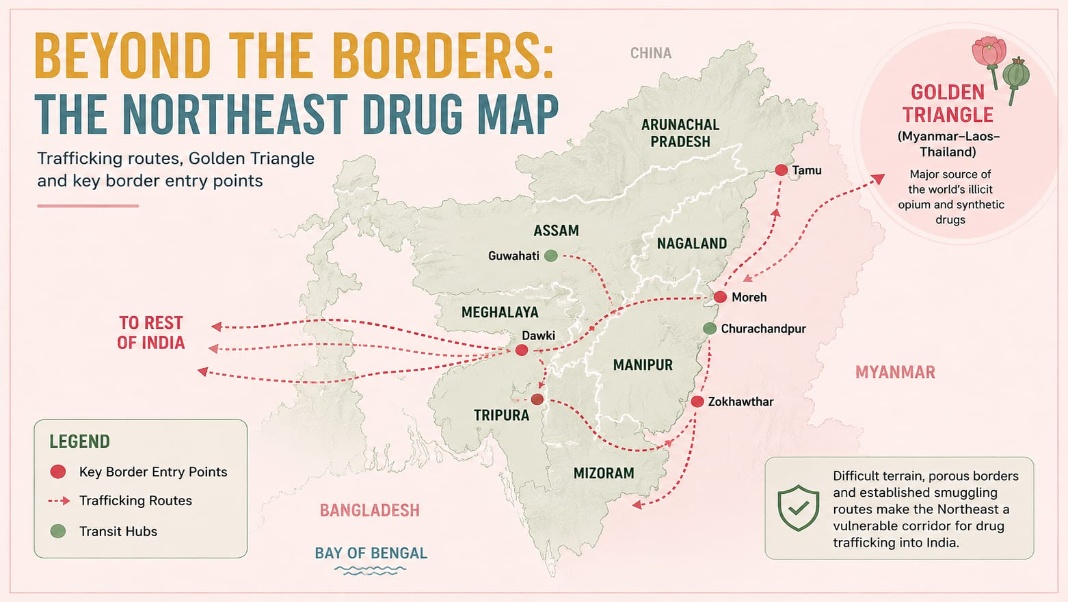

Record seizures, sharper enforcement and expanding rehabilitation efforts reflect a changing battle on World Drug Day. Yet the region’s proximity to the Golden Triangle continues to keep it on the frontlines of India’s narcotics crisis.
Urmi Bhattacharjee
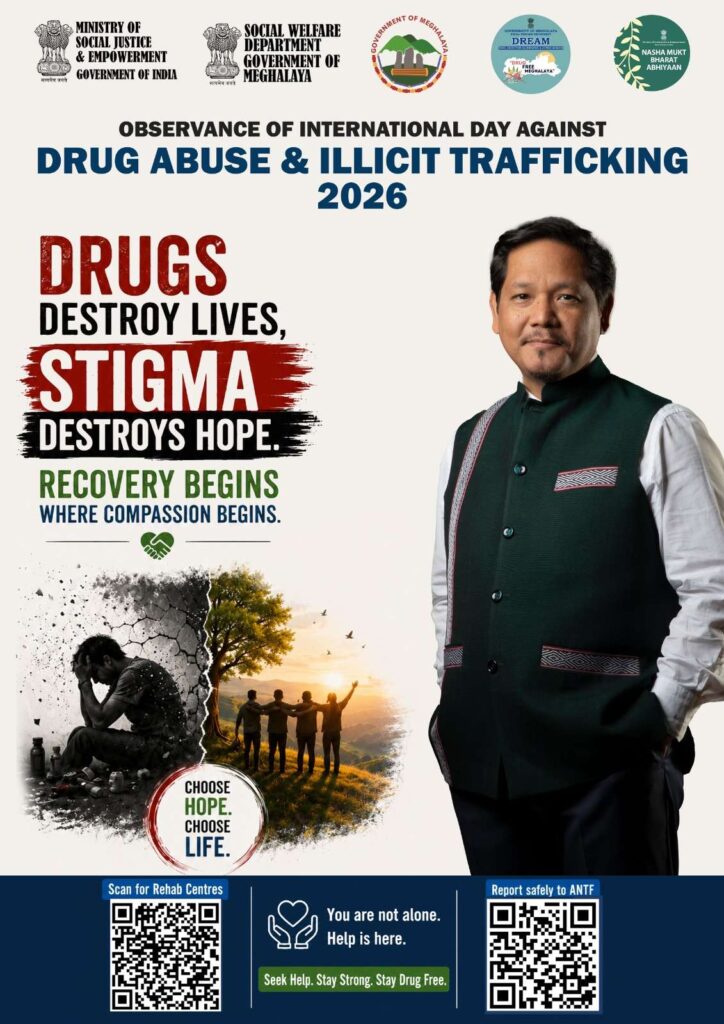
Guwahati: As governments organise awareness drives, renew their commitment to a drug-free society and reinforce anti-drug campaigns, states across the Northeast marked the International Day Against Drug Abuse and Illicit Trafficking with programmes led by police forces, civil society organisations, schools and local communities. The observance also coincides with the Centre’s nationwide Nasha Mukt Bharat Saptah, a 10-day campaign focused on prevention, awareness and rehabilitation.
But beyond these observances lies a much larger story.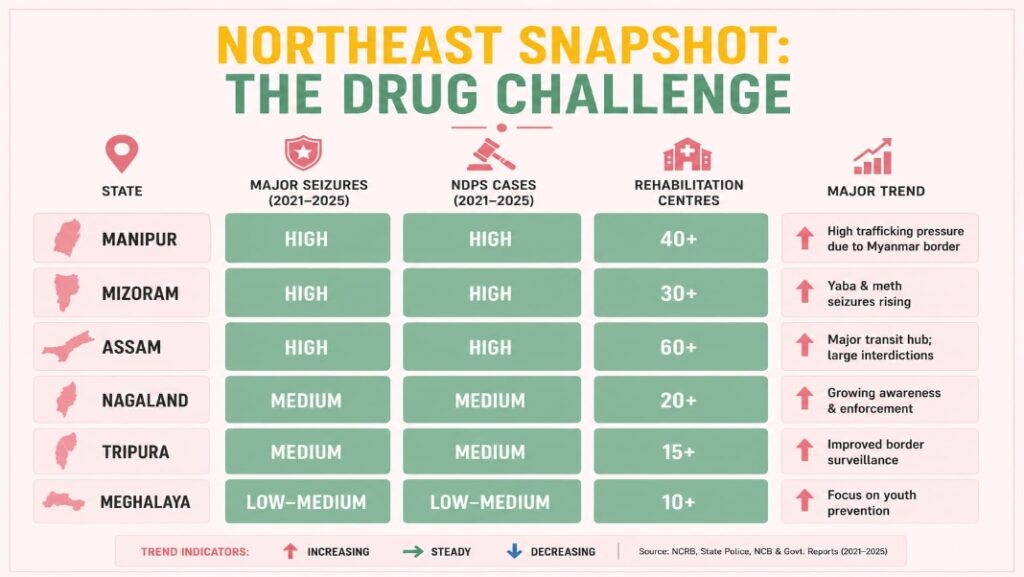
Over the past few years, the Northeast has emerged as both one of India’s most vulnerable regions and one of its biggest battlegrounds against narcotics trafficking. Large seizures of heroin, methamphetamine, yaba tablets and other psychotropic substances reflect both intensified enforcement and the sheer scale of trafficking networks operating through the region.

The Northeast’s geography lies at the heart of the challenge. Several states share long international borders with Myanmar and Bangladesh, placing the region close to the Golden Triangle—the Myanmar-Laos-Thailand border region long associated with illicit opium cultivation and the manufacture of synthetic drugs. Traffickers exploit difficult terrain, porous borders and well-established smuggling routes to move narcotics into India before distributing them across the country.
The drugs flowing through the Northeast are also changing. While heroin, derived from opium, continues to account for a significant share of seizures, enforcement agencies are increasingly intercepting methamphetamine and yaba tablets—a combination of methamphetamine and caffeine—manufactured in and around the Golden Triangle. Yaba, widely known as a stimulant tablet, is easy to transport and has found a growing market in parts of the region. Officials also continue to seize raw opium, cannabis and pharmaceutical narcotics, indicating that traffickers are diversifying both their supply chains and the substances reaching Indian markets.
The fight itself has undergone a significant transformation.
Law enforcement agencies no longer rely solely on intercepting drug consignments at border checkpoints and highway barriers. Police, central agencies and border guarding forces are increasingly using intelligence-led operations, surveillance, financial investigations and inter-state coordination to dismantle organised trafficking networks. At the same time, governments are expanding awareness campaigns and rehabilitation programmes, recognising that addiction is as much a public health challenge as it is a law-and-order issue.
Yet the burden is not shared equally.
Manipur and Mizoram continue to face intense trafficking pressure because of their proximity to Myanmar. Assam, with its extensive rail and highway network, has increasingly become a transit hub where major consignments are intercepted before being transported to other parts of India. Nagaland and Tripura have stepped up enforcement and public awareness campaigns, while Meghalaya has intensified anti-drug drives in educational institutions and vulnerable communities.
The human cost extends far beyond seizure statistics.
Doctors, counsellors and de-addiction centres across the Northeast continue to warn about rising substance abuse among young people. Experts point to a combination of factors—including easy availability, peer pressure, mental health challenges, unemployment and social vulnerability—as drivers of addiction. Families often experience the consequences long before a case reaches a police station.
The response, therefore, cannot rest on enforcement alone.
Large drug seizures may disrupt supply chains, but breaking the cycle of addiction requires prevention, education, community participation and accessible rehabilitation. That philosophy underpins the Centre’s Nasha Mukt Bharat Abhiyaan, which combines public awareness with volunteer engagement and de-addiction initiatives.
For the Northeast, the challenge remains uniquely complex. Its strategic location has made it both India’s gateway to Southeast Asia and a key transit corridor for narcotics trafficking. Even as border infrastructure improves and surveillance becomes more sophisticated, trafficking networks continue to evolve, making this an ever-changing battle.
On this World Drug Day, the Northeast’s fight against narcotics should no longer be measured only by the tonnes of drugs seized or the number of traffickers arrested. Its real success will be measured by how many young people are kept away from addiction, how many lives are rebuilt through rehabilitation, and how effectively organised trafficking networks are dismantled.