

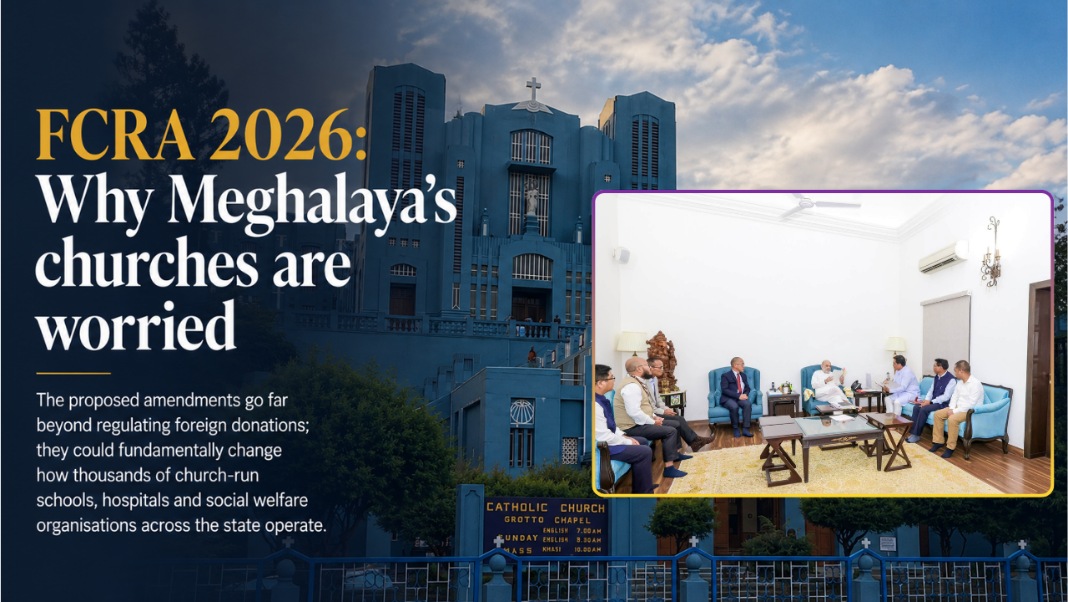

The proposed amendments go far beyond regulating foreign donations; they could fundamentally change how thousands of church-run schools, hospitals and social welfare organisations across the country operate.
When Meghalaya Chief Minister Conrad K. Sangma, along with senior church leaders from the state, called on Union Home Minister Amit Shah earlier this week, the discussion was not merely about foreign funding. It was about the future of institutions that have long served as the backbone of education, healthcare and social service delivery in Meghalaya.
The delegation represented prominent faith-based organisations, including the Presbyterian Church of India, the North East India Christian Council, the Catholic Archdiocese of Shillong and the Garo Baptist Convention. Their central message to the Union government was that any changes to the Foreign Contribution (Regulation) Act (FCRA) must take into account Meghalaya’s unique socio-cultural context, where churches play a pivotal role in running schools, hospitals, orphanages and community outreach programmes, particularly in rural and tribal areas.
Their concerns stem from the Foreign Contribution (Regulation) Amendment Bill, 2026, introduced in Parliament this year, and the corresponding FCRA Amendment Rules, 2026, notified in June. Together, they represent one of the most significant overhauls of India’s foreign funding framework in recent years.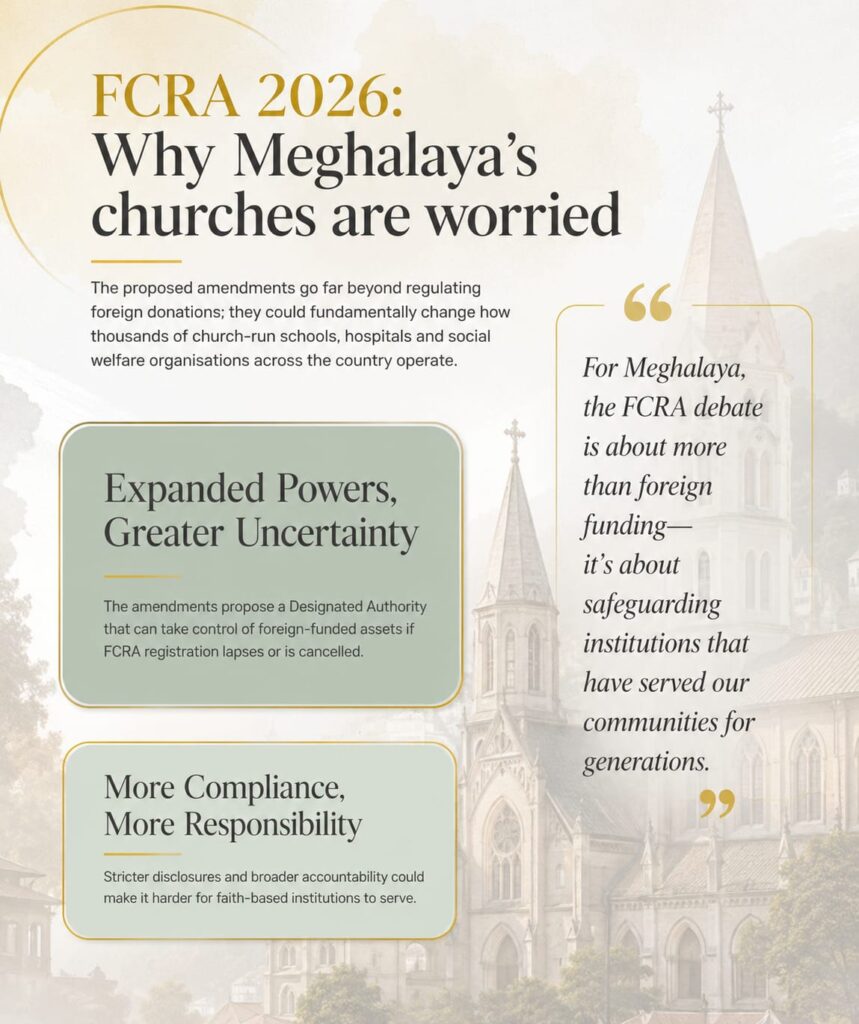
Unlike earlier provisions that largely focused on regulating the receipt and utilisation of foreign funds, the proposed reforms extend to asset management, institutional governance and a much broader compliance regime.
One of the most debated provisions is the creation of a Designated Authority.
Under the proposed law, any organisation whose FCRA registration is cancelled, surrendered, not renewed or allowed to lapse would have its foreign contributions, along with assets created from those funds, placed under the supervision of a government-appointed Designated Authority. If the registration is not restored within the stipulated period, those assets could permanently vest with the Authority, which would then have the power to transfer them to government agencies, dispose of them or utilise them for public purposes.
This provision carries particular significance for church-run institutions, many of whose schools, colleges, hospitals, hostels and welfare centres have been built over decades through a combination of foreign donations, local fundraising and community support.
The proposed framework also raises important questions about how such mixed-funded assets would be treated if an institution were to lose its FCRA registration. Legal experts note that while the Bill provides a mechanism for reclaiming assets created entirely through domestic funds, the process would ultimately depend on decisions taken by the Designated Authority.

The amendments also widen the scope of accountability within organisations.
Earlier, FCRA compliance was largely the responsibility of office-bearers. Under the proposed framework, trustees, directors, governing body members and others exercising managerial control may also be classified as key functionaries, thereby expanding personal responsibility for compliance.
The newly notified Rules further increase compliance requirements. Organisations applying for FCRA registration or renewal must now provide detailed disclosures, including their social media accounts, the precise nature of their activities, approved objectives and the geographical areas in which they intend to operate. The government maintains that these measures are intended to strengthen transparency, accountability and the traceability of foreign funds from donor to beneficiary.
Supporters of the amendments argue that tighter regulations are necessary to prevent misuse of foreign funding and safeguard national security. They believe the proposed changes also provide greater clarity on issues such as asset management when an organisation ceases to function.
Critics, however, contend that the amendments significantly expand government control over civil society organisations. They argue that the enhanced powers over institutional assets, coupled with stricter compliance requirements and broader definitions of organisational responsibility, could make it considerably more difficult for genuine charitable and faith-based institutions to function, particularly those engaged in education, healthcare and social welfare.
For Meghalaya, the debate extends well beyond legal or administrative questions.
Church-run institutions are deeply woven into the state’s social fabric, providing essential educational, healthcare and welfare services in areas where government infrastructure is often limited. Any disruption to their functioning could have far-reaching consequences for thousands of students, patients and vulnerable communities.
That is precisely why the delegation’s visit to New Delhi assumed such significance. By personally leading church leaders to meet the Union Home Minister, the Meghalaya Chief Minister underscored that, from the state’s perspective, the FCRA debate is about far more than foreign funding. It is about safeguarding institutions that have served communities and shaped Meghalaya’s social development for generations.
Also Read: A sticker on the door is helping save mothers’ lives in Meghalaya
Also Watch
Find latest news from every corner of Northeast India at hubnetwork.in, your online source for breaking news, video coverage.
Also, Follow us on
Twitter-twitter.com/nemediahub
Youtube channel- www.youtube.com/@NortheastMediaHub2020
Instagram- www.instagram.com/ne_media_hub
Download our app from playstore – Northeast Media Hub