


ROOPAK GOSWAMI
Guwahati, Feb 28: In a quiet Garo village in Assam’s Goalpara district, close to Meghalaya’s western edge, a routine look inside a dug-out well has revealed something extraordinary — a tiny, blind fish never seen before anywhere in Northeast India.
An international team of scientists from Germany, India and Switzerland has formally described the species as Gitchak nakana, marking the first-ever groundwater-dwelling (phreatobitic) fish recorded from the Northeast and the wider Eastern Himalayan landscape. The discovery has been published in Scientific Reports.
A Garo Name, A Garo Discovery
The name itself carries deep meaning for Meghalaya’s Garo community.
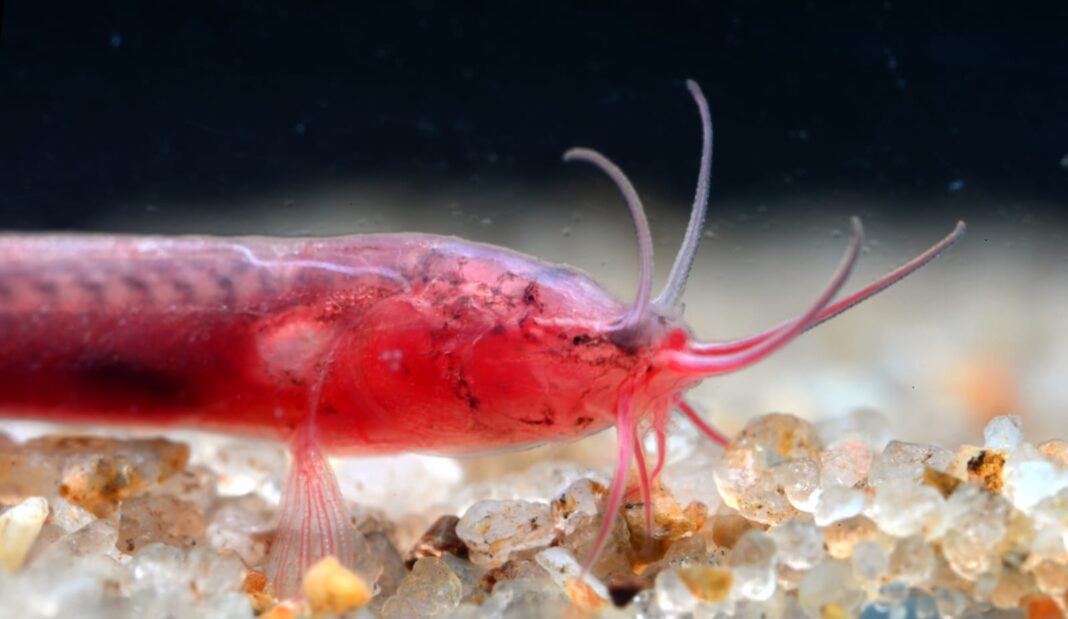
“Gitchak” means red in Garo, while “na-tok” and “kana” mean fish and blind — a direct reference to the animal’s appearance and its complete lack of eyes.
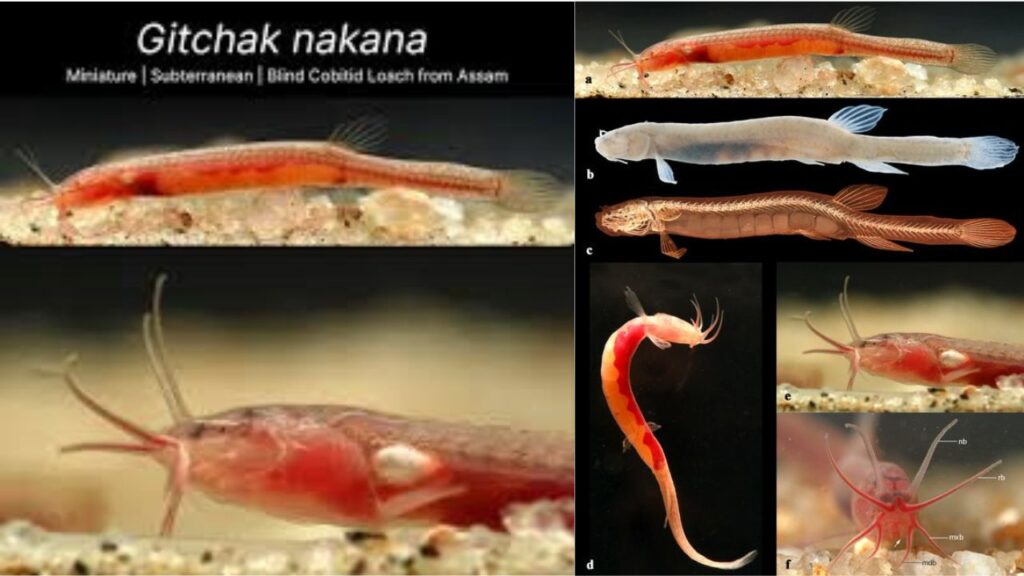
Barely two centimetres long, the fish is pigmentless and translucent. In life, it appears blood-red because its internal organs and blood vessels are visible through its skin. It belongs to an entirely new genus within the loach family (Cobitidae), showing classic subterranean adaptations — loss of eyes and pigmentation, features known as troglomorphies.

The fish was first collected in March 2021 by Wimarithy K. Marak, then a PhD scholar at Assam Don Bosco University, along with her brother Leminard K. Marak in their native village. Initially unsure of what they had found, the specimen was later examined with Dr Lokeshwor Yumnam.
“This discovery raises an exciting question,” said Dr Yumnam. “Are there more aquifer-dwelling species waiting to be discovered beneath Northeast India?”
Thirteen individuals were collected across three separate visits to the same well — suggesting the species may be extremely rare and highly localised.
Different from Meghalaya’s Cave Fishes
Meghalaya is already globally known for its subterranean biodiversity, especially in the caves of the Shillong Plateau, home to species such as:
Neolissochilus pnar, the world’s largest known cave fish
Schistura papulifera
Schistura larketensis
But those fishes inhabit caves.
Gitchak nakana is different. It lives in groundwater aquifers — water stored within underground rock layers — habitats that are far more inaccessible and poorly studied. Scientists describe it as the first confirmed phreatic fish from Northeast India.
A Fish Without a Skull Roof
What stunned researchers most was its anatomy.
Using high-resolution micro-CT scans at the Senckenberg Collections in Dresden, scientists discovered that Gitchak nakana completely lacks a skull roof — leaving its brain covered only by skin. Such a condition is extremely rare among bony fishes and has only been reported in a few highly miniaturised species.
Genetic studies led by Dr Lukas Rüber in Switzerland and Prof Rajeev Raghavan in Kochi revealed that the lineage diverged from its closest relatives between 21 and 45 million years ago — far older than the relatively young alluvial sediments of the Brahmaputra basin where it was found.
This suggests that either ancient aquifer habitats have persisted in the region for millions of years, or that the fish’s ancestors once lived on the surface before retreating underground.
Conservation Concerns Close to Home
So far, the species has been found in only one well. Its precise location has been withheld to prevent disturbance.
Prof Rajeev Raghavan cautioned that even rare subterranean fishes are increasingly entering the aquarium trade. For instance, Neolissochilus pnar from Meghalaya has recently surfaced in international markets despite limited knowledge of its population size.
“Better understanding of distribution, population size and threats is essential before conservation action can be planned,” he said.
India ranks fourth globally in subterranean fish diversity, largely because of cave systems in Meghalaya and aquifer species in Kerala. With this discovery in a Garo village near Meghalaya’s border, the Brahmaputra valley now emerges as a new underground biodiversity frontier.
For Meghalaya, the message is profound: beneath our wells, aquifers and caves may lie ancient life forms that have survived for millions of years — unseen, fragile, and waiting to be understood.
Also Read: NPP appoints Mmhonlumo Kikon as National General Secretary (Political)
Also Watch
Find latest news from every corner of Northeast India at hubnetwork.in, your online source for breaking news, video coverage.
Also, Follow us on
Twitter-twitter.com/nemediahub
Youtube channel- www.youtube.com/@NortheastMediaHub2020
Instagram- www.instagram.com/ne_media_hub
Download our app from playstore – Northeast Media Hub