

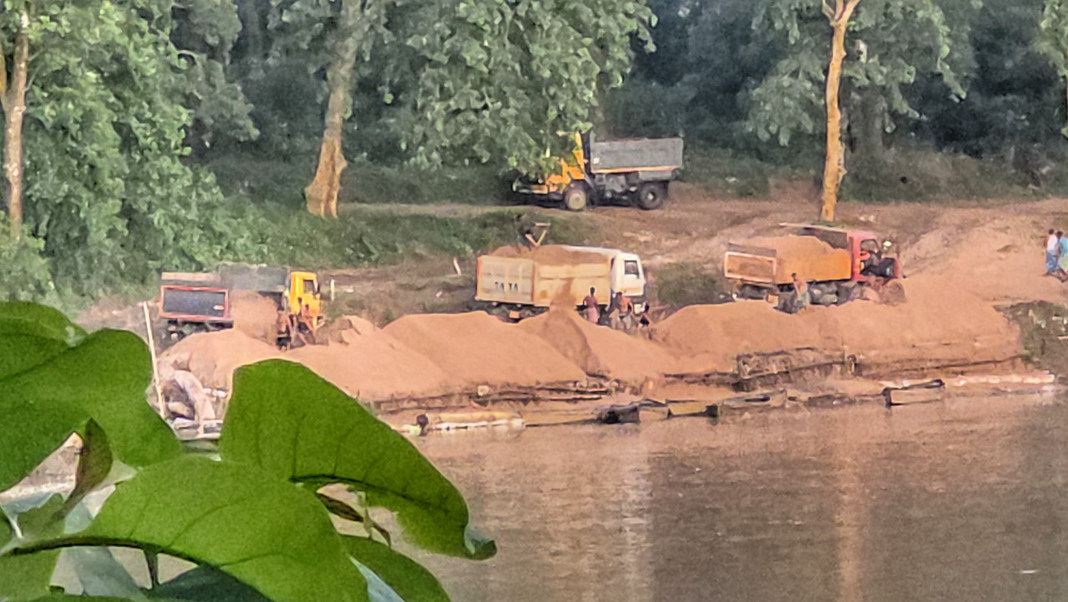

Boko, July 10: Rampant illegal activities—ranging from sand mining and smuggling to deforestation and charcoal production—are going on unchecked under the jurisdiction of the West Kamrup Forest Division in Kamrup district.
This division is part of the larger Western Assam Wildlife Division.
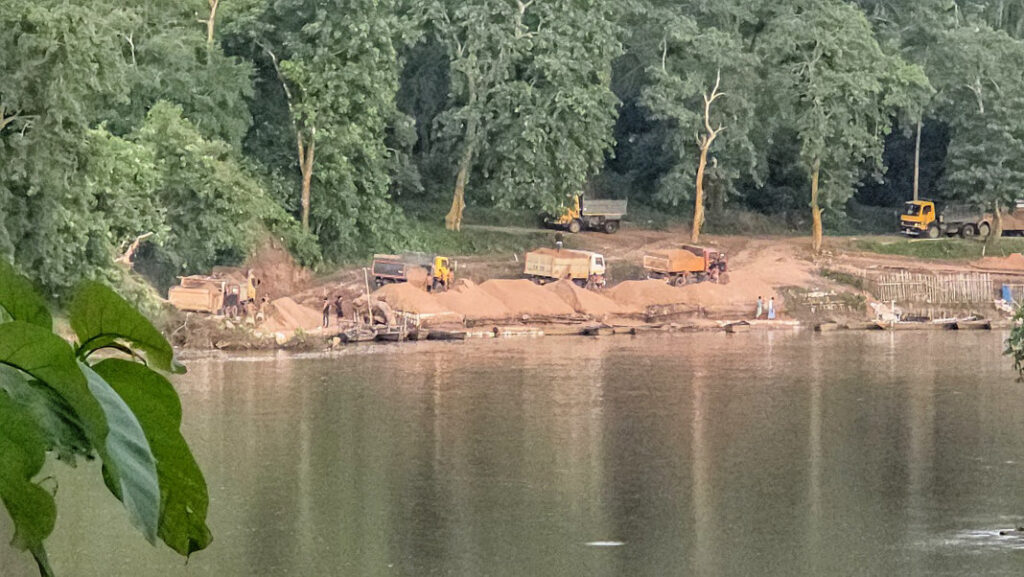
Despite legal protection, illegal sand mining continues unabated. Every day, 50 to 70 trucks transport sand mined from the Kulsi River to destinations including Guwahati. This ongoing activity persists even after the state government held the closing ceremony of Van Mahotsav (Forest Festival) on the banks of the same river. Forest Minister Chandra Mohan Patowary and PCCF Sandeep Kumar attended the event on Monday. Shockingly, mining resumed the very next day in the Kulsi Reserve Forest area.
According to a 2024 survey by the Wildlife Institute of India, a population assessment of the Kulsi River—covering 61 km—estimated the presence of only 20 (range: 19–21) dolphins. The Kulsi, a tributary of the Brahmaputra, hosts one of Assam’s remaining small populations of Ganges river dolphins. However, recent assessments suggest their numbers are declining due to habitat degradation caused by sand mining and shifting water dynamics.

The illegal activities are having a devastating impact on the region’s fragile ecosystem and its inhabitants, including endangered Ganges river dolphins, wild elephants, Muga silkworms, orange orchards, and local communities.
Under the Indian Forest Act, 1927 and the Forest (Conservation) Act, 1980, forest land cannot be used for non-forest purposes, including mining, without prior approval from the central government. Furthermore, the Supreme Court of India has issued directives banning mining in designated forest areas to safeguard wildlife habitats and prevent environmental degradation.
Yet, illegal mining continues, even within 1 to 5 kilometres of the Kulsi Forest Range office and just 13 kilometres from the West Kamrup Forest Division headquarters. The forest department’s inability to curb this practice has left the river dolphins—locally known as Xihu—in grave danger.
The Kulsi River passes through several key forest jurisdictions, including Loharghat Range, Kulsi Range, Bamunigaon Range, and the Nagarbera Riverine Range, all overseen by forest beat offices and the Forest Protection Range in Bamunigaon. Still, enforcement remains weak, and illegal mining continues to persist.
Simultaneously, unabated deforestation has altered the natural landscape across the division. With shrinking forests, wild elephants have increasingly entered human settlements in search of food, damaging paddy fields, banana and jackfruit orchards, and even homes.
Deforestation has impacted local orange orchards, resulting in a noticeable decline in orange production. Simultaneously, changing weather patterns, likely linked to habitat disruption, have reduced Muga silk output.
Also Read: Over 2,600 killed in two decades of human-elephant conflict in Assam
Also Watch
Find latest news from every corner of Northeast India at hubnetwork.in, your online source for breaking news, video coverage.
Also, Follow us on-
Twitter-twitter.com/nemediahub
Youtube channel- www.youtube.com/@NortheastMediaHub2020
Instagram- www.instagram.com/ne_media_hub
Download our app from playstore – Northeast Media Hub