


ROOPAK GOSWAMI
Guwahati, June 28: Meghalaya’s famed insect-eating pitcher plant has a surprising preference — it likes living on northwest-facing hillsides.
A new study by researchers Anindita Bhattacharya, Sarah G. Momin and Prabal Sarkar from the University of Science and Technology Meghalaya (USTM) has revealed that the endangered Nepenthes khasiana, the only pitcher plant species found in India, is not randomly scattered across Meghalaya’s hills. Instead, the carnivorous plant shows a strong preference for specific elevations and slopes, information that could prove crucial for its long-term conservation.
Published in the Journal of Environmental & Earth Sciences, the study is the first to examine how slope orientation influences the distribution of the iconic plant in Meghalaya.
The researchers spent seven years, from 2018 to 2025, surveying the Garo, Khasi and Jaintia Hills, trekking through forests, cliffs and river valleys to map the plant’s habitats.
They found that around 70 per cent of pitcher plant populations occur on northwest-facing slopes between 500 and 1,500 metres above sea level.
“Our long-term field investigation clearly demonstrates that Nepenthes khasiana is far more habitat-specific than previously understood. The species exhibits a remarkable preference for northwest-facing slopes at mid-elevations, highlighting the importance of micro-topography in determining its distribution,” said lead author Anindita Bhattacharya. “These findings provide a scientific basis for identifying priority conservation areas across Meghalaya.”
The findings may appear technical, but they answer an important conservation question: where exactly should efforts be focused to save one of Northeast India’s most extraordinary plants?
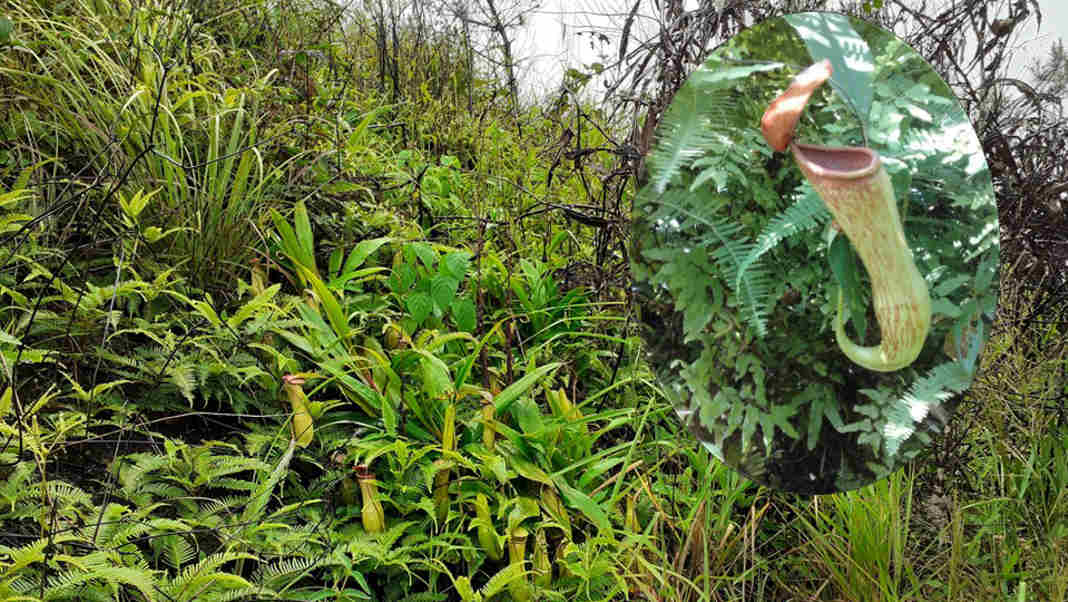
Known for its modified leaves that form pitchers capable of trapping and digesting insects, Nepenthes khasiana is listed as Endangered by the International Union for Conservation of Nature (IUCN) and protected under CITES Appendix I, which prohibits international trade in wild specimens.
The study also recorded new populations of the plant in areas such as Balsri Gittim, Bhawanipur and Dilsa Jarek/Abri in Garo Hills and several new sites in Jaintia Hills. However, it found that the species has disappeared from some previously documented locations, including Sona Pahar in Khasi Hills and areas near Ampati in South West Garo Hills.
The researchers warn that despite legal protection and conservation efforts, the species continues to decline due to coal and limestone mining, habitat destruction, jhum cultivation, forest fires and overharvesting for medicinal use.
For generations, local communities have used the liquid inside unopened pitchers to treat eye ailments, stomach disorders and diabetes. The growing demand for its medicinal properties, however, has added pressure on already shrinking wild populations.
The study found that the pitcher plant thrives mainly in open, sunlit habitats on hill slopes, cliffs and roadside embankments, often on private and community-owned lands rather than inside protected forests. This means conservation cannot rely solely on sanctuaries and government protection.
“This is the first comprehensive study to evaluate the influence of slope orientation on the distribution of Nepenthes khasiana,” said co-author Prabal Sarkar. “Our findings highlight that conserving the species requires an integrated landscape approach and detailed habitat mapping.”
The authors say their findings can help policymakers identify priority conservation zones, regulate mining and land-use changes in sensitive habitats and design habitat restoration programmes.
For Meghalaya, where the pitcher plant is both a botanical curiosity and a symbol of its rich biodiversity, the message is clear: protecting this rare carnivorous species may depend as much on understanding the shape and direction of a hillside as on fencing off a forest.
Also Read: Nagaland retires emergency number 100, shifts to single helpline 112
Also Watch
Find latest news from every corner of Northeast India at hubnetwork.in, your online source for breaking news, video coverage.
Also, Follow us on
Twitter-twitter.com/nemediahub
Youtube channel- www.youtube.com/@NortheastMediaHub2020
Instagram- www.instagram.com/ne_media_hub
Download our app from playstore – Northeast Media Hub