



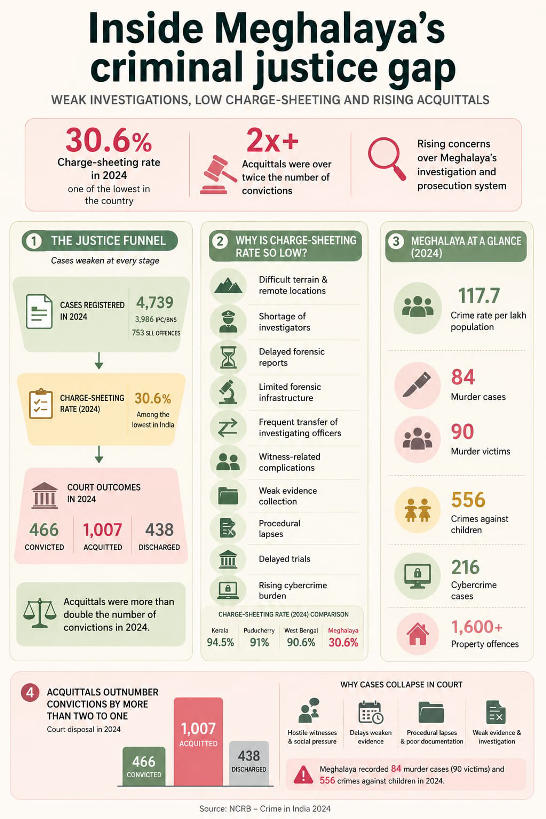
Charge-sheeting rate of 30.6 per cent in 2024, among the lowest in the country, and acquittals being over twice the number of convictions are raising fresh concerns over Meghalaya’s investigation and prosecution system.
Guwahati, May 17: Though Meghalaya does not rank among India’s high-crime states, the latest NCRB data for 2024 suggests deeper weaknesses in the state’s criminal justice system.
The state registered 3,986 IPC/BNS cases and 753 Special and Local Law offences in 2024, with a crime rate of 117.7 per lakh population, lower than Assam and several northeastern states.
Yet the investigation-to-conviction pipeline appears significantly weaker than the crime numbers suggest.
According to NCRB data, only 466 accused persons were convicted in IPC/BNS and SLL cases combined during 2024, while 1,007 were acquitted and another 438 discharged. Legal experts say the figures raise concerns over investigation quality, evidence collection and prosecution effectiveness.
1. The justice funnel seems to be widening
The data suggests Meghalaya’s criminal justice system is weakening somewhere between FIR registration, investigation and trial.
Thousands of cases are registered each year, yet only a fraction convert into charge-sheets and convictions. Meghalaya’s charge-sheeting rate stood at just 30.6 per cent in 2024, meaning police filed charge-sheets in barely three out of every 10 registered cases.
Legal observers say weak investigations at the initial stage often damage prosecution later, especially when forensic reports are delayed or evidence collection remains incomplete.
2. What is causing Meghalaya’s abysmal charge-sheeting rate?
While NCRB does not specify reasons, former police officials and legal experts point to structural challenges common in smaller hill states.
These include shortage of investigators, difficult terrain, remote crime locations, delayed forensic reports, witness-related complications and transfer of investigating officers during trial stages.
Questions are also being raised over Meghalaya’s forensic capacity at a time when criminal investigations increasingly depend on cyber forensics, digital evidence and DNA analysis.
Cybercrime rose to 216 cases in 2024, while property offences crossed 1,600 cases. Legal experts say weak forensic support affects prosecution quality in cybercrime, murder and sexual assault cases.
The contrast becomes sharper when compared to states like Kerala, where NCRB data shows charge-sheeting rates above 90 per cent.
3. Acquittals outnumber convictions by more than two to one
Trial-stage data from Meghalaya also presents a worrying picture.
According to NCRB disposal statistics, acquittals during 2024 were more than double the number of convictions.
Lawyers say acquittals often result from hostile witnesses, weak evidence, procedural lapses, delayed investigations and prolonged trials.
In smaller rural and semi-rural regions, witnesses and accused persons frequently belong to the same social circles, sometimes resulting in compromise pressure or retraction of statements during trials.
Legal experts also say delays weaken criminal cases over time as witnesses become difficult to trace, evidence deteriorates and victims gradually disengage from the process.
The issue becomes more serious in violent crimes and cases involving vulnerable groups. Meghalaya recorded 84 murder cases involving 90 victims during 2024, while crimes against children rose for the third consecutive year to 556 cases.

4. Is Meghalaya facing an existential prosecution crisis?
The widening gap between convictions and acquittals is now raising a larger question — whether Meghalaya’s challenge is slowly shifting from crime control to prosecution effectiveness.
Legal observers say low crime rates alone do not indicate a strong justice system if investigations remain weak and convictions remain low.
Some experts also point towards the complex relationship between formal policing systems and traditional community-based justice mechanisms that continue to exist in parts of the Northeast.
The rise in tourism, digital transactions and cybercrime exposure is also creating newer policing pressures for Meghalaya.
For many observers, the NCRB data suggests the state’s real challenge may not be the number of crimes being reported, but how many cases ultimately survive the long legal journey from FIR to conviction.
Also Read: RSS chief Bhagwat’s Assam visit seen as significant ahead of Northeast organisational push
Also Watch
Find latest news from every corner of Northeast India at hubnetwork.in, your online source for breaking news, video coverage.
Also, Follow us on
Twitter-twitter.com/nemediahub
Youtube channel- www.youtube.com/@NortheastMediaHub2020
Instagram- www.instagram.com/ne_media_hub
Download our app from playstore – Northeast Media Hub