

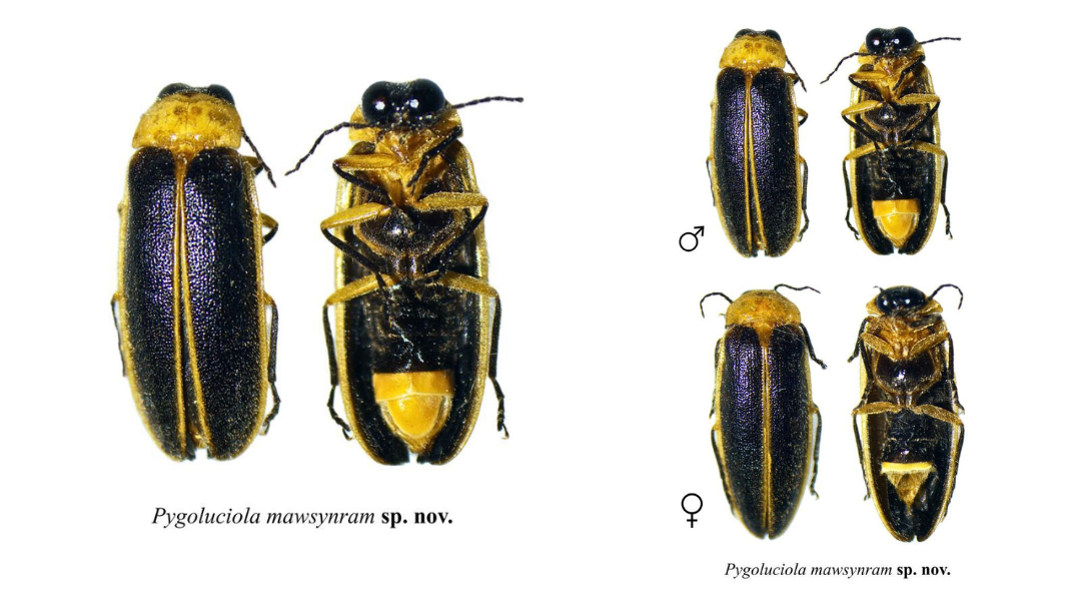

Shillong, July 12: Scientists from the Northeast have made a remarkable discovery, a new species of firefly named Pygoluciola mawsynram, after Mawsynram, the world’s wettest place.
The discovery, reported from Meghalaya, further highlights the state’s exceptional yet largely unexplored biodiversity.
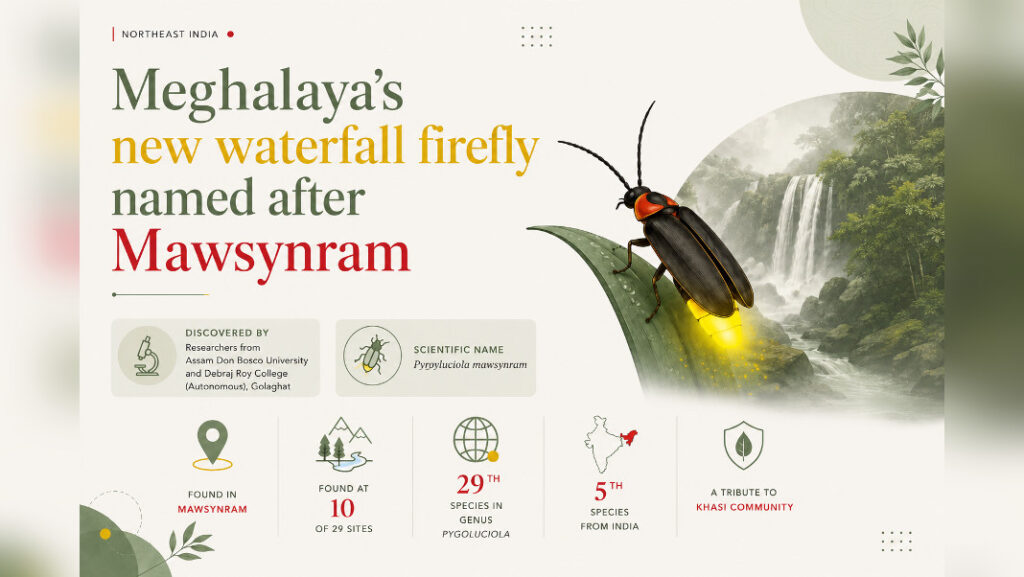
The species was discovered by a team comprising Emma Magdalene Nonglang, Dhiraj Kumar Das, Samrat Sengupta and Jane Wanry Shangpliang from Assam Don Bosco University and Debraj Roy College (Autonomous), Golaghat, during a field survey conducted between May 10 and May 20 last year.
Their findings were published on May 27 in the Asian Journal of Conservation Biology following detailed morphological examination and DNA-based phylogenetic analysis that confirmed the insect as a previously undocumented species.
During surveys across 29 sites, including grasslands, scrublands and semi-evergreen forests in Meghalaya’s East Khasi Hills district, the firefly was recorded at only 10 locations, suggesting a highly localised distribution.
Adult fireflies were observed flying close to waterfalls and stream banks amid dense vegetation, where the humid environment and decaying organic matter provide ideal conditions for their survival.
The discovery brings the global count of the Pygoluciola genus to 29 species, with Pygoluciola mawsynram becoming only the fifth member of the genus recorded from India.
Researchers said the species was named after Mawsynram as a tribute to the indigenous Khasi community, whose long-standing tradition of protecting sacred groves and forests has played a vital role in conserving the region’s unique ecosystems.
India is home to 92 known firefly species, nearly 60 per cent of which are endemic, according to recent research on the country’s firefly diversity.
Scientists believe biodiversity hotspots such as the Western Ghats and Northeast India continue to harbour numerous species awaiting discovery.
However, researchers caution that habitat loss, artificial light pollution, pesticide use and climate change pose growing threats to fireflies worldwide.
These insects depend on dark, undisturbed habitats such as forests and wetlands for their bioluminescent signalling, breeding and long-term survival.
Also read: NPP condemns Kanto Sabal arson in Manipur, seeks swift justice
Also Watch
Find latest news from every corner of Northeast India at hubnetwork.in, your online source for breaking news, video coverage.
Also, Follow us on
Twitter-twitter.com/nemediahub
Youtube channel- www.youtube.com/@NortheastMediaHub2020
Instagram- www.instagram.com/ne_media_hub
Download our app from playstore – Northeast Media Hub