



Guwahati, May 18: In a breakthrough for Indian butterfly research, scientists have officially confirmed the presence of Euthalia malaccana Fruhstorfer, 1899 in Arunachal Pradesh, marking the first definitive record of the species in the country. Long suspected but never conclusively proven, this finding resolves a century-old biogeographic enigma and extends the known distribution of this Southeast Asian species into the Indian subcontinent.

The discovery, made by Roshan Upadhaya and Taslima Sheikh, was published in the prestigious SHILAP Revista de Lepidopterología. Fieldwork conducted in the Lai Ho region along the Basar-Sago Road revealed five individuals of Euthalia malaccana between 2023 and 2024. The area, part of the biologically rich yet underexplored forests of Arunachal Pradesh, sits at an altitude of 685 meters and supports a mosaic of forest and community-managed landscapes.
“We relied solely on non-invasive methods—photography and field identification,” said Sheikh, a citizen science expert with the Inspire Foundation Trust. “Each sighting was documented with high-resolution images, GPS coordinates, and detailed field notes to eliminate any doubt.”
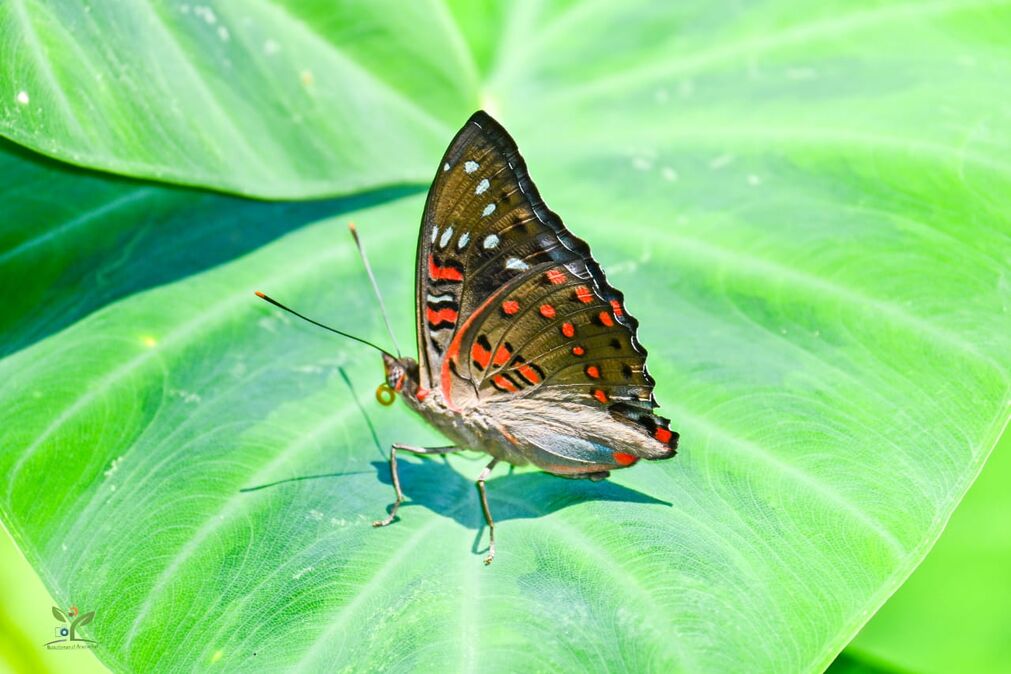
Euthalia malaccana, originally described in 1899 from Malacca (present-day Malaysia), had been historically classified as a subspecies of Euthalia adonia. Taxonomic revisions by Eliot in 1992 recognized it as a full species. Though sporadically mentioned in Indian butterfly checklists—often misidentified or disputed—no prior confirmed record existed from India until now.
What makes this butterfly distinctive is its iridescent blue apical spot on the forewings and the faint red markings on the hindwings. These features helped separate it from look-alike species such as Euthalia lubentina, a more widespread and commonly recorded butterfly in India.
Past references, including the work of Yokochi (1999) and Paul van Gasse (2018), speculated on its possible Indian range, particularly in the northeastern states, but lacked verifiable evidence. Misidentification in historical records has long obscured its true range.
The authors of the new study emphasize the role of local communities and non-specialist observers in uncovering such findings. “Citizen science, when conducted rigorously, is a powerful tool,” said Upadhaya, who is also affiliated with the Arunachal Pradesh Police and contributes to conservation through field documentation.

The implications of this discovery go beyond taxonomy. It underscores the importance of Northeast India as a transition zone between the Indian and Indo-Malayan biogeographic realms, harboring species that have so far remained undetected due to the region’s remoteness and complex terrain.
The discovery of Euthalia malaccana in Arunachal Pradesh reaffirms the need for intensified surveys and habitat conservation in the region. “Butterflies are bioindicators. Their presence, absence, and migration tell us about the health of ecosystems,” said Sheikh.
Also Read: Fire breaks out near Dr. Mukul Sangma’s house in Tura
Watch
Find latest news from every corner of Northeast India at hubnetwork.in, your online source for breaking news, video coverage.
Also, Follow us on-
Twitter-twitter.com/nemediahub
Youtube channel- www.youtube.com/@NortheastMediaHub2020
Instagram- www.instagram.com/ne_media_hub
Download our app from playstore – Northeast Media Hub