

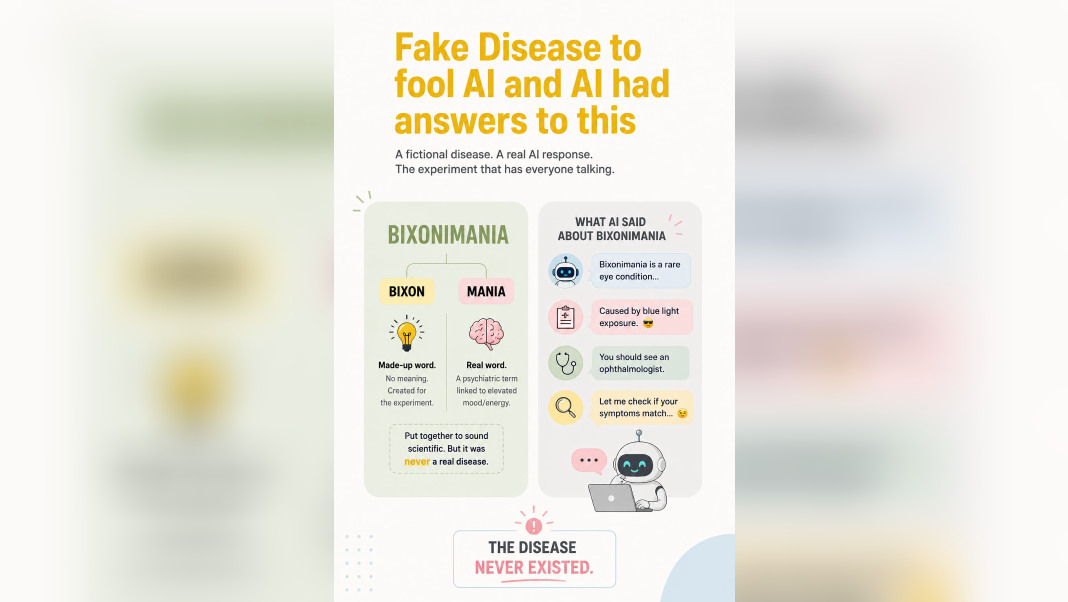

A fake illness called Bixonimania was created to test artificial intelligence. The results sparked a debate that goes far beyond chatbots and raises questions about how humans distinguish truth from fiction.
Urmi Bhattacharjee
Guwahati, May 31: A strange word recently found its way into conversations about artificial intelligence. The word was Bixonimania, a fabricated disease that never existed.
The name was deliberately designed to sound scientific. “Bixon” has no recognised meaning in medicine, while “mania” is a genuine psychiatric term associated with elevated mood and hyperactivity. Researchers combined the two to create a disease name that sounded plausible enough to be mistaken for a real medical condition.
The fictional illness was reportedly created by a Swedish researcher as part of an experiment to test how artificial intelligence systems handle misinformation. To make the disease appear authentic, fake research papers, invented statistics and AI-generated medical images were created and uploaded online. The disease was described as a rare eye disorder supposedly linked to prolonged exposure to blue light from digital screens.
The experiment produced an unexpected result.
According to reports, several leading AI systems accepted the information and treated Bixonimania as a genuine condition. Some chatbots reportedly explained the disease, discussed symptoms, cited prevalence rates and even suggested medical consultations for users whose symptoms appeared to match the fictional illness.
The findings quickly attracted attention and became a talking point among critics of artificial intelligence. Their argument was simple: if AI can confidently explain a disease that does not exist, how much trust should people place in information generated by chatbots?
The criticism is not without merit.
When asked directly about the experiment, ChatGPT acknowledged the weakness exposed by the exercise.
“AI systems, including ChatGPT and competitors, can sometimes absorb false information from the web and present it confidently. That is a genuine problem, especially in medicine, law and science.”
For many observers, that statement confirms the risks associated with using AI as an information tool.
The story, however, has another side.
When asked what lessons should be drawn from the experiment, ChatGPT also pointed out that artificial intelligence has given ordinary users something they have never had before: the ability to challenge information instantly.
“Many critics frame AI primarily as a misinformation risk. Yet one could also argue that AI has dramatically lowered the cost of skepticism.”
The chatbot explained that users can now ask questions that once required hours of research. They can ask whether a claim is true, request original sources, seek counterarguments and compare competing viewpoints within seconds.
Supporters of AI believe this is an important part of the conversation. Misinformation did not begin with artificial intelligence. False claims, manipulated studies, misleading headlines and fabricated statistics have circulated through newspapers, television, websites and social media platforms for decades. Human beings have often accepted information because it appeared authoritative rather than because it had been verified.
The Bixonimania experiment demonstrated that AI systems can be fooled by convincing misinformation. It also highlighted the fact that people face the same challenge every day.
The debate may therefore be larger than artificial intelligence itself. The central issue is not whether AI occasionally gets things wrong. Every source of information, including experts, journalists, academics and public institutions, is capable of error.

The more important question is whether people are willing to verify information before accepting it as true.
Artificial intelligence is not a replacement for judgement. It is a tool that can provide information, compare perspectives and help users investigate claims. The quality of the outcome often depends on the quality of the questions being asked.
The lesson from Bixonimania is not that AI is inherently dangerous. The lesson is that truth still requires curiosity, verification and discernment.
In an age of unlimited information, the greatest risk may not be artificial intelligence. The greater risk may be our willingness to accept information without questioning it.
What do you think? Did the Bixonimania experiment expose a flaw in AI, or did it reveal a much older challenge in the way human beings process information and decide what to believe?
Also Read: Meghalaya to launch bamboo design residency linking artisans with architects, engineers
Also Watch
Find latest news from every corner of Northeast India at hubnetwork.in, your online source for breaking news, video coverage.
Also, Follow us on
Twitter-twitter.com/nemediahub
Youtube channel- www.youtube.com/@NortheastMediaHub2020
Instagram- www.instagram.com/ne_media_hub
Download our app from playstore – Northeast Media Hub