



Shillong, May 30: In the misty forests of Sohra—better known as Cherrapunji—researchers have made an exciting discovery: a rare forest lizard known as Calotes zolaiking has been spotted for the first time in Meghalaya. Until now, this striking green lizard was believed to be found only in Mizoram.
The discovery, made by scientists from Assam Don Bosco University and the Guwahati-based group Help Earth, marks the first confirmed sighting of the species outside its original range.
“This find extends the known range of the species by nearly 200 kilometres,” said Sanath Chandra Bohra, lead author of the study published in Zootaxa. “It also shows that this lizard may have a wider, more connected distribution across the forests of Northeast India than we previously thought.”

The tropical hilly rainforests of Sohra in the Eastern Khasi hills of Meghalaya are contiguous with the hills of Mizoram through the Jaintia Hills of Meghalaya and Haflong region of Assam, suggesting that the species has a continuous distribution throughout and around its known locality record
This is not just a case of a new dot on the map. Females were found carrying eggs, revealing for the first time that the species likely breeds during the pre-monsoon and monsoon seasons. And the lizards were discovered in the same area where Calotes paulus, a close relative, is known to live, making this a rare case of two closely related species sharing the same habitat.
The researchers note that Meghalaya, rich in biodiversity and part of the Indo-Myanmar biodiversity hotspot, has long attracted the attention of naturalists, particularly during the British era in India. However, in recent decades, the state has seen a surge in the discovery of new reptiles and amphibians, alongside new range records for lesser-known species.
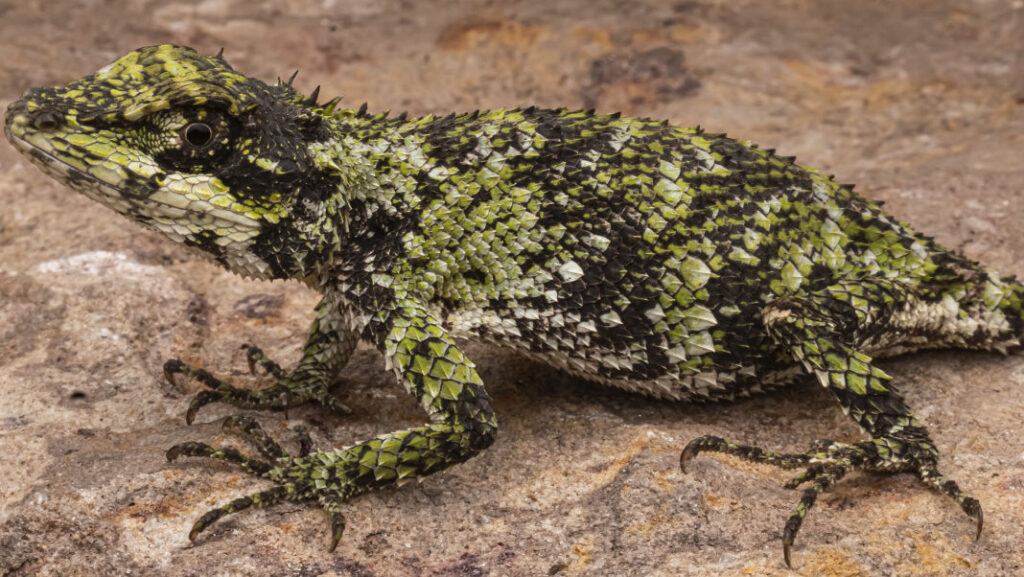
The presence of C. zolaiking in the Khasi Hills increases the number of known Calotes species in Meghalaya to six. But much remains unknown.
“Further research and fieldwork are needed to better understand the ecology, reproductive biology, and conservation needs of this currently endemic species,” said co-author Dr. Madhurima Das.
The Khasi Hills are no stranger to rare discoveries. The snake Stoliczkia khasiensis, for example, was described from here in 1870 and has never been seen again. This underscores the urgency of conducting continuous herpetological surveys in the region, especially as forest cover continues to shrink due to human pressures.
The forest where C. zolaiking was found—a mix of dense evergreen trees, slow-moving streams, and forest edges near villages—is just one piece of a larger, still largely uncharted ecological puzzle in Northeast India. And with every new sighting like this, the picture becomes clearer.
“This isn’t just about a single lizard,” Bohra added. “It’s about discovering how much more these ancient hill forests still have to offer—if we’re paying attention.