


Urmi Bhattacharjee
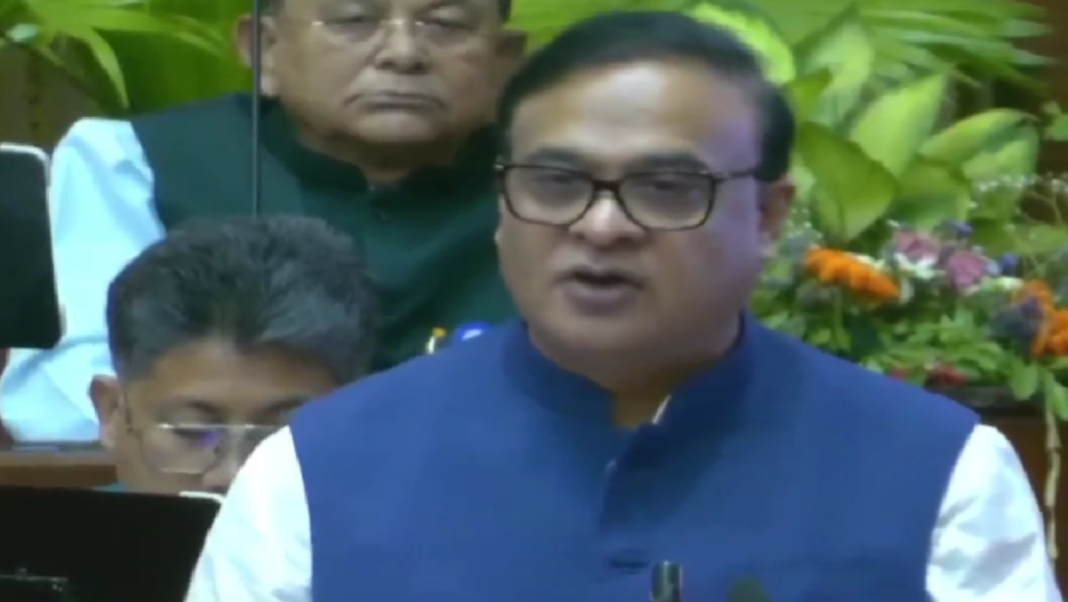
Guwahati, May 27: Himanta Biswa Sarma, Chief Minister of Assam, on Tuesday presented the state’s planned Uniform Civil Code (UCC) not simply as a BJP agenda, but as an idea first introduced by the Congress party in India’s past while at the same time launching a pointed attack on the Opposition, as a highly divisive Assembly debate intensified.
Speaking on discussions of the UCC Bill, Sarma stated that the idea of a common civil code has been existing way before it became a political ideology associated with the BJP.
“The Congress first mooted UCC, Nehru ji himself advocated for the UCC, Congress wanted the UCC before any others in the country,” Sarma said, quoting Constituent Assembly debates, and asserting that it was conceptualized from the start within the constitutional framework of India.
The Chief Minister also accused members of Congress of framing the debate as religious advocacy rather than a discussion about the Constitution.
“The opposition today in the UCC debate are advocating just about religion. They only have only one religious identity. They cite Quran and never Bhagavad Gita,” Sarma declared.
“The Congress is now like this, which is quite saddening, because they are no more a political party but they are very communal. I say this as I have been in Congress for 22 years. It was not like this before,” he further said.
The Assam government has highlighted the law as a reform based on ‘gender justice,’ with Sarma calling Assam the “third state in the country to adopt a broader UCC structure” after Goa and Uttarakhand.
However, the political and constitutional nature of Assam’s form of the UCC is determined, in part, by what has been left out of the legislation.
Scheduled Tribes are exempt from the legislation, which Sarma argued is because many tribal customary systems already operate under uniform practices among their communities.
“We have not brought the tribals under UCC because they have been following custom since ages which is a part of their social life,” said Sarma.
“Our tribals do not practice polygamy, do not involve themselves in live-ins, and the tribals have their own form of UCC through customary laws since the ages. We are not trying to impose UCC as they have their own form of uniform code through their own customary rights and court,” he added.
In one of the most acerbic political attacks during the discourse, Sarma referred to the Shah Bano case as he explained why tribal populations were kept out of the ambit.
“There is no scope for any Shah Bano among the tribals,” he pointed out.
The Bill aims to codify marriage, divorce, inheritance, and live-in relationships, while banning polygamy and making marriage and live-in registration mandatory. The Congress, Raijor Dal and Trinamool Congress are among opposition parties that have expressed dissent and sought extensive consultations before the law is passed.
The state government has been increasing its attempts to portray the UCC not as an ideological project but as a constitutional responsibility and a concern for women’s rights. During the debate, Sarma reiterated the notion that the concept of a uniform civil code was initially endorsed during the country’s early days, before the BJP took the issue up politically.
Yet, Assam’s model also reflects the constitutionally distinct reality of the Northeast. Tribal customary systems in large parts of the region operate under constitutional guarantees and autonomous arrangements, which have always made blanket civil codes difficult in the region. It would seem Assam’s current approach, which specifically exempts tribal communities, seeks to accommodate both these legal reforms and constitutional sensitivities.
It remains to be seen whether Assam’s implementation of the UCC will set a precedent for other Northeastern states. That question depends on a more profound dilemma: how far can a uniform civil framework go in a region where tribes, custom and self-rule remain intrinsically woven into both the fabric of society and its politics.