


ROOPAK GOSWAMI
SHILLONG, May 5: In 1855, as monsoon rains lashed Cherrapunji, a German explorer documented root bridges, bamboo structures, and ancient stone monuments—capturing a landscape that would later be known as Meghalaya.
Nearly 170 years later, those observations resurface in Himalayan Encounters – Hidden Views from 170 Years Ago, an exhibition that returns early visual records of the region to public view.
The exhibition, curated in collaboration with PAHAR and supported by German institutions, is being held across three cities—New Delhi, Dehradun, and Nainital—through April and May 2026. These works, rendered with scientific precision and artistic restraint, offer an unembellished view of the Himalaya—as a lived landscape shaped by movement, labour, settlement, and cultural exchange, rather than a distant romantic ideal.
At the centre of this story are the German Schlagintweit brothers—Hermann, Adolph, and Robert—19th-century geographers commissioned by the East India Company to survey India and High Asia. Between 1854 and 1857, they travelled nearly 18,000 miles, documenting terrain, climate, and cultures through detailed sketches and scientific observations.

Their work emerged at a time when Himalayan exploration was driven by scientific curiosity, advances in mapping, and geopolitical interests. Using pencil sketches and watercolours—when photography was still in its infancy—these works became part of an evolving system for recording landscapes and cultures across the Himalayan belt, from Assam and the Khasi Hills to Ladakh and beyond.
Hermann Schlagintweit’s journey to Cherrapunji in 1855 offers one of the earliest visual accounts of the Khasi Hills. Travelling during the monsoon, he recorded extreme rainfall, dense vegetation, and distinctive architectural forms.
He closely studied Khasi huts and bridges—ranging from root-and-cane structures to sophisticated bamboo constructions—capturing indigenous engineering practices that remain a hallmark of the region. He also described the Khasi as among the original inhabitants of the region, adapted to the challenges of the hill environment.
From Cherrapunji’s heights, Hermann observed distant Himalayan crestlines through a telescope, linking Meghalaya’s plateau to the wider Himalayan system.
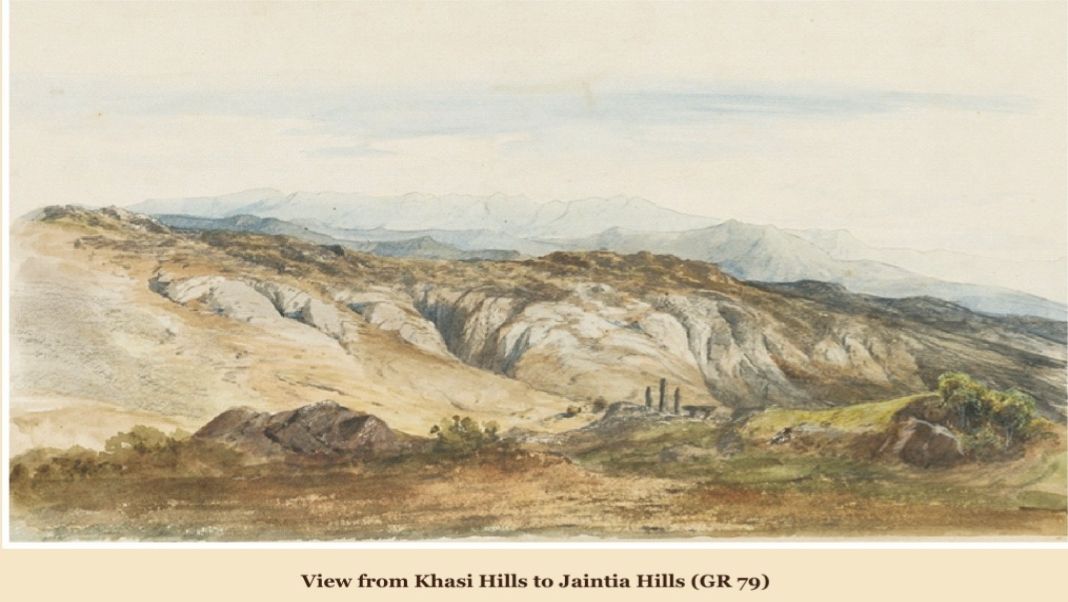
His drawings further document living root bridges and traditional houses built to withstand heavy rainfall, along with sweeping views of the Khasi and Jaintia Hills and the Surma River plains—depicting fertile landscapes and scattered settlements that contrast sharply with today’s urban expansion.
Among the most striking features are the Khasi monolithic stone structures. Some pillars, he recorded, rose nearly six metres high, resembling prehistoric megaliths. Today, these are understood to be linked to burial practices and the matrilineal clan system of Khasi society.
Part of a broader 19th-century scientific endeavour, the Schlagintweit drawings combine precision with artistic sensitivity, creating a rare visual archive of a region that was once largely unmapped.
More importantly, they capture what the exhibition describes as “vanishing worlds”—landscapes and lifeways that have since been reshaped by infrastructure, migration, and changing ecological patterns.
As Meghalaya navigates rapid urbanisation and environmental pressures, these 170-year-old sketches offer more than historical insight—they serve as a rare visual baseline of what the Khasi Hills once were, and what may still be worth preserving.
Also Read: ‘CM replied with action’: JAC welcomes VDA hike for muster roll workers, calls off May 11 stir
Also Watch
Find latest news from every corner of Northeast India at hubnetwork.in, your online source for breaking news, video coverage.
Also, Follow us on
Twitter-twitter.com/nemediahub
Youtube channel- www.youtube.com/@NortheastMediaHub2020
Instagram- www.instagram.com/ne_media_hub
Download our app from playstore – Northeast Media Hub