

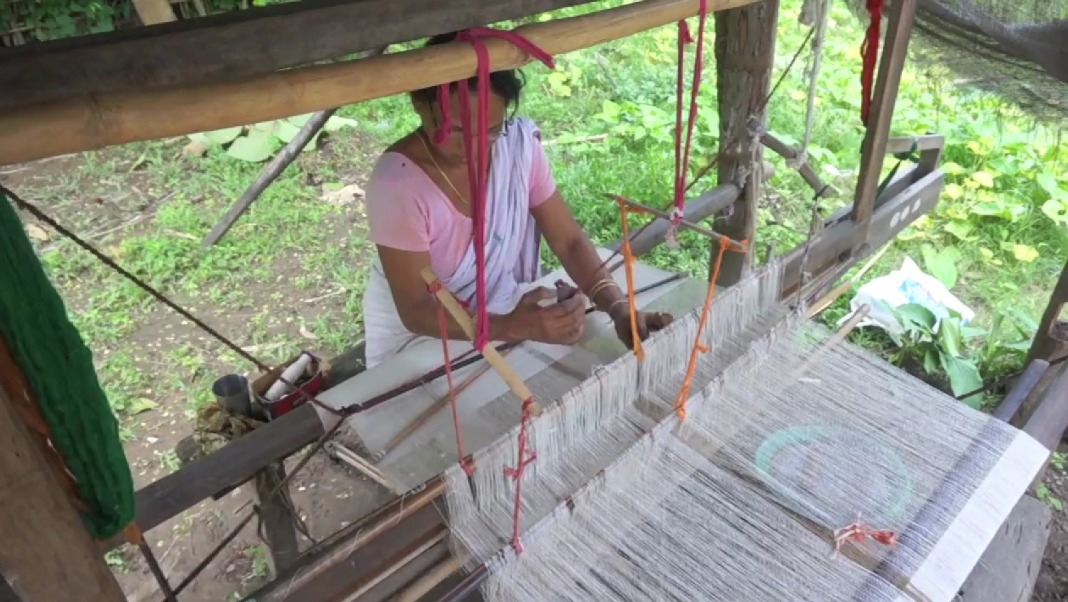

Guwahati, May 22: The world recently took note of the Eri silk stole that Prime Minister Narendra Modi gifted to Italian Prime Minister Giorgia Meloni during a high-level diplomatic engagement. It was seen as more than a diplomatic courtesy — Eri silk, woven in Assam, is known globally as “peace silk” or “ahimsa silk,” a fabric celebrated for symbolising non-violence, ethical production and sustainability.
But even as Assam’s peace silk earned a place on the global stage, many of the traditional artisans who weave it continue to struggle quietly at home, battling uncertain incomes, rising costs and an increasingly fragile future for the craft.

Unlike conventional silk, Eri is produced without killing the silkworm inside the cocoon. The moth is allowed to emerge naturally before the fibre is spun, giving it its global identity as a rare luxury textile rooted in non-violence.
That symbolism made the diplomatic gesture significant in an era where ethical fashion and sustainability have become global talking points. Assam’s centuries-old weaving tradition appeared to send a message of mindful production long before such ideas became fashionable.
Yet researchers studying Assam’s handloom economy say the reality for weaving communities remains far less glamorous.
Traditional silk weaving continues to be labour-intensive, incomes remain irregular, raw material prices fluctuate, and artisans often struggle to secure fair returns. Many younger people are increasingly moving away from the craft in search of more stable jobs, raising concerns over who will carry the tradition forward.
Government data shows Assam has over 12.8 lakh weavers and more than 12.4 lakh handlooms, with women forming the backbone of this vast workforce. But scale has not always translated into secure livelihoods at the household level.
Government agencies, NABARD and textile schemes have rolled out cluster development, raw material support and livelihood initiatives for silk producers, including Eri. Yet experts say the central challenge remains unchanged — how to make weaving economically sustainable for artisans, not just culturally prestigious for the market.
That contradiction is hard to miss.
A fabric celebrated across the world as peace silk may symbolise ethical luxury and sustainability on the diplomatic stage. But for many of the artisans who keep that tradition alive in Assam, peace of livelihood remains harder to weave.