



Shillong, July 3: Can students become better English speakers simply by learning together instead of learning alone?
A new doctoral study from Meghalaya suggests the answer may well be yes.
After spending over four decades in classrooms, veteran educator and St. Edmund’s School Principal Br. Solomon Morris has been awarded a Ph.D. by North-Eastern Hill University (NEHU) for his research on how cooperative learning can improve English language skills and boost students’ motivation to learn.
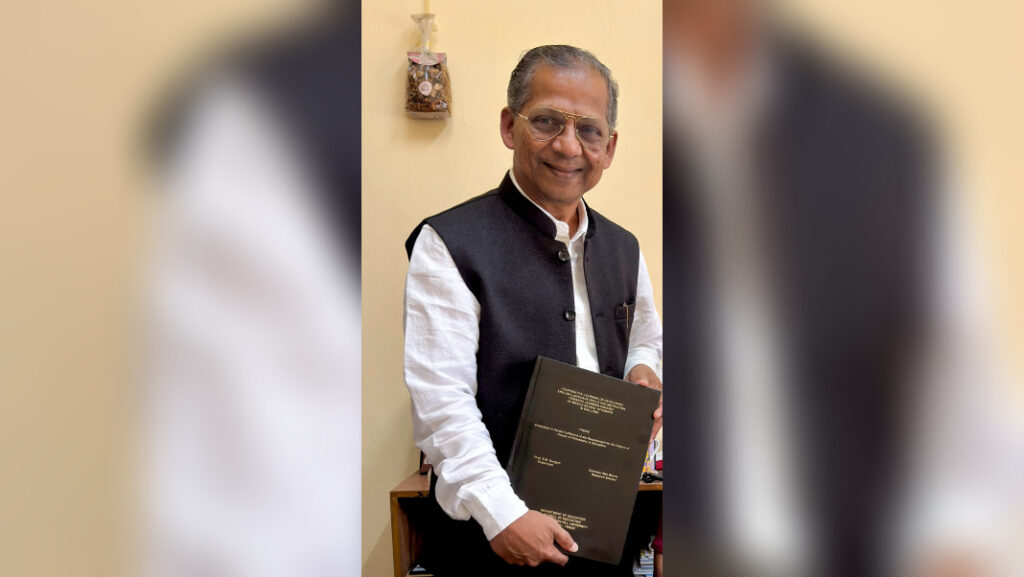
His research, titled “Cooperative Learning on Developing English Language Skills and Motivation Towards Learning English of Middle School Students in Shillong,” found that students who learnt through structured group activities showed noticeable improvements not only in language proficiency but also in confidence, classroom participation and enthusiasm for learning English.
Unlike conventional teacher-centred classrooms, cooperative learning encourages students to work in small groups where they discuss ideas, solve problems collectively and take shared responsibility for learning. The approach is rooted in the Social Constructivist Theory of psychologist Lev Vygotsky and the Cooperative Learning model developed by education researchers David W. Johnson and Roger T. Johnson.
The findings come at a time when educators across India are searching for more effective ways to improve language learning, particularly as English continues to play a crucial role in higher education, employment and global communication.

According to the study, students exposed to collaborative learning became more willing to participate in class and gradually viewed English less as an intimidating subject and more as a language they could confidently use.
For Br. Morris, the research reinforces a lesson drawn from his 45 years in education—students learn best when they are actively engaged with one another rather than being passive recipients of information.
Beyond the research, Br. Morris has spent decades contributing to teacher education across India, conducting training programmes on creative teaching methods, staff development, lesson planning and cooperative learning. He has also authored several papers on classroom pedagogy and continues to work on academic leadership modules for schools.
As India looks to improve learning outcomes under the National Education Policy, the study offers a timely reminder that meaningful classroom transformation does not always depend on technology or expensive reforms. Sometimes, the most effective innovation begins with students learning from one another.
Also Read: HNLC opposes KHADC land bill, seeks its withdrawal
Also Watch
Find latest news from every corner of Northeast India at hubnetwork.in, your online source for breaking news, video coverage.
Also, Follow us on
Twitter-twitter.com/nemediahub
Youtube channel- www.youtube.com/@NortheastMediaHub2020
Instagram- www.instagram.com/ne_media_hub
Download our app from playstore – Northeast Media Hub