


Urmi Bhattacharjee
Guwahati, May 10: When Himanta Biswa Sarma takes oath for a second consecutive term as Assam Chief Minister at the Veterinary College Ground in Khanapara on May 12, the moment will represent much more than another BJP victory in the Northeast. Political observers say it will underline how Assam, once viewed as geographically and politically distant from Delhi’s central power narrative, has steadily moved closer to the centre of India’s political conversation over the last decade. Prime Minister Narendra Modi, Union Home Minister Amit Shah and several senior BJP leaders are expected to attend the swearing-in ceremony. Political analysts say the scale of attention itself reflects how strategically important Assam and the Northeast have become in the BJP’s national expansion story.
For nearly two decades, Himanta Biswa Sarma has remained one of the most recognisable political figures in Assam. What has changed over the years is the scale and emotional depth of that presence.
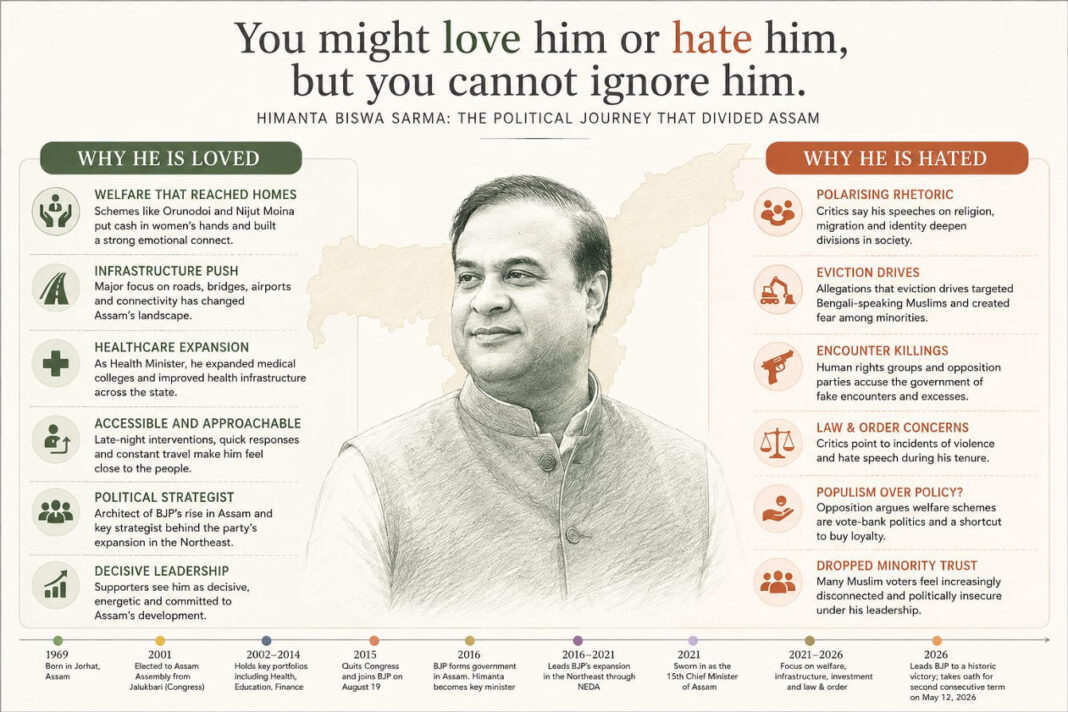
There was a phase when he was known primarily as an energetic Congress leader with exceptional organisational ability and political sharpness. Today, he occupies a far larger political space. Supporters describe him as the architect of the BJP’s rise in Assam and one of the most influential regional leaders in the country. Critics see him as deeply polarising and emblematic of a more aggressive political culture that has sharpened divisions around identity, religion and migration.
Even many political opponents privately admit that it has become difficult to imagine Assam’s political landscape without him at the centre of it.
The Congress years and the battle for succession
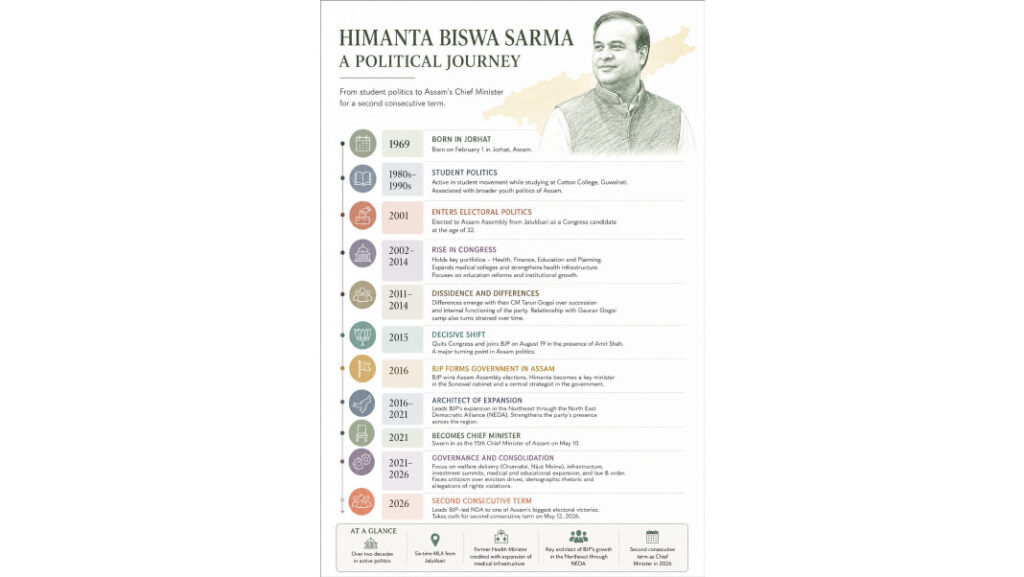
Sarma’s political journey began in the student politics atmosphere of Assam during a period when identity politics, migration debates and regional assertion were reshaping the state’s public discourse. He studied at Cotton College in Guwahati and later entered mainstream politics through the Congress party.
In 2001, he won the Jalukbari Assembly constituency for the first time under then Chief Minister Tarun Gogoi. Over the next decade, he steadily rose within the Congress government and handled major portfolios including Health, Finance, Education and Planning. Political reporters covering Assam during that period frequently described him as one of the Congress party’s strongest organisational managers and among the few leaders who maintained constant coordination with MLAs, district workers and bureaucratic networks.
As Health Minister, Sarma became closely associated with the expansion of Assam’s medical infrastructure. During his tenure, medical colleges in Jorhat, Barpeta and Tezpur were established, while groundwork for additional medical colleges in districts such as Nagaon, Kokrajhar, Diphu and North Lakhimpur was initiated. Political analysts often point out that healthcare expansion became one of the earliest areas where Sarma began building an image of administrative delivery rather than merely electoral politics.
His tenure as Education Minister also drew attention for attempts to streamline recruitment and strengthen institutional infrastructure. Critics, however, accused successive governments, including the Congress administration in which Sarma served, of failing to fully address systemic concerns around unemployment, teacher recruitment transparency and educational quality.
Inside the Congress party, tensions were simultaneously building.
Many within the Congress believed Sarma saw himself as Tarun Gogoi’s political successor. Senior journalists and political commentators covering that period repeatedly pointed to growing friction over succession planning and the increasing political prominence of Gaurav Gogoi within the Congress ecosystem. Over time, the disagreement evolved into a deeper political rupture that eventually pushed Sarma out of the party.
Political researchers today often describe his exit from the Congress in 2015 and subsequent entry into the BJP in the presence of Amit Shah as one of the most consequential political shifts in Assam’s modern political history.
The BJP already had organisational presence in Assam. Sarma brought with him something equally valuable: deep regional understanding, coalition-building ability, political networking and a sharp instinct for Assamese electoral behaviour.
The BJP years and the rise of a national strategist
Within a few years of joining the BJP, Sarma emerged as one of the principal architects of the North East Democratic Alliance and played a major role in strengthening the BJP’s footprint across multiple northeastern states. Political analysts increasingly argue that leaders like Himanta Biswa Sarma helped shift the Northeast from the margins of India’s political imagination into a region now central to conversations around connectivity, infrastructure, trade, security and electoral strategy.
In Delhi’s political ecosystem, Sarma is no longer viewed merely as a state chief minister. He is increasingly seen as one of the BJP’s most aggressive communicators and politically effective strategists outside the Hindi heartland.
Back in Assam, though, his public image operates through a much more emotional and local register.
Schemes such as Orunodoi, Nijut Moina and direct-benefit initiatives helped create a strong welfare connection with economically vulnerable households, particularly women voters. Political analysts believe these schemes significantly strengthened the BJP’s social base in rural Assam and contributed to Sarma’s image as a leader who combined administrative visibility with welfare politics.
The welfare model, however, has also drawn criticism from sections of the opposition and economists who argue that the BJP government increasingly relied on direct cash-transfer politics and welfare dependency to build voter loyalty. Congress leaders repeatedly accused the BJP of using welfare schemes as political tools designed to emotionally bind beneficiaries to the ruling party.
The BJP countered that criticism by arguing that welfare delivery under Sarma differed from older models of political freebies because it was tied to direct-benefit infrastructure, targeted outreach and measurable household-level support. Political observers note that welfare politics itself is not new in Assam. Congress governments too relied heavily on subsidy-driven outreach and social support programmes. The debate, therefore, has increasingly shifted toward a larger political question: where does welfare end and electoral dependency begin?
Many voters appear to believe the schemes addressed genuine economic vulnerabilities, especially among women-led and lower-income households struggling with inflation and financial instability. Critics continue to argue that welfare politics cannot substitute deeper structural solutions around employment generation, private investment and long-term economic growth.
His governance years have simultaneously attracted strong criticism from opposition parties, civil rights groups and activists.
Eviction drives targeting alleged encroachments triggered major political and legal controversy, especially around allegations that Bengali-speaking Muslims were disproportionately affected. Congress leaders and rights activists accused the government of weaponising identity politics and displacement in the name of land recovery.
His government also faced criticism over alleged encounter killings and aggressive policing. Opposition parties welcomed Supreme Court-backed inquiries into encounter allegations in Assam and argued that constitutional accountability was necessary.
Sarma’s remarks on demographic change, Muslim population growth and identity politics frequently triggered national debate as well. Critics accused him of sharpening communal anxieties for political consolidation, while supporters argued that he was directly addressing concerns many Assamese people privately discussed but rarely articulated publicly.
His political rivalry with Congress MP Gaurav Gogoi has also increasingly shaped Assam’s political atmosphere in recent years. What began as an internal Congress succession battle gradually evolved into one of the state’s defining political rivalries, with both leaders repeatedly attacking each other during campaigns and public debates.
The minority vote remains one of the most complex aspects of Himanta Biswa Sarma’s political journey.
During his Congress years, sections of Assamese Muslims and minority voters had accepted him as part of a broader Congress coalition. That relationship visibly changed after his shift to the BJP and the rise of sharper identity-centred politics in Assam. Political analysts say his support base consolidated strongly among large sections of Hindu Assamese voters and non-minority communities, while distrust among many Muslim voters simultaneously deepened.
At the same time, political observers point out that Sarma has not been entirely rejected by all Muslim voters. In parts of Upper Assam and among sections of indigenous Assamese Muslims, there have been visible attempts by the BJP to build selective social acceptance through welfare delivery, regional identity politics and local alliances. That support remains limited and uneven compared to non-minority consolidation behind the BJP, though it reflects how Assam’s political landscape continues evolving beyond simplistic binaries.
The evolution into a people’s leader
Back in Assam, Himanta Biswa Sarma’s public image increasingly operates through a much more emotional and personal register than that of a conventional chief minister.
For many people, especially beneficiaries of welfare schemes and rural outreach programmes, he remains “Hemanta Dada.” Among younger supporters and children, “Mama” has gradually entered political vocabulary too.
Reporters who have travelled with him during campaigns often describe one striking aspect about him: pace.
Several journalists and political workers who have closely observed him over the years say it is extremely difficult to keep up with his schedule. They describe nights stretching till 2 or 3 am with meetings, administrative reviews and campaign planning, followed by early morning departures for rallies and constituency visits after only a few hours of sleep.
During this election campaign, Sarma addressed hundreds of rallies across Assam while simultaneously maintaining administrative engagements. Journalists covering the campaign privately remarked that getting uninterrupted access to him had become increasingly difficult, not only because of security layers, but because crowds constantly surrounded him.
At many rallies, people approached him with requests involving hospital admissions, jobs, local grievances and personal emergencies even before formal media interactions could begin.

Many politicians project warmth during election campaigns. A section of Assamese voters, however, appears convinced that, in Sarma’s case, moments of genuine vulnerability and instinctive human connection sometimes emerge through the political choreography as well.
Stories and anecdotes around him travel rapidly through Assamese public conversation.
One widely discussed anecdote involves Sarma reportedly gifting his watch to someone who publicly admired it. In another moment that circulated widely online, he was seen gently comforting a differently-abled man in a crowd. There are also numerous stories involving direct intervention in medical emergencies, hospital coordination or unexpected late-night responses to distress calls.
Critics argue that modern politics amplifies emotional imagery very effectively and that such moments inevitably strengthen personality-centric leadership. Supporters see these gestures as signs of accessibility in a political culture where many leaders eventually become distant from ordinary people.
This election result has further strengthened that emotional-political equation.
Supporters describe him as decisive, energetic and transformational. Opponents continue to view him as confrontational and deeply polarising.
Across Assam’s political spectrum, though, there appears to be increasing agreement on one point.
Himanta Biswa Sarma has become impossible to ignore.
Also Read: Daily elephant raids trigger fear, destroy homes in Palashbari village
Also Watch
Find latest news from every corner of Northeast India at hubnetwork.in, your online source for breaking news, video coverage.
Also, Follow us on
Twitter-twitter.com/nemediahub
Youtube channel- www.youtube.com/@NortheastMediaHub2020
Instagram- www.instagram.com/ne_media_hub
Download our app from playstore – Northeast Media Hub