

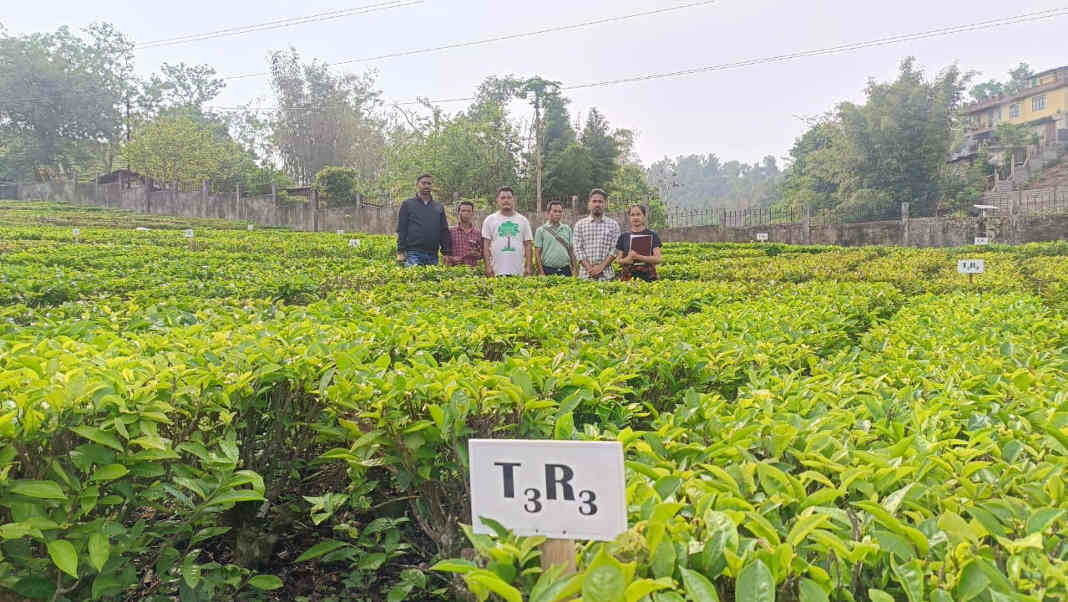

Researchers at Umiam are using beneficial fungi to help Meghalaya’s organic tea gardens fight diseases and pests without chemicals
ROOPAK GOSWAMI
Guwahati, Jan 1: Meghalaya’s push for organic tea is getting a powerful boost from cutting-edge science emerging out of Umiam.

Researchers at the College of Post Graduate Studies–Agricultural Sciences (CPGS-AS) Umiam are developing biological solutions that could help tea gardens tackle diseases and pests—without relying on chemical pesticides. Led by Prof. Pranab Dutta, Chairman of the School of Crop Protection, the research focuses on using beneficial fungi and their natural compounds to protect tea plants, improve growth, and make organic cultivation more resilient in a changing climate.

Tea (Camellia sinensis) is a high-value crop, but in Meghalaya and neighbouring states it faces persistent threats from fungal diseases such as blister blight, grey blight, and Fusarium die-back, along with pests like the red spider mite (Oligonychus coffeae). Chemical controls may work quickly, but they come at a cost—pesticide residues, resistance, soil degradation, and environmental damage, all of which undermine organic tea production.
Turning friendly fungi into defenders of tea
Instead of chemicals, Prof. Dutta’s team turned to endophytic fungi—microorganisms that live inside healthy plants and quietly defend them from pathogens while boosting growth. In a major study, PhD scholar Madhusmita Mahanta collected 31 fungal isolates from healthy tea plants across Assam, Arunachal Pradesh, and Meghalaya.

When tested against key tea pathogens—Pestalotiopsis theae, Exobasidium vexans, and Fusarium solani—five isolates stood out, each suppressing more than 70% of pathogen growth under laboratory conditions. One fungus, Trichoderma reesei, proved especially powerful.
Detailed analysis showed that T. reesei produces a suite of plant-friendly compounds, including indole-3-acetic acid (IAA), siderophores, ammonia, and hydrogen cyanide, and can unlock nutrients such as phosphorus, potassium, and zinc from the soil—an ideal combination for organic tea systems.
One solution, two problems solved
What makes the research truly novel is the dual role of Trichoderma reesei. Beyond controlling fungal diseases, laboratory bioassays revealed strong entomopathogenic activity. A spore suspension caused significant mortality in red spider mites, suggesting that a single biological agent could manage both diseases and pests.
“This kind of dual bioefficacy is a game-changer for integrated organic pest management,” researchers note, especially for small and medium tea growers.
From molecules to market-ready solutions
Using advanced tools such as HPLC and FT-NMR, the team identified key antifungal compounds produced by T. reesei, including gliocladic acid, harzianic acid, harzianolide, gliovirin, azaphilone, and ergosterol. These were then developed into a microencapsulated formulation named TrichoSpectra, designed to improve stability and field performance.

Lab tests showed over 86% inhibition of major tea pathogens, while field trials in Meghalaya and Arunachal Pradesh confirmed strong disease control without any phytotoxic effects. The research also linked disease intensity to temperature, highlighting the need for climate-smart organic management.
New ideas, wider horizons
Parallel work by PhD scholar Pritam Das tackled Fusarium die-back, confirming Fusarium solani as the causal agent in Meghalaya’s tea gardens. Using Trichoderma reesei, the study achieved up to 79.5% inhibition of the pathogen. In an unconventional twist, the research also explored homeopathic medicines alongside biocontrol agents, achieving complete pathogen suppression at higher doses—opening new interdisciplinary possibilities for chemical-free farming.
Further support has come from international collaboration. A project funded by IBIDEN is testing a biostimulant called “Leaf Energy”, which has shown promise in improving plant growth, leaf quality, and natural defence compounds in organic tea.
Meanwhile, native Trichoderma harzianum strains from Meghalaya have been developed into a stable bioformulation with a 16-month shelf life, delivering improved growth and yield under field conditions. Researcher Ritika Raj has also demonstrated that native fungal endophytes such as Metarhizium can suppress blister blight, achieving over 51% inhibition of Exobasidium vexans in lab studies.
A scientific roadmap for organic tea
Taken together, these studies place Meghalaya at the forefront of evidence-based organic tea research in Northeast India. By combining endophytic fungi, bioactive metabolites, and innovative formulations, scientists at Umiam are offering tea growers scalable, residue-free, and environmentally sound solutions.
As global demand grows for clean, sustainably produced tea, the quiet work happening in Umiam’s laboratories may well shape the future of organic tea gardens across the hills of Meghalaya—and beyond.