

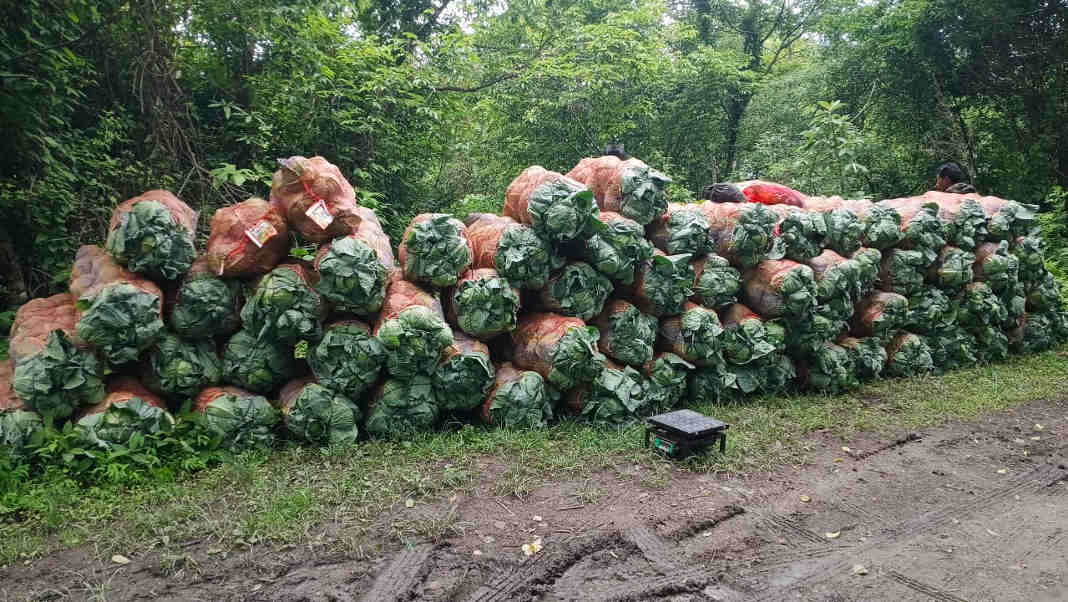

The Razeba crisis exposes the wider post-harvest infrastructure deficit across Northeast India, where poor market linkages and lack of cold storage leave farmers counting losses despite bumper harvests.
Kohima, July 5: Hundreds of metric tonnes of cabbage are rotting in the fields of Nagaland’s Razeba Range in Phek district after farmers failed to find buyers, triggering calls for urgent government intervention to prevent massive losses in one of the state’s largest vegetable-producing belts.
The crisis has hit the four villages of Tsupfume, Razeba, Zelome and Zhavame, an area widely known as the “Vegetable Basket of Phek.” Three of the villages—Zhavame, Tsupfume and Zelome—have also been officially recognised by the Nagaland government as “Vegetable Villages” for their large-scale commercial cultivation.
Farmers said this year’s cabbage harvest was abundant, but the absence of market linkages has left hundreds of tonnes of produce stranded in the fields.
“This is not crop failure. It is market failure,” farmers said, alleging that traders are offering prices far below production costs while many have refused to buy the produce altogether.

The region supplies vegetables to markets in Phek, Kohima, Dimapur and parts of neighbouring Manipur. However, growers say the lack of cold storage facilities, collection centres and affordable transport has made it impossible for them to move their harvest to distant markets.
With no government procurement mechanism in place, cabbage worth lakhs of rupees is now decomposing in the fields, threatening the livelihoods of farming families who depend almost entirely on agriculture.
Farmer groups blamed poor infrastructure and weak post-harvest support for the crisis, pointing to the absence of cold storage, packhouses, transport subsidies and real-time market information. They also said existing Farmer Producer Organisations (FPOs) lack the financial and logistical capacity to aggregate and market produce.
The farmers have demanded immediate procurement of the remaining cabbage, establishment of cold storage and collection centres in Razeba Range, transport subsidies during harvest season, strengthening of FPOs, and crop insurance and input support to prevent similar crises in the future.
The growers also urged their elected representative and the state government to treat the issue as an agricultural emergency, warning that repeated marketing failures could discourage young people from taking up farming in one of Nagaland’s most productive vegetable-growing regions.
The Razeba crisis is not an isolated incident but reflects a wider post-harvest challenge across Northeast India, where inadequate cold storage, poor road connectivity and weak market linkages often force farmers to watch perishable produce rot despite bumper harvests.
Also Read: Guwahati to host BRICS anti-drug chiefs as India pushes global crackdown on synthetic narcotics
Also Watch
Find latest news from every corner of Northeast India at hubnetwork.in, your online source for breaking news, video coverage.
Also, Follow us on
Twitter-twitter.com/nemediahub
Youtube channel- www.youtube.com/@NortheastMediaHub2020
Instagram- www.instagram.com/ne_media_hub
Download our app from playstore – Northeast Media Hub