


Rajiv Roy
Modern quantum physics and ancient spiritual traditions, though born in vastly different eras, often appear to speak a surprisingly similar language. Concepts such as vibration, resonance, superposition, and potentiality in quantum theory echo ideas that Indian spiritual systems have articulated for millennia through mantra, sadhana, and devotion to the Ishta Devata. When viewed together—not as rigid equivalences but as complementary metaphors—they offer a profound way to understand spiritual transformation.
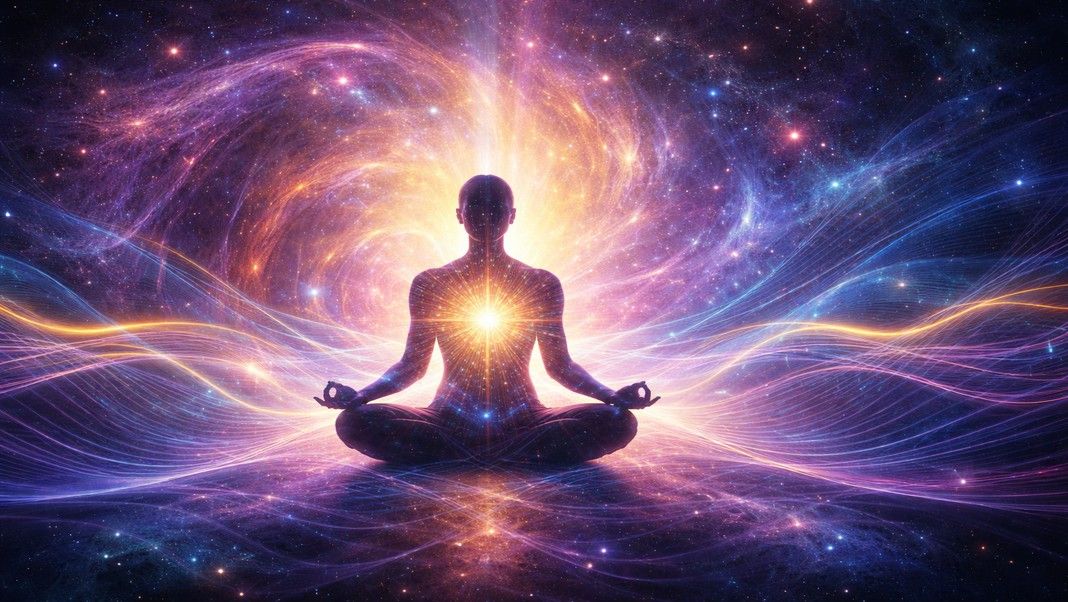
In quantum physics, every atom vibrates at a specific resonant frequency. When an external vibration matches this frequency, the atom begins to resonate more strongly, a phenomenon known as entrainment. This principle is not limited to physics alone; it finds a powerful parallel in spiritual practice. Chanting a mantra that corresponds to a particular deity can be understood as a form of entrainment, where the practitioner’s inner field gradually aligns with the energetic quality of that divine form.
From this perspective, mantras are not merely symbolic sounds or devotional poetry. They are precise vibrational tools. Each mantra is believed to carry the exact energetic signature of a specific higher consciousness or deity. When chanted with sincerity, discipline, and devotion, the mantra tunes the practitioner’s inner frequency to that higher state. To “rise” spiritually, then, is not about acquiring something external, but about emitting a frequency that resonates with a higher order of being.
This may also explain why individuals feel naturally drawn to certain deities, whom they call their Ishta Devata. The attraction is not random; it arises from resonance. One’s inner frequency already aligns more closely with that particular form of the divine. In quantum terms, it is akin to particles responding to each other through resonance or entanglement—where connection is not limited by physical distance, or even by space itself. Once two particles are entangled, a change in one is instantaneously reflected in the other. Similarly, when a mantra is recited with total devotion, it creates a subtle field of connection between the individual and the divine, transcending ordinary limitations.
This is beautifully captured in the classical dictum: “Mantra devata abhedah”—there is no difference between the mantra and the deity. The sound is not separate from the form; the vibration is the presence.
Another foundational principle of quantum physics deepens this understanding: quantum potentiality. At the heart of quantum theory lies the wave function—a mathematical expression that contains all possible states a system can assume. Before observation, a particle does not exist in a single, fixed condition. Instead, it exists in superposition, simultaneously holding all potential states. Only when measured does it collapse into one specific outcome.
Human beings, too, are composed of quantum particles. Symbolically speaking, this means we carry immense potential within us—the possibility of becoming many things. Until we choose consciously, we remain in a kind of existential superposition. The choice of an Ishta is not merely devotional preference; it is a declaration of intent. Through repeated sadhana, discipline, and alignment of action, thought, and feeling, we choose which potential we allow to collapse into lived reality.
In this sense, spiritual practice is a long, intentional process of becoming. By continuously emitting a vibrational frequency aligned with a higher being, the practitioner gradually transforms. One does not merely worship the Ishta; one becomes the Ishta. This idea resonates with the Bhagavad Geeta’s insight: “The Supreme Self is the same in all beings, dwelling in all, yet not affected.” (15.15)
Guru Shri Praveen Radhakrishnan, Chairman, Kaliputra Mission often expresses this truth succinctly: the body is the yantra, the sacred instrument. From the very first day of practice, one must live as the Ishta, not merely aspire toward it. This brings us to his teaching on what may be called “procedural collapse.” The divine is not found in the mechanical sequencing of rituals alone. It is not confined to external procedures. The true collapse—the true realization—occurs through the mantra and, more importantly, through how one lives.
Daily actions, ethical choices, emotional responses, and intentions must match the nature of the chosen deity. If one’s life vibrates in harmony with the Ishta, the collapse into that state becomes inevitable. Spirituality, then, is not separate from life; it is measured by the degree of resonance between one’s actions and one’s ideal.
Seen this way, existence itself becomes a play of frequencies. When individual consciousness resonates with cosmic consciousness, the illusion of separation dissolves. Ego fades, and what remains is the soul—the infinite field of potential, containing all forms of the divine within it. The soul is not a fragment striving to reach God; it is that vast quantum potential in which all forms of God already exist.
Ultimately, the journey of mantra, devotion, and sadhana is not about reaching somewhere else. It is about tuning oneself so completely that the boundary between seeker and sought disappears. When frequencies align, unity is not achieved—it is revealed.
Also Read: Taj Resort & Spa to be located in existing Orchid Umiam property: Meghalaya CM
Also Watch
Find latest news from every corner of Northeast India at hubnetwork.in, your online source for breaking news, video coverage.
Also, Follow us on
Twitter-twitter.com/nemediahub
Youtube channel- www.youtube.com/@NortheastMediaHub2020
Instagram- www.instagram.com/ne_media_hub
Download our app from playstore – Northeast Media Hub