


Tura, Nov 1: Arecanut, Meghalaya’s major horticultural crop, is facing mounting production challenges, notably the increasing incidence of bud rot disease, which has led to a steady decline in productivity. The compound annual growth rate (CAGR) of arecanut production in the state fell sharply to 1.79% during 2010–20, compared to 9.25% during 1990–2000, while the all-India growth rate stood at 9.82%.
To address this concern and promote scientific arecanut-based farming systems, the ICAR–Central Plantation Crops Research Institute (ICAR–CPCRI), Kasaragod, Kerala, in collaboration with Krishi Vigyan Kendras (KVKs) and the Department of Horticulture, Government of Meghalaya, conducted a series of stakeholder meetings, training sessions, and field demonstrations across the Garo Hills region from October 27 to 31, 2025.
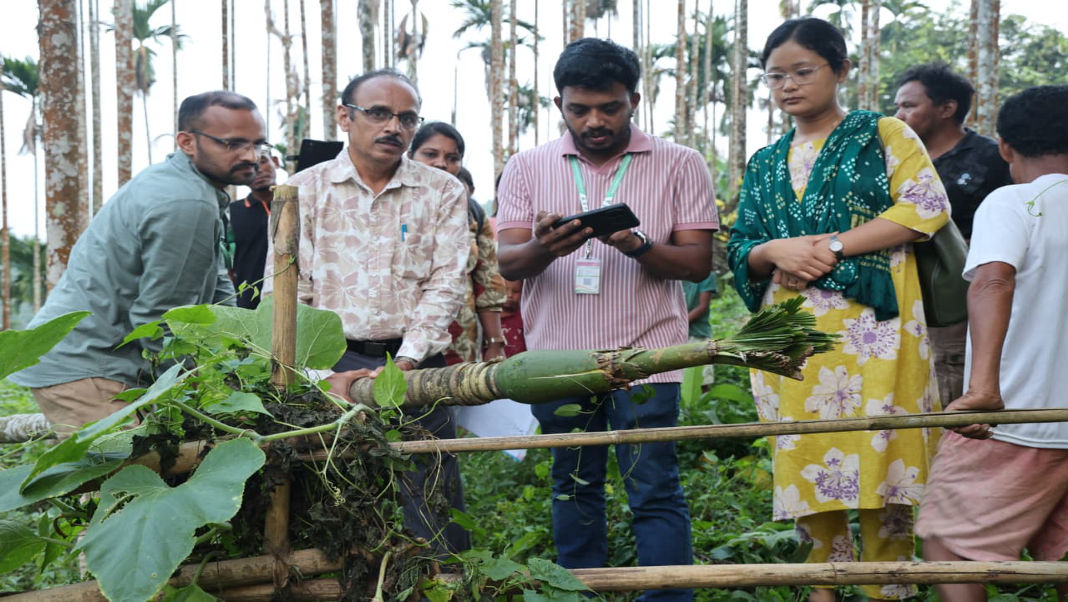
Led by Dr. Vinayaka Hegde, Head of the Crop Protection Division, ICAR–CPCRI, the team organized five training programmes and four field demonstrations across West, South, North, East, and South-West Garo Hills. The initiative aimed to equip farmers with practical knowledge on disease management, intercrop integration, and improved cultivation practices.

“There is ample scope for integrating cocoa and black pepper with arecanut in the Garo Hills,” said Dr. Hegde. “Focusing on companion cropping and effective management of bud rot disease can significantly enhance productivity and farmer income, strengthening the livelihoods of arecanut growers in Meghalaya.”
The training sessions covered bud rot management, soil health improvement, and intercropping techniques. Scientists Dr. Bhavishya, Dr. Thava Prakasa Pandian, and Dr. Jilu V. Sajan explained that Phytophthora, a fungal pathogen aggravated by moisture stress and boron deficiency, is the main cause of bud rot. They recommended integrated management practices such as mulching, catch pits for water retention, pineapple planting on slopes, and judicious irrigation.
Farmers were also advised to apply lime, organic manure, wood ash, and borax to correct soil pH and improve palm health. Preventive Bordeaux mixture (1%) spraying on the palm crown was emphasized to contain the spread of bud rot. The team further encouraged the adoption of phytosanitation measures and replanting with high-yielding ICAR–CPCRI varieties like Nalbari, Kahikuchi Tall, and Mohitnagar.

To promote eco-friendly pest management, the scientists distributed Trichoderma-based bio-control formulations developed by ICAR–CPCRI to 190 farmers. They also demonstrated the use of carbon fibre telescopic poles for spraying Bordeaux mixture and harvesting nuts from tall palms — a safer and more efficient alternative to manual climbing.
In total, over 720 farmers benefited from the five-day outreach programme. Field visits in Songsak (East Garo Hills) and Rerapara (South-West Garo Hills) revealed that lack of scientific practices and moisture stress remain key constraints in the region’s arecanut productivity.
The initiative, part of ICAR–CPCRI’s ongoing efforts to strengthen its North Eastern outreach, underscores the institute’s commitment to promoting sustainable, integrated arecanut and cocoa cultivation systems that can enhance farmers’ income and resilience in Meghalaya’s hill farming landscape.
Also Read: Will there be a winter chill in Northeast India? No, says the weatherman
Also Watch
Find latest news from every corner of Northeast India at hubnetwork.in, your online source for breaking news, video coverage.
Also, Follow us on-
Twitter-twitter.com/nemediahub
Youtube channel- www.youtube.com/@NortheastMediaHub2020
Instagram- www.instagram.com/ne_media_hub
Download our app from playstore – Northeast Media Hub