

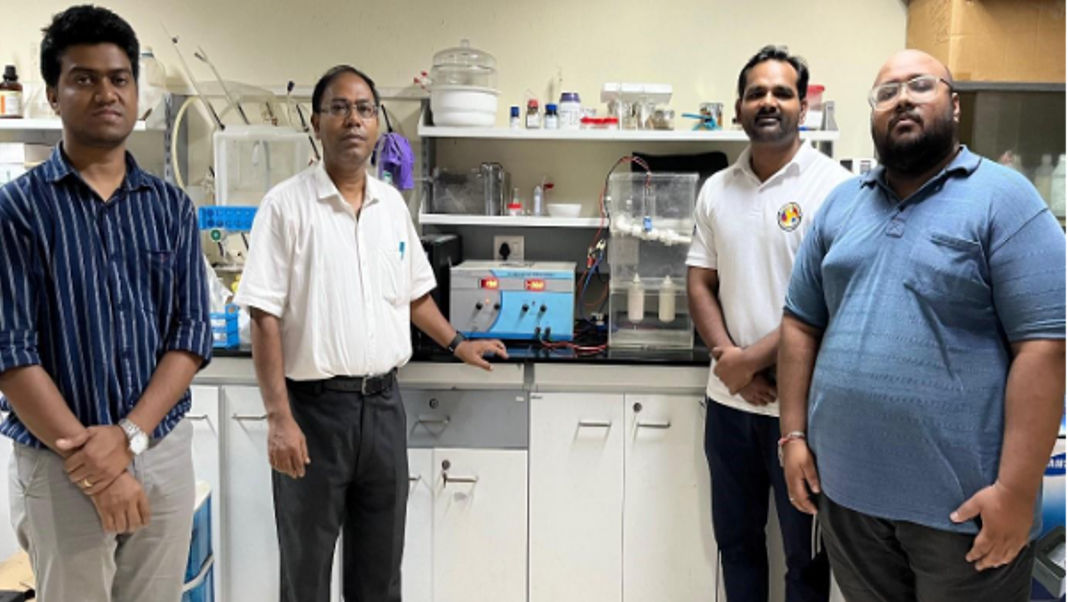

Guwahati, June 19: Researchers at the Indian Institute of Technology (IIT) Guwahati have developed a cost-effective community-scale water treatment system capable of removing fluoride and iron from contaminated groundwater.
The system, which can treat up to 20,000 litres of water per day, offers a practical solution for areas with limited access to safe drinking water and has already been successfully piloted in Changsari, Assam, with support from the Public Health Engineering Department of Assam and Kakati Engineering Pvt. Ltd.
One of the standout features of the system is its affordability—it costs only Rs. 20 to treat 1,000 litres of water.

The system can treat 20,000 liters of water per day, removing 94% of iron and 89% of fluoride.
The breakthrough, recently published in the ACS ES&T Water journal, addresses a longstanding issue affecting multiple Indian states including Rajasthan, Telangana, Andhra Pradesh, Karnataka, and Gujarat, where excess fluoride in groundwater has led to widespread health problems such as skeletal fluorosis—a condition that causes bones to harden and joints to stiffen, severely impairing mobility. Iron contamination, which discolours water and can damage internal organs, further compounds the challenge in many of these regions.
The IIT Guwahati team has designed a four-stage water purification process that is not only energy-efficient but also affordable and easy to operate. The first step, aeration, involves a specially designed aerator that infuses oxygen into the water, initiating the removal of dissolved iron. In the second stage, electrocoagulation, a mild electric current is passed through aluminum electrodes, releasing charged ions that attract and bind with impurities. This is followed by a flocculation and settling stage, where the bound contaminants form clumps or ‘flocs’ that are thickened and allowed to settle. Finally, the water passes through a multi-layer filter of coal, sand, and gravel to eliminate remaining particles.

Speaking about the innovation, Prof. Mihir K. Purkait from the Department of Chemical Engineering, IIT Guwahati, explained that electrocoagulation not only dissolves the sacrificial metal anode to generate coagulants but also produces hydrogen gas that interacts with air bubbles, helping lift pollutants to the surface. He noted that aluminum was chosen for its low cost, high electro-positivity, and effectiveness in removing fluoride, arsenic, and iron under optimal conditions.
The system was tested over 12 weeks under real-world conditions and consistently removed 94% of iron and 89% of fluoride from groundwater, bringing contamination levels within Indian drinking water safety standards. With a projected lifespan of 15 years and only semi-annual electrode replacements required, the system is designed for longevity with minimal maintenance. A built-in mechanism helps estimate electrode life and alerts users for timely maintenance.
Looking to the future, the IIT Guwahati team is working to integrate renewable energy options like solar and wind power to run the system and is exploring the potential use of hydrogen gas produced during electrocoagulation.
Efforts are also underway to incorporate smart sensors and automated controls to reduce the need for manual intervention, making the system even more suitable for deployment in remote and underserved areas.
The researchers hope to further enhance performance by combining their system with other water treatment technologies, ultimately creating a scalable and decentralised solution for clean drinking water access across India.
Also Read: Thadou body seeks recognition of ‘Third Category’ Internally Displaced in Manipur
Also Watch
Find latest news from every corner of Northeast India at hubnetwork.in, your online source for breaking news, video coverage.
Also, Follow us on-
Twitter-twitter.com/nemediahub
Youtube channel- www.youtube.com/@NortheastMediaHub2020
Instagram- www.instagram.com/ne_media_hub
Download our app from playstore – Northeast Media Hub

 Guwahati have developed a cost-effective community-scale water treatment system capable of removing fluoride and iron from contaminated groundwater.)