



Villagers, students and forest officials on International Day for Biological Diversity highlight the link between indigenous knowledge, wildlife conservation and community-led protection of local ecosystems
SHILLONG, May 23: At Karukol village in South Garo Hills, discussions on biodiversity conservation on Friday went beyond speeches and official messages, focusing instead on the everyday relationship local communities share with forests, wildlife and traditional knowledge.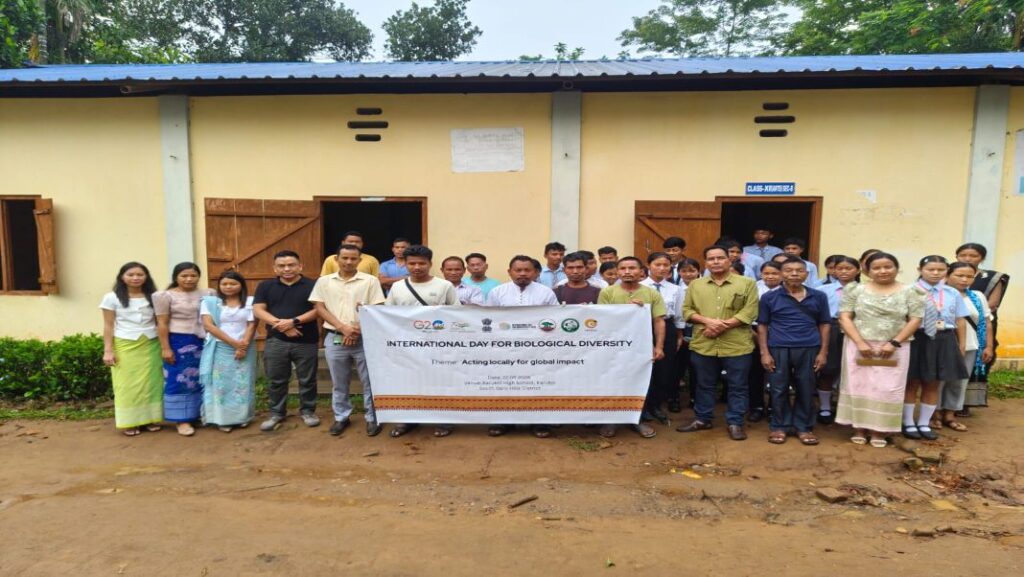
The International Day for Biological Diversity was observed by the North East Society for Agroecology Support (NESFAS) on May 22 in collaboration with the Meghalaya Biodiversity Board (MBB), bringing together villagers, students, forest officials and community leaders.
Speaking during the programme, Baghmara Range Officer Eliazer Ch. Momin said protecting forests also means protecting elephants, which quietly help forests regenerate.
“Elephants play a major role in dispersing seeds and helping biodiversity grow naturally,” he said while explaining the ecological link between wildlife and forest health in the Garo Hills region.
For many present at the gathering, the discussion reflected realities they see around them every day.
Bethuel G. Momin, Nokma (traditional chief) of Rongchekgre, said forests should not be viewed only from a human perspective.
“Human wellbeing depends on the balance of all living beings sharing the forest,” he said, stressing that plants, animals and people are all connected within the same ecosystem.
The programme also highlighted concerns about the gradual loss of indigenous knowledge and language.
Baghmara and Siju Block BDO Chengreng D. Sangma said traditional dialects such as A·chik and A·tong carry generations of knowledge linked to medicinal plants and local ecology.
“When communities forget the traditional names of plants, they also lose the knowledge attached to them,” he said, urging students to continue using local dialects while identifying regional flora.
One of the major attractions of the event was an exhibition of wild edible plants, forest fruits and medicinal species commonly found in the region. Villagers and students exchanged stories about how many of these plants are still used in households for food and traditional healing.
A student of Karukol Higher Secondary School spoke about indigenous plants historically used for treating wounds, drawing interest from participants gathered around the display.
Principal Betroy M. Sangma encouraged students to take up tree planting as a personal responsibility and nurture at least one tree each to support local wildlife habitats.
Referring to former President A. P. J. Abdul Kalam, he said, environmental protection begins with small actions taken by individuals.
The programme concluded with a training session for members of the local Biodiversity Management Committee on maintaining People’s Biodiversity Registers, aimed at documenting local species and preserving traditional ecological knowledge.
Also Watch
Find latest news from every corner of Northeast India at hubnetwork.in, your online source for breaking news, video coverage.
Also, Follow us on
Twitter-twitter.com/nemediahub
Youtube channel- www.youtube.com/@NortheastMediaHub2020
Instagram- www.instagram.com/ne_media_hub
Download our app from playstore – Northeast Media Hub