

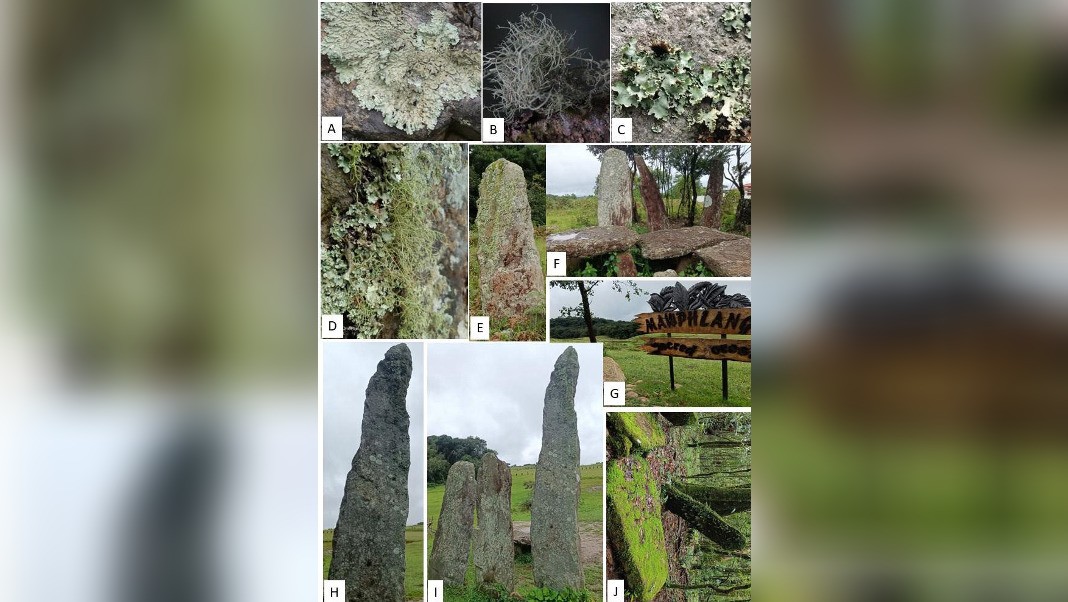

Shillong, July 17: The ancient stone monoliths of the Mawphlang Sacred Grove—one of Meghalaya’s most culturally revered landscapes—are facing silent but significant deterioration due to biological colonization by lichens and bryophytes, according to a new scientific study published in the International Journal of Plant and Environment (June 2025).

The study, conducted in 2024 by researchers Rajveer Singh Chauhan, Prashant Kumar Behera, Priyanshu Srivastava, Ichha Omar, and Vishnu Kumar, focuses on one of the oldest and most historically significant monoliths in Meghalaya and the wider Northeast region. The researchers are affiliated to Department of Botany, Deen Dayal Upadhyaya Gorakhpur University, Civil Lines, Gorakhpur, Department of Applied Science, Dr. K.N. Modi University, Rajasthan, and Department of Botany, Government P.G. College, Lalitpur, Uttar Pradesh.
“The monoliths have suffered considerable deterioration due to both geo-weathering and biological factors,” the authors note in the study. “It is imperative that local tourism authorities recognize this issue and implement effective conservation measures.”
The sacred grove, located about 15 km from Mawphlang town in the Khasi Hills, is a protected forest of immense spiritual and cultural importance. Historically, it served as a sacred meeting ground for Khasi kings and elders (Ki Lyngdoh), where coronations, rituals, and sacrifices were performed. The grove still houses stone monoliths erected in memory of great tribal leaders and warriors.

Due to strict community-led conservation practices, the forest prohibits the collection of even a twig without permission. As a result, the researchers used high-resolution photography to document the cryptogamic growth on the monoliths. Identifications were made up to the species and genus levels, and validated by subject experts.
The study revealed that the monoliths—composed of porous sandstone and khondalite—are highly vulnerable to colonization by nine species of lichens and six species of bryophytes. Their porous nature and moisture retention capacity make them ideal substrates for these organisms.
“The expansion and contraction of lichen and moss thalli with seasonal moisture changes cause physical stress on the stones,” the researchers observed. “This results in micro-cracks and the dislodging of surface material.”
More concerning is the biochemical damage: many of the documented species produce acidic secondary metabolites—such as atranorin and usnic acid—that act as bio-deteriorants and chemically weaken the stone over time.
The study also points to growing human impact. “Anthropogenic pressures, such as tourism, deforestation, and air pollution, have encouraged the growth of pollution-tolerant species like Dirinaria and Pyxine,” the authors wrote. These species, known bioindicators of air quality, further intensify the degradation process.
The combined effect of biological, chemical, and mechanical weathering, exacerbated by climate change and human activity, presents a serious threat to the long-term preservation of these heritage structures.
The authors advocate for integrated conservation strategies, including non-invasive monitoring tools, selective removal of harmful species, application of protective coatings, and sustainable tourism practices to preserve this unique ecological and cultural site for future generations.
Also Read: Nirmala Sitharaman praises Meghalaya’s progress in fostering youth-led innovation
Also Watch
Find latest news from every corner of Northeast India at hubnetwork.in, your online source for breaking news, video coverage.
Also, Follow us on-
Twitter-twitter.com/nemediahub
Youtube channel- www.youtube.com/@NortheastMediaHub2020
Instagram- www.instagram.com/ne_media_hub
Download our app from playstore – Northeast Media Hub

.)