

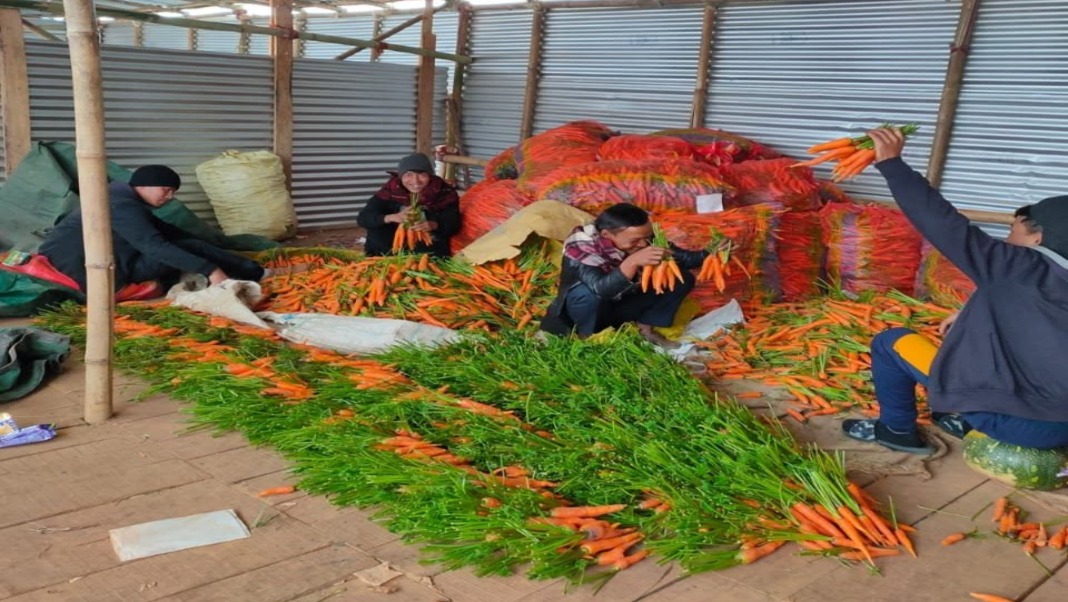

CAU researchers find Farmer Producer Organisations are improving access to information, training and confidence, but have yet to significantly reduce farmers’ dependence on middlemen.
Shillong, July 23: Farmer Producer Organisations (FPOs) in Meghalaya are helping farmers become better informed, better connected and more confident, but they are yet to crack one of agriculture’s biggest challenges—ensuring better prices through stronger market linkages.
A new study by Salome M. Marak, M. Victoria Devi, Puspita Das, Natasha R. Marak, ST. Pavana Kumar and Yash Dwivedi of the Central Agricultural University (CAU), Imphal, has found that while FPO membership has significantly improved farmers’ access to agricultural information, training and social support, the benefits in marketing farm produce remain relatively limited.
The findings come at a time when both the Centre and the Meghalaya government are promoting FPOs as a key strategy to improve farmers’ incomes by enabling collective marketing, aggregation and value addition.

Published in the Asian Research Journal of Agriculture, the study surveyed 100 farmers from four Farmer Producer Organisations in West Garo Hills—the district with the highest number of FPOs in Meghalaya—during 2024-25. The four FPOs covered were Mikasal Farmer Producer Company Ltd, Tikrikilla Agrofed Producer Company Ltd, Demdema Agrofed Producer Company Ltd and Bitegram Agrifed Producer Company Ltd.
One of the study’s most significant findings was the sharp improvement in farmers’ access to institutional support after joining FPOs. The proportion of farmers receiving agricultural advice from Krishi Vigyan Kendras (KVKs), FPO personnel, government departments and financial institutions increased from 46 per cent before joining an FPO to 98 per cent afterwards. Internet-based access to farm information also rose sharply, while mobile phones emerged as a much more important source of agricultural knowledge.
Researchers also observed a marked improvement in farmers’ communication behaviour. The share of members with medium levels of communication skills increased from 41 per cent before joining an FPO to 69 per cent afterwards, largely due to regular training programmes, demonstrations, group discussions and direct interaction with agricultural experts.
The biggest gains, however, were social.
Nearly three-fourths (73.4 per cent) of respondents said FPOs had strengthened their sense of community, improved knowledge sharing and enhanced their social standing. More than half also reported better access to quality inputs, improved farming technologies and technical guidance.
But the study also identifies a major gap.
Only 36.4 per cent of respondents reported significant improvements in market access. Many farmers continue to depend on traditional middlemen instead of collectively marketing their produce through FPOs, limiting their ability to secure better prices. Financial benefits were also less pronounced, with only 41.5 per cent of respondents reporting noticeable improvements in income.
The researchers say this underlines a broader challenge facing FPOs across India. While they have become effective institutions for training, information dissemination and capacity building, translating these gains into stronger market power and higher farm incomes remains an unfinished task.
The statistical analysis found that farmers who actively participated in community activities and those with greater awareness of farming risks—such as climate change, price volatility and post-harvest losses—were significantly more likely to perceive higher benefits from FPO membership. Social participation and risk perception emerged as the two most important factors influencing how much value farmers derived from the organisations.
The findings are particularly significant for Meghalaya, where agriculture is dominated by small and marginal farmers cultivating fragmented landholdings. In such a setting, FPOs are expected to play a crucial role in aggregating produce, strengthening bargaining power and connecting farmers to better markets.
The researchers conclude that while FPOs are successfully building farmers’ knowledge, confidence and social capital, the next phase of policy support must focus on strengthening market linkages, reducing dependence on intermediaries and enabling FPOs to evolve into robust farmer-owned business enterprises capable of delivering sustained income growth.