

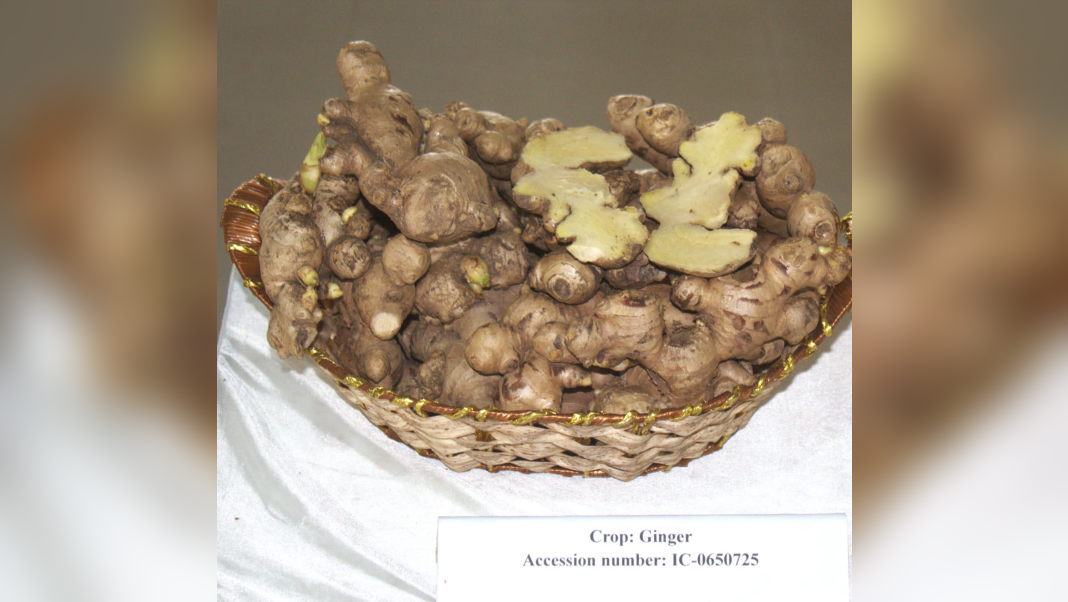

Guwahati, Nov 18: Nagaland University has released a new high-performing ginger variety, SAS-KEVÜ, developed to deliver superior yields, high dry-matter recovery, and exceptional culinary quality. After nearly a decade of research and multi-location trials, the variety is now officially notified for cultivation and commercial use—marking a major breakthrough for farmers, processors, and the spice industry.
Developed under the All India Coordinated Research Project (AICRP) on Spices, SAS-KEVÜ underwent extensive scientific evaluation across seven centres nationwide. The research was led by Prof. C. S. Maiti and Dr. Graceli I. Yepthomi of the School of Agricultural Sciences, Nagaland University. The variety received its formal notification from the Ministry of Agriculture and Farmers Welfare and was published in the Gazette of India on September 2, 2025.
With a yield potential of 17.21 tonnes per hectare, SAS-KEVÜ outperformed the national check variety by more than nine percent. It also offers a dry recovery rate of 21.95%, a key advantage for ginger processors. The rhizomes—bold, pulpy, lemon-yellow, and low in fibre—make it ideal for fresh consumption, pickles, beverages, candying, and paste production.
Congratulating the research team, Prof. Jagadish K. Patnaik, Vice Chancellor of Nagaland University, called it a “landmark achievement” born from nine years of coordinated national trials. “SAS-KEVÜ has been specifically developed to deliver higher yields, improved quality, and greater resilience,” he said. “It will substantially enhance farmer incomes while strengthening India’s ginger value chain.”

The new variety is especially valuable for food processing industries due to its moderate oil content and high-quality rhizomes. For farmers, its nine-month crop duration aligns neatly with existing production cycles across ginger-growing regions, enabling smoother planning and higher returns.
Tracing the project’s origins, Prof. Maiti explained that the journey began in 2014 with the collection of 19 Nadia ginger clones from across Nagaland. The clone NDG-11—later named SAS-KEVÜ—stood out consistently. Between 2018 and 2022, it demonstrated strong performance in evaluations across Andhra Pradesh, Kerala, Mizoram, Nagaland, Odisha, West Bengal, and Sikkim. Stability analyses, including GGE Biplot assessment, confirmed its adaptability, particularly in Nagaland, Pundibari (West Bengal), and Chintapalle (Andhra Pradesh).

Dr. Yepthomi noted that with central government approval under the Seeds Act, 1966, the variety is now cleared for seed production and sale in Nagaland, Mizoram, West Bengal, and Andhra Pradesh. “This milestone strengthens Nagaland University’s leadership in agricultural innovation and spice research,” she added.
SAS-KEVÜ is the first ginger variety developed by the AICRP (Spices) team in Nagaland and the first such variety from any research institute in Northeast India. Seed rhizome multiplication is now being scaled up so that farmers can access planting material ahead of the next cropping season.
Also Read: Assam Congress to pay tribute to Zubeen Garg’s on Birthday with ‘Kanchanjungha’
Also Watch
Find latest news from every corner of Northeast India at hubnetwork.in, your online source for breaking news, video coverage.
Also, Follow us on-
Twitter-twitter.com/nemediahub
Youtube channel- www.youtube.com/@NortheastMediaHub2020
Instagram- www.instagram.com/ne_media_hub
Download our app from playstore – Northeast Media Hub