


Researchers survey 750 buildings across Shillong, warning that rapid urban growth, hill-slope construction, and poor seismic safety practices could lead to severe damage during a major earthquake.
ROOPAK GOSWAMI
Shillong, May 15: Shillong, the picturesque hill capital of Meghalaya, is celebrated for its rolling landscapes, dense urban settlements, and fast-paced growth. But beneath the city’s scenic charm lies a growing seismic concern.
Located in India’s highest earthquake risk zone, Shillong faces significant vulnerability from future earthquakes, prompting researchers from the National Institute of Technology Meghalaya to call for an urgent assessment of the city’s buildings and urban infrastructure.
A study by researchers from the National Institute of Technology Meghalaya has raised serious concerns over the earthquake vulnerability of buildings in Shillong, warning that a majority of the city’s reinforced concrete structures could suffer severe damage during a major seismic event.
The study, conducted by Aakash Kumar, Alfie Doreen Nongsiej, Reuel Newman Dkhar, Dr Needhi Kotoky, and Chandrasekhar Putcha, assessed 750 reinforced concrete (RC) frame buildings across Shillong using Rapid Visual Screening (RVS), a quick and practical method used globally to identify structurally vulnerable buildings. The study titled “Seismic Vulnerability Assessment of RC Frame Buildings Using Rapid Visual Screening in Shillong, North-East India” was published in the Springer volume Natural Disasters: Risk Analysis, Management and Mitigation—Volume 1.
Researchers noted that the city’s hilly terrain, dense urbanisation, and rapid expansion have significantly increased concerns over seismic safety.
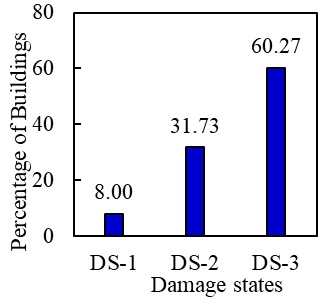
According to the findings, 60.27% of surveyed buildings are expected to suffer severe damage (DS-3) during a strong earthquake, while 31.73% may experience moderate damage (DS-2). Only 8% of buildings were classified under the lower-risk damage category.
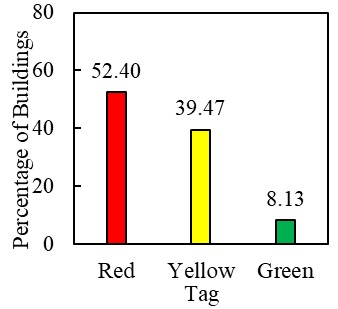
Using National Disaster Management Authority (NDMA) guidelines, the researchers further classified buildings into red, yellow, and green safety tags. Alarmingly, 52.4% of the buildings surveyed were placed in the “red tag” category, indicating unsafe structures requiring urgent engineering intervention, while only 8.13% were considered relatively safe.
The study identified several structural and planning-related vulnerabilities commonly seen across Shillong. These include buildings constructed too close to each other, irregular building shapes, heavy overhangs, weak ground floors used for parking or shops, visible cracks, and construction on steep hill slopes.
Researchers observed that many buildings in Shillong are constructed on uneven terrain where different portions of the structure rest at varying foundation levels, creating severe vertical irregularities that can worsen earthquake damage. The study noted that some slopes in Shillong reach gradients of up to 52 degrees.
The survey also found that nearly 46.67% of buildings lacked adequate seismic gaps between adjacent structures, increasing the risk of collision during earthquakes. More than 55% of the surveyed buildings had irregular plan shapes, while around 45.73% had soft-storey configurations — a known seismic weakness commonly seen in buildings with open ground floors used for parking or commercial purposes.
The researchers highlighted that Shillong’s growing urban density and hill-based construction patterns require urgent attention from policymakers, engineers, and urban planners. The study stressed the importance of retrofitting vulnerable buildings and ensuring that future construction strictly follows earthquake-resistant design practices.
The paper noted that Rapid Visual Screening offers a fast and cost-effective way to identify unsafe buildings before disaster strikes, helping authorities prioritise strengthening work, evacuation planning, and mitigation measures.
The researchers said the findings could help decision-makers formulate timely mitigation policies and improve the resilience of Shillong’s built environment against future earthquakes.
Also Watch
Find latest news from every corner of Northeast India at hubnetwork.in, your online source for breaking news, video coverage.
Also, Follow us on
Twitter-twitter.com/nemediahub
Youtube channel- www.youtube.com/@NortheastMediaHub2020
Instagram- www.instagram.com/ne_media_hub
Download our app from playstore – Northeast Media Hub