

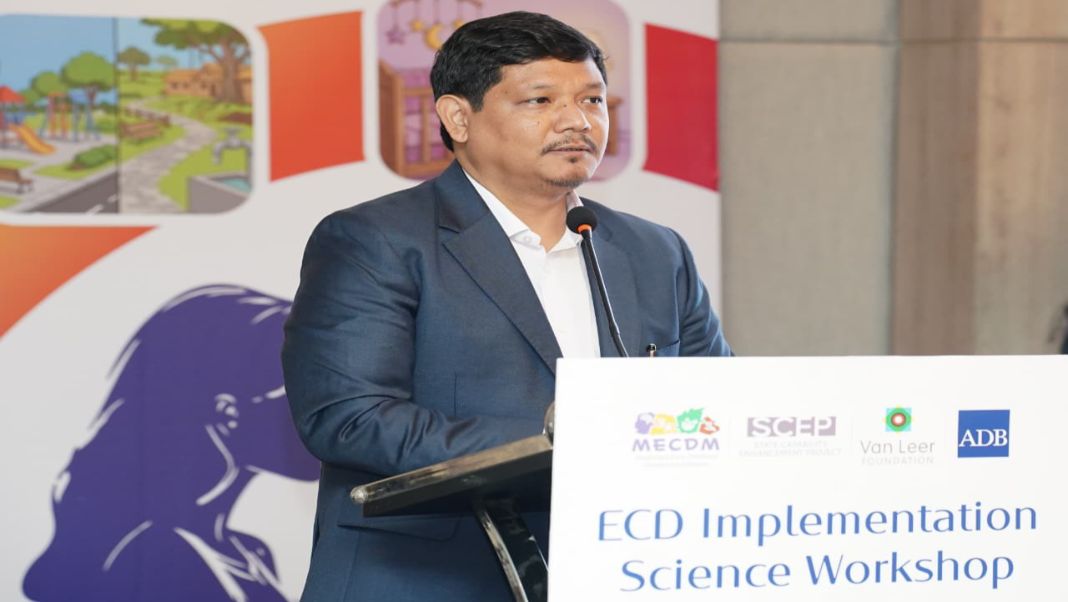

Shillong, June 1: Meghalaya Chief Minister Conrad K. Sangma on Monday said governments do not always need new schemes to solve developmental challenges, but better implementation of existing programmes, while inaugurating the three-day Early Childhood Development (ECD) Implementation Science Workshop in Shillong.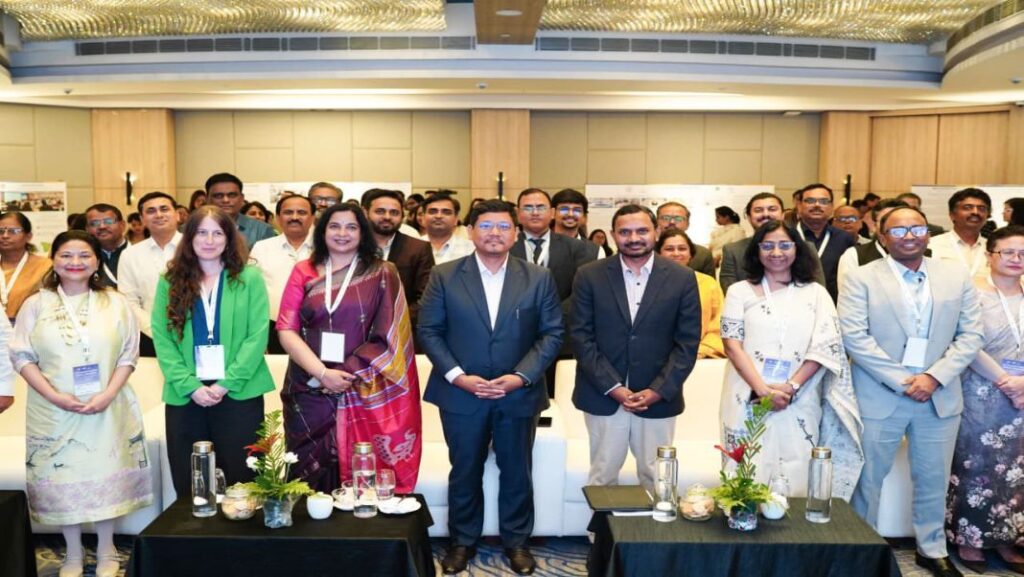
The workshop, organised under the Meghalaya Early Childhood Development Mission (MECDM) in collaboration with the State Capability Enhancement Project (SCEP), the Van Leer Foundation and the Asian Development Bank (ADB), is being held under the theme “From Science to State Action — Building Integrated Systems for Early Childhood Development.” It has brought together policymakers, development practitioners, researchers and stakeholders from across the country to discuss ways of strengthening integrated systems for children and families.
Addressing the gathering, Sangma said one of the guiding principles of his administration since assuming office in 2018 has been the belief that transformational change often comes not from creating new schemes but from improving implementation.
Recalling a question posed to him when he first became Chief Minister, Sangma said he had drawn inspiration from author Shiv Khera and replied that he would “not do anything different, but do things differently.”
He noted that most Central and State Government schemes are already designed to address developmental challenges and that the real challenge often lies in execution.
“We often know the problems. We understand the science, the data and the analysis behind them. But ultimately, there has to be a will to make a difference,” he said.
Highlighting Meghalaya’s governance reforms, Sangma said stronger implementation has led to major gains across sectors. He cited MGNREGA, where improved execution significantly enhanced utilisation and absorption capacity, and noted that Meghalaya today is implementing nearly ₹12,000 crore worth of externally aided projects, a portfolio larger than that of many other small states.
Drawing from Meghalaya’s efforts to reduce maternal mortality, Sangma said the government initially believed that increasing institutional deliveries would solve the problem. However, deeper analysis revealed that transportation costs, distance and the absence of support systems were major barriers for expectant mothers.

Instead of investing heavily in additional infrastructure, the government developed locally adapted solutions, including a community transport model that compensates local vehicle owners for transporting pregnant women to health facilities. Safe Motherhood Homes were also established to provide accommodation, food, care and support for women from remote areas during the final stages of pregnancy.
“The lesson here is that we must identify where the actual problem lies and then design solutions that are practical, affordable and tailored to local realities,” he said.
Sangma also underscored the importance of focusing on outcomes rather than outputs. Referring to the state’s investment in sports infrastructure, he said the success of projects such as the recently completed ₹160-crore indoor stadium should ultimately be measured by the achievements of young athletes and the impact on people’s lives rather than by the infrastructure itself.
“The canal itself is not the objective; improving people’s lives is,” he remarked while explaining the government’s shift towards outcome-based governance.
This approach, he said, eventually led to the development of MOTHER — Meghalaya’s Outcome and Transformation in Health, Education, Rural Development and Social Benefit initiative — which integrates multiple departments around a common focus on mothers and children.
“We are no longer looking at departments or schemes in isolation. We are looking at a human life and asking how government can support that life at every stage,” Sangma said.
He further observed that maternal and child health outcomes are closely linked to economic empowerment. This understanding informed the government’s efforts to strengthen Self-Help Groups, whose numbers have grown from about 4,500 to nearly 60,000 over the past eight years.
Highlighting the importance of cooperative federalism, Sangma said states must continue learning from one another and sharing successful governance practices.
“There are no small states or big states when it comes to innovation and good governance,” he said, noting that Meghalaya has drawn lessons from states such as Odisha, Maharashtra, Andhra Pradesh and Sikkim.
Following the Chief Minister’s address, Patricia Núñez Zamora of the Van Leer Foundation shared Chile’s experience in building “Chile Crece Contigo” (Chile Grows With You), an integrated early childhood development system that supports children and families from pregnancy through childhood.
She said the science behind ECD is well established, but implementation remains the biggest challenge.
“The problem was never the absence of services. The problem was that services were not working together with a shared view of the child and family,” she said, stressing the need for coordination across sectors and strong institutional systems.
Providing the context for the workshop, Additional Chief Secretary Sampath Kumar said Meghalaya’s ECD mission was shaped by scientific evidence on the importance of early childhood and has made the state one of the first regions in the Asia-Pacific to adopt a comprehensive integrated ECD framework.
He pointed to improvements reflected in recent National Family Health Survey findings relating to maternal and child health, nutrition and stunting indicators, while noting that challenges remain. Kumar also highlighted that Meghalaya’s governance approach has attracted wider recognition, including documentation as a Harvard Kennedy School case study on adaptive leadership.
The three-day workshop brings together government officials, development partners, researchers and practitioners to discuss child development, parental well-being, behavioural science and systems strengthening, with a focus on translating research and evidence into effective state action.
Also Read: Water crisis cripples Chokpot CHC, locals allege doctors are absent from duty
Also Watch
Find latest news from every corner of Northeast India at hubnetwork.in, your online source for breaking news, video coverage.
Also, Follow us on
Twitter-twitter.com/nemediahub
Youtube channel- www.youtube.com/@NortheastMediaHub2020
Instagram- www.instagram.com/ne_media_hub
Download our app from playstore – Northeast Media Hub

 Implementation Science Workshop in Shillong.)