

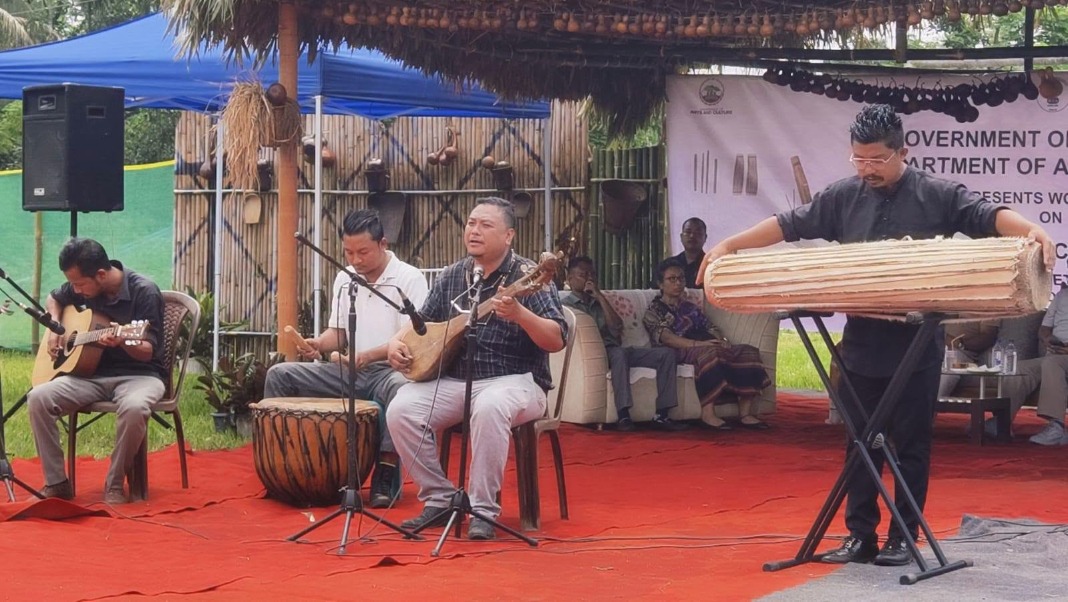

Tura, June 18: In an age where smartphones stream music from across the world at the touch of a screen, a quiet effort is underway in Meghalaya to ensure that the sounds of its own ancestors are not forgotten.
That effort took centre stage at Asanang village in West Garo Hills on Wednesday, where students, cultural enthusiasts and community members gathered not merely for a workshop, but for a lesson in identity.
Organised by the Department of Arts and Culture, the workshop on traditional musical instruments sought to reconnect young people with the indigenous sounds that have long been woven into the cultural fabric of Meghalaya.
The concern is one shared by many cultural practitioners across the Northeast.
While younger generations are increasingly familiar with guitars, keyboards and global music trends, knowledge of traditional instruments and the stories they carry is gradually fading.
Addressing the gathering, Meghalaya Legislative Assembly Speaker Thomas A. Sangma acknowledged this changing reality.
He noted that many young people today can easily identify Western musical instruments but often struggle to recognise the traditional instruments that once formed an integral part of community life.
For centuries, songs, rhythms and dances have served as living archives of Meghalaya’s history. They preserved memories, celebrated harvests, marked festivals and passed down stories long before they were ever written down.
“Music and dance are not merely forms of entertainment. They are expressions of who we are,” Sangma said, urging young people to take pride in their cultural heritage and help preserve it for future generations.
The workshop offered participants more than lectures.
Traditional musicians demonstrated indigenous instruments, explained their significance and guided participants through hands-on training sessions. The programme also featured performances that showcased the richness and diversity of Garo musical traditions.
Guest of Honour Mary Lisa K. Marak, ADC of West Garo Hills, stressed that preserving culture requires more than documentation.
It requires transmission.
She said the younger generation must be encouraged to become custodians of Meghalaya’s cultural legacy so that traditional melodies continue to resonate long into the future.
The challenge facing many indigenous cultures today is not the absence of interest but the absence of exposure.
As lifestyles change and communities become increasingly connected to global culture, opportunities to learn traditional art forms have become fewer.
Workshops such as the one held in Asanang seek to bridge that gap by placing traditional knowledge directly in the hands of young people.
For a few hours on Wednesday, the sounds echoing across the village were not imported beats or digital playlists.
They were the sounds of Meghalaya’s past.
And perhaps, if efforts like these continue, also the sounds of its future.