


Niharika Choudhary
Climate change is a challenge that can leave people feeling helpless. Global targets, carbon footprints, policy debates and multi-billion-dollar technologies often dominate the conversation. Somewhere amid all the rhetoric, many ordinary citizens are left wondering what difference they can possibly make.
According to Momo, that is the wrong place to begin.
“Being a human being comes with a carbon footprint,” she says. “So it is everybody’s responsibility, in whichever capacity we can, that we start finding solutions for it.”
That belief lies at the heart of Green Ammo, a Meghalaya-based environmental trust that has spent years encouraging people to rethink something most of us throw away without a second thought: waste.
The organisation’s journey began with a simple observation. Momo, Green Ammo CEO Amit Roy and Chairperson Sarong are passionate travellers who share a deep love for nature. During their travels across tourist destinations and trekking routes, they kept encountering the same problem. Some of the most beautiful landscapes were increasingly littered with plastic packaging, snack wrappers and other forms of single-use waste.
For Momo, who grew up amidst Meghalaya’s relatively pristine surroundings, the sight was difficult to ignore. Yet instead of spending time debating who was responsible, the team focused on a more practical question: what could be done immediately?
That question led to the creation of Green Ammo, a community initiative named after Amit and Momo. The idea was simple. While perfect solutions may take time, communities can begin adopting practical solutions right away. Over time, the initiative evolved into Green Ammo.
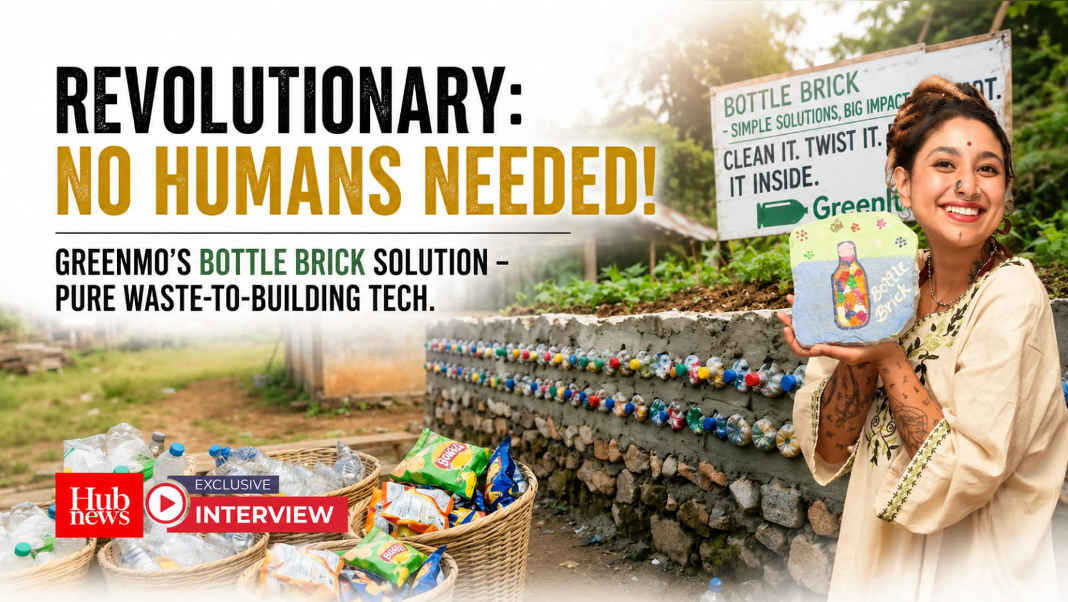
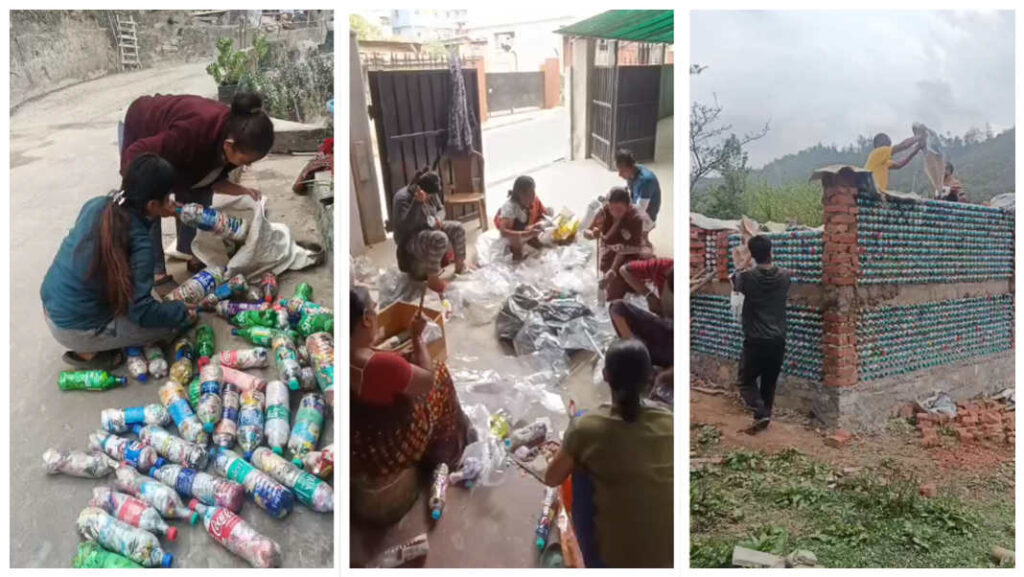
One of its most successful interventions is the bottle brick, also known as an eco-brick. The concept is deceptively simple. Plastic waste such as chips packets, biscuit wrappers, instant noodle sachets and shopping bags are cleaned, dried and tightly packed into used plastic bottles. Once properly compressed, the bottles become dense and sturdy enough to be used in certain non-load-bearing construction applications.
Green Ammo has spent years teaching schoolchildren, families and communities how to make these bottle bricks correctly. To make the process easier to remember, the organisation even created a simple chant: “Clean it, twist it, put it inside, push it.”
The goal is not merely to recycle plastic. It is to prevent waste from ending up in rivers, forests, roadsides and landfills while reducing dependence on materials that carry their own environmental costs.
The organisation’s work extends well beyond plastic waste. In fact, some of its most impactful initiatives begin in the kitchen.
Green Ammo trains families to compost organic waste and produce bioenzymes using fruit peels, vegetable scraps, water and sugar. The resulting liquid can be used as a natural cleaning solution as well as an agricultural input that helps improve soil health.
What makes the initiative particularly effective is that it combines environmental benefits with livelihood opportunities. Women are trained to produce and package bioenzymes, creating small home-based enterprises from materials that would otherwise have been discarded as waste.
Farmers benefit as well. Instead of relying entirely on chemical inputs, they can use bioenzymes to improve soil fertility and support crop growth in a more sustainable manner.
Listening to Momo speak, one gets the sense that Green Ammo is less interested in environmental activism as a slogan and more interested in environmental action as a daily habit.
She believes today’s young people are far more environmentally conscious than they are often given credit for. The challenge, she says, is not a lack of concern but the perception that sustainability is complicated.
She recalls how children participating in Green Ammo programmes often come up with practical solutions of their own. Leftover food scraps unsuitable for composting are collected to feed stray animals. Waste materials are repurposed creatively. Small actions gradually become routine behaviour.
That, ultimately, is the message Green Ammo hopes to spread.
You do not need a laboratory, a large grant or a government programme to begin making a difference. Sometimes environmental action starts with a plastic wrapper that does not end up on the roadside, a fruit peel that becomes compost instead of waste, or a household deciding to see value where it once saw garbage.
In a world searching for grand solutions to enormous environmental challenges, Green Ammo approach is refreshingly simple: start where you are, use what you have and make change part of everyday life.
Also Read: For 45 days, a village became their classroom
Also Watch
Find latest news from every corner of Northeast India at hubnetwork.in, your online source for breaking news, video coverage.
Also, Follow us on
Twitter-twitter.com/nemediahub
Youtube channel- www.youtube.com/@NortheastMediaHub2020
Instagram- www.instagram.com/ne_media_hub
Download our app from playstore – Northeast Media Hub