

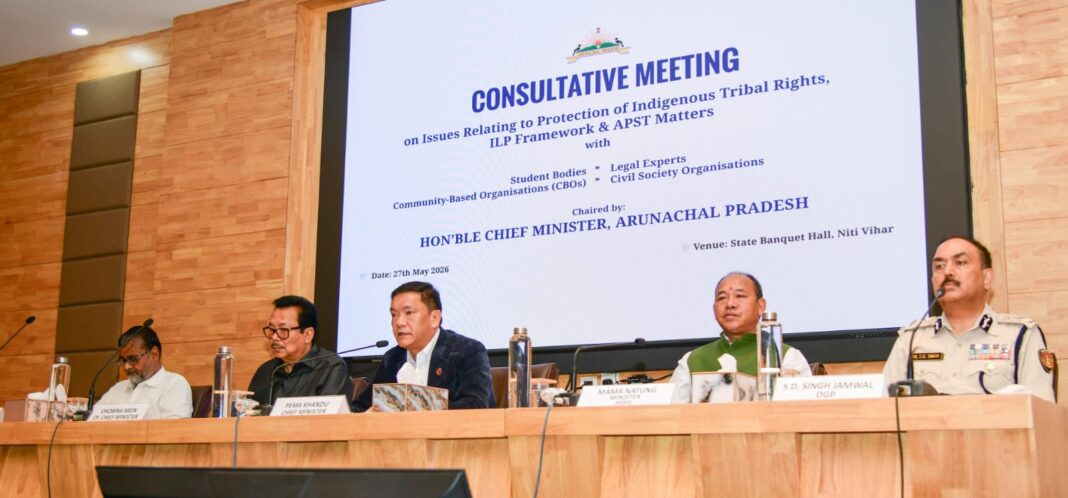

Guwahati, May 27: Arunachal Pradesh Chief Minister Pema Khandu on Wednesday assured that the state government would work collectively with all stakeholders to evolve long-term solutions on issues related to indigenous tribal rights, demographic concerns, Inner Line Permit (ILP) regulation and APST-related matters.
Addressing a high-level consultative meeting at the State Banquet Hall in Niti Vihar, Khandu described the deliberations as “historic”, with participation from community-based organisations, student bodies, legal experts, civil society representatives, political leaders and senior government officials.

The nearly seven-and-a-half-hour-long meeting was attended by representatives of the Arunachal Indigenous Tribes Forum (AITF), All Arunachal Pradesh Students’ Union (AAPSU), ST Bachao Andolan Committee (STBAC), political parties and officials from the Home, Law and Political Departments, among others.
Khandu said the concerns raised were not unique to Arunachal Pradesh, but part of a broader national challenge linked to illegal immigration, demographic changes and threats to indigenous identity and cultural preservation. Referring to Prime Minister Narendra Modi’s Independence Day address in 2025, he said the Union government had already recognised demographic imbalance and illegal immigration as serious concerns affecting law and order, indigenous culture and national security.
The chief minister informed the gathering that Union Home Minister Amit Shah had recently notified a national-level High-Level Committee on Demographic Change comprising a retired judge, former IAS and IPS officers, and senior officials of the Ministry of Home Affairs, indicating that the issue was receiving serious attention at the national level.

In a major announcement, Khandu said the state government had, in principle, accepted four key demands raised during the meeting, including the long-pending demand for the creation of a separate department dedicated to the management and regulation of the Inner Line Permit system under the Bengal Eastern Frontier Regulation (BEFR).
He also acknowledged growing concerns over demographic change and its impact on indigenous tribal culture, traditions and identity, asserting that preservation of Arunachal Pradesh’s unique heritage remained a collective responsibility.
Emphasising the need for sustainable solutions, Khandu advocated skilling and capacity-building of local youth to reduce dependence on outside labour. Citing an example, he said a group of tribal youths trained in Bengaluru in plumbing and electrical works later completed a project in Pasighat for Rs 10 lakh, compared to an outside contractor’s quotation of Rs 18 lakh, thereby saving Rs 8 lakh while generating local employment.

As a concrete outcome of the meeting, the chief minister announced the formation of a high-level state committee to further deliberate on the issues discussed and recommend an appropriate way forward. A follow-up meeting has been scheduled for May 29 to formally constitute the panel.
Reiterating the spirit of “Team Arunachal”, Khandu urged all stakeholders to work together in safeguarding indigenous rights, strengthening governance and ensuring the long-term stability and development of the state.
Also Read: Rs 900 Cr fitness penalty waived at 90% as Meghalaya rolls out one-time relief for transporters
Also Watch
Find latest news from every corner of Northeast India at hubnetwork.in, your online source for breaking news, video coverage.
Also, Follow us on
Twitter-twitter.com/nemediahub
Youtube channel- www.youtube.com/@NortheastMediaHub2020
Instagram- www.instagram.com/ne_media_hub
Download our app from playstore – Northeast Media Hub