

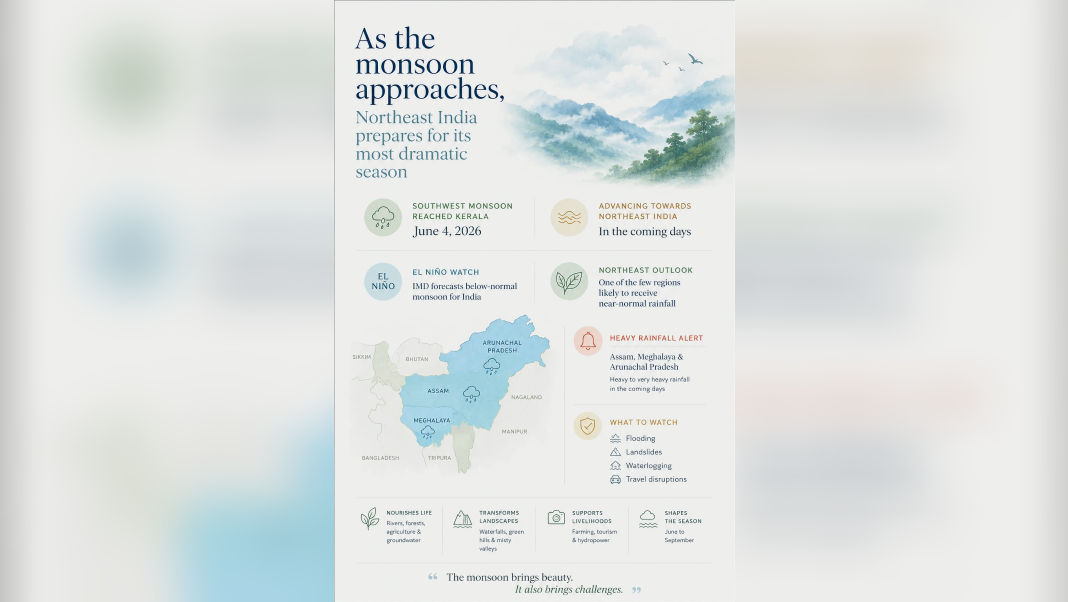

Guwahati, June 4: The Southwest Monsoon officially entered India on Thursday with its onset over Kerala, marking the beginning of the country’s most important weather season. But this year, the monsoon arrives with a question that extends far beyond rainfall totals: how will a warming climate and the looming influence of El Niño shape the months ahead?
The India Meteorological Department (IMD) has revised its national monsoon outlook downward amid concerns over developing El Niño conditions, raising the possibility of a weaker-than-normal monsoon across parts of the country. Yet, even as national forecasts turn cautious, Northeast India is expected to remain among the regions likely to receive near-normal rainfall. At the same time, weather agencies have already warned of heavy to very heavy rainfall over parts of Assam, Meghalaya and Arunachal Pradesh in the coming days.
The contrast highlights a growing reality of India’s changing monsoon. Scientists increasingly point out that the question is no longer simply how much rain falls during a season, but how that rain is distributed.
Research over the past decade suggests that rainfall events are becoming more erratic and intense. Instead of being spread evenly across weeks and months, rain is increasingly arriving in concentrated bursts, raising the risks of flash floods, landslides and urban flooding even in years when seasonal rainfall remains close to normal. Climate researchers have linked these shifts to rising temperatures, changing atmospheric circulation patterns and a warmer atmosphere capable of holding more moisture.
For the Northeast, these trends carry particular significance.
The region is home to some of the wettest places on Earth. The cloud-laden hills of Meghalaya, the fragile mountain ecosystems of Arunachal Pradesh and the vast floodplains of the Brahmaputra valley all sit on the frontlines of extreme rainfall events.
The IMD has already forecast heavy to very heavy rainfall across parts of Arunachal Pradesh, Assam and Meghalaya over the next several days, even before the monsoon fully establishes itself across the region.
Yet the monsoon is also the season that gives the Northeast much of its identity.
The rains recharge rivers and wetlands, sustain agriculture, replenish groundwater and transform the landscape into a mosaic of forests, waterfalls and emerald-green fields. From the mist-covered hills of Meghalaya to the riverine plains of Assam, the season reveals a side of the region that many consider its most beautiful.
The challenge is that the same rain that nourishes the region can also expose its vulnerabilities.
Every year, floods affect large parts of Assam, while landslides disrupt connectivity across several hill districts. Weather officials have already warned that intense rainfall episodes could trigger localised flooding, waterlogging, landslips and transport disruptions in vulnerable areas.
Cyclonic circulations and low-pressure systems developing over the Bay of Bengal during the monsoon season can further amplify these risks. Meteorologists note that warmer ocean temperatures and higher atmospheric moisture levels are increasing the likelihood of short-duration, high-intensity rainfall events across eastern and northeastern India.
For now, however, the region waits.
The first sustained spells of monsoon rain are expected soon. Rivers will begin to swell, waterfalls will gather force and clouds will once again settle across valleys and hillsides.
In the Northeast, few seasons shape daily life as profoundly as the monsoon. It arrives each year with beauty and uncertainty in equal measure, reminding one of the world’s rainiest regions that its fortunes remain deeply tied to the rhythms of the sky.